I found this in a secondhand ("disposals") shop in Adelaide. It looks like a family gathering, but there is nothing to say who these people were or on what occasion the photograph was taken.
Tuesday, August 26, 2025
Family Photograph (circa 1896 or 1897)
Monday, July 28, 2025
Hilda, Rosina and Almira (Weldon's Ladies' Journal, July 1897)
To end the month, I thought I'd take a look at some Victorian fashions as pictured in the July 1897 issue of Weldon's Ladies' Journal. In the 1890s, Weldon's named all of its designs. Here we have Hilda, Rosina and Almira and their costumes.
Because Weldon's Ladies' Journal sold dressmaking patterns, the descriptions accompanying these illustrations were heavy on technical details. Suffice it to say that a lot of interlining was involved (often in horsehair cloth) to achieve the shapes of those skirts and those sleeves.
As with all good fashion magazines, Weldon's had a lot to say about current trends.
Monday, February 17, 2025
"Chit-Chat On Dress" (Cassell's Family Magazine, February 1895)
I managed to pick up another bound volume of Cassell's Family Magazine the other week. This one is from 1895, but people who have been following this blog for a while might recall I own a similar volume from 1888. In 1888 the magazine published a monthly "Chit-chat on Dress" column describing the latest fashions from London and Paris for its female readers. By 1895 its emphasis had changed: it was still interested in fashionable dress, but it also offered dressmaking patterns so its readers could attempt to make their own versions of the garments described. (Given the complexity of some of the garments, I suspect many readers enlisted the help of a local dressmaker.)
The February 1895 column begins with the following pronouncement:
SELDOM has Fashion so favoured the contour of a figure that has lost its youthful slimness as at the present moment.
But let's take a look at a couple of the featured patterns.
Lounge-Gown for Invalid
Our design... is made in old-rose pink velveteen and Irish point lace, with over-dress of cashmere in either light maize or grey. The whole of the upper portion, that is, the yoke and sleeves, is made separate and mounted on a short-waisted lining reaching just below the armholes, and the over-dress, cut square back and front, is slipped over the head and fastened on each shoulder beneath the ribbons.
Monday, June 24, 2024
Weldon's Ladies Journal, June 1897
"In this joyous June we are to celebrate an historic event with which the whole world is ringing,"
Weldon's Ladies' Journal was referring to the Diamond Jubilee of Queen Victoria. Naturally the readers of the Journal would want a pretty outfit to wear to the celebrations, and the magazine was happy to oblige with a selection of patterns for dainty, ultra-feminine garments. (Ironically, most of the fashions featured originated in Paris.) Below are a couple examples:
Monday, January 8, 2024
The Lammermoor Dress (Girl's Own Paper, January 31, 1891)
The "Lammermoor" dress was probably named for Walter Scott's historical novel The Bride of Lammermoor. The jacket is styled after an early 18th century gentleman's frock coat, with wide skirts, flap pockets and deep cuffs. The little tricorne hat perched on the model's head completes the effect. However, there are also many details that mark the jacket as being from late nineteenth century, including the basque bodice, the leg of mutton sleeves, and the deep revers exposing the high-necked bodice beneath.
The Lammermoor coat was available as a pattern from the Girl's Own Paper:
In our illustration of the "Lammermoor Dress" we show one of the long-waisted jackets such as that unhappy bride is supposed to have been arrayed in; and for our paper pattern we have selected the same, as these long coats or jackets, with their long coat-basques, will unquestionably be worn for some time to come. They seem becoming, too, to nearly all figures save the very short and stout, and they go well with the plain skirt which is now worn...
The paper pattern for the month, as we have said, is a "Ravenswood", or a "Lammermoor Jacket", which will be suitable for serge or cloth, and for use as a walking or indoor jacket, to be worn on mild days with a boa or ruff. There are twelve pieces, and great care must be taken to bone the bodice firmly, and put in the linings evenly and neatly. The long basque will need lining with silk, or if not, with sateen; and unless in the hands of a good fitter, the home dressmaker may fail in both the ways suggested, unless very careful.
(That last is somewhat discouraging advice for home dressmakers!)
Monday, February 20, 2023
"Recent Ideas on Dress Reform" (Girl's Own Paper, November 1 1890)
As socially conscious Victorian women set out to reform the world, some began see a need to reform their own clothes as well. The "Dress Reform" movement became particularly vigorous in the English speaking world, with middle-class reformers on both sides of the Atlantic and through the British empire trying to find ways to make Victorian fashions healthier, easier to move in and more comfortable.
Alas for all their efforts, most Victorian women stuck to their unhealthy, restrictive and uncomfortable garments, preferring discomfort to attracting ridicule! As it happened, there was some movement towards more practical and comfortable dress in the forms of tea gowns for leisure and skirt suits for the "New" working woman. However it took a World War and some quite drastic social changes before the ideas of the dress reformers became fashionable.
Annie Jeuness Miller was an American editor and women's dress reformer. She created her own system of dress, which the Girl's Own Paper reported on in November 1890.
MRS. JEUNESS MILLER is as equally determined to abolish the corset as our own dress reformers, though she begins more circumspectly. But I find she has also been obliged to give way to those who desire a bodice of some kind, and has invented a very pretty-looking model bodice with a neck-yoke, the bodice buttoning in front and lacing at the back. The need felt for a bodice is probably owing to the lack of warmth realised when the stays are left off, and also to the want of support of some kind.
Our illustrations show the whole of the garments which Mrs Miller suggests. The first is the ordinary woven "combination", as we call it, which may be of silk, thread, cotton or wool, or, what is nearly as warm, of stout spun-silk. This garment we can now obtain of every good draper in England; and for India, of gauze, silk, or wool. The next garment in this system is called the "chemisette" and this is an improved cut of "combinations" or union dress, or the union of the drawers and chemise of old days. This garment has a yoke at the neck, and fits the figure closely. The next article of clothing is an improved version of the "divided skirt," which was invented by Lady Harberton, but has a better-fitting yoke, and is, in general aspects, more practical. These three last-named garments are made in all materials—cotton, flannel, mohair or alpaca, cashmere and silk. I find that Mrs Miller has much adopted the natural-coloured tussore as a material, and certainly nothing could prove a wiser selection, or wear better. "It washes like a rag," as the vulgar saying is...
...The chief thing to be noticed is the admirable idea of a dress-form, that is to say, a dress foundation—one on which every dress can be made, the trimmings being made to suit the prevailing styles, so that each may have her own taste unshackled, and wear what suits her best. This dress-form is accurately fitted, is well boned, and is made of the material of each dress. Our illustration of it shows exactly what it looks like, and how, by a clever alteration of Mrs Miller's own, the chief defect, so often found in the "Princess dress," is got over—i.e. the cutting across the front, so as to permit the skirt and the bodice being fitted accurately on the wearer...
The dresses we show in our illustrations were all made in this manner; and it can be gathered from them how easy it is to make any style of drapery or ornamentation to suit the foundation. The greatest freedom of movement is gained by the dress being made in one piece, and for the home dressmaker this seems an immense advance.
Mrs. Jeuness Miller considers that one of the great essentials for a perfectly health-promoting dress is to get rid of bands at the waist, and though the waist is larger, it is more natural in form, more healthy, and more comfortable. All the garments are made in one piece, and the weight and warmth are equally distributed. The ordinary dress is always worn, and there is no desire to have anything conspicuous or ugly; nothing revolutionary is intended, and there is nothing to attract attention in the reformed costume but its superior prettiness and grace.
Friday, July 8, 2022
Suits (The Delineator, May 1896)
suit
/su:t/
noun
1. a set of outer clothes made of the same fabric and designed to be worn together, typically consisting of a jacket and trousers or a jacket and skirt.
Ladies' Jacket and Skirt. "...The jaunty box fronts are lapped and closed in double breasted style with button holes and buttons placed at the throat and below the waist... The collar is in military turn-down style and is inlaid with black velvet."
Ladies' Eton Costume. "The newest style in the popular Eton costume is here illustrated, brown mixed cheviot being shown in the jacket and skirt and figured red silk in the blouse-waist."
Ladies Basque and Skirt. "The toilette is here pictured made of cadet gray cloth and stylishly decorated with black braid, gilt buttons and black silk cord."
Ladies' Jacket and Skirt. "The toilette is a most desirable style for the promenade and general outdoor wear and includes a covert jacket and a stylish skirt. Light-brown broadcloth was here selected for the jacket which is skillfully shaped to give a long effect to the waist..."
Ladies' Toilette "This toilette is somewhat severe in style, but is given much distinction by its military air. It is here shown made up in a Scotch mixture and decorated with braid and buttons."
Sunday, October 25, 2020
"Bikes and Bloomers" by Kat Jungnickel
Let's start by quoting Susan B. Anthony:
“Let me tell you what I think of bicycling. I think it has done more to emancipate women than anything else in the world. It gives women a feeling of freedom and self-reliance. I stand and rejoice every time I see a woman ride by on a wheel…the picture of free, untrammeled womanhood.”
The invention of the safety bicycle and the subsequent cycling craze of the 1890s enabled many a woman to pedal her way to freedom, but it wasn't a completely smooth ride. Cycling women not only ran counter to Victorian ideas of Woman's Place (in the home, not gadding around on the roads!) but there was also the problem of what they should wear. Conventional dress—long skirts and petticoats—was inconvenient, and sometimes downright dangerous, whereas "rational" dress (i.e. bloomers) was considered indecent and apt to get one harassed on the street.
In Bikes and Bloomers, Kat Jungnickel looks at this dilemma and some of the solutions for it arrived at by Victorian women inventors. She makes a detailed examination of five patents for cycling costumes and the women who took them out: Alice Bygrave, Julia Gill, Frances Henrietta Müller, Mary and Sarah Pease, and Mary Ward.
Alice Bygrave created the most commercially successful cycling costume, the "Bygrave" with a skirt that could be raised or lowered with a system of cords, pulleys and weights. (It is shown on the cover of Bikes and Bloomers as worn by her cousin Rosina Lane, a competitive racing cyclist!) Julia Gill's invention, on the other hand, was never put into production. As she was a court dressmaker and as her costume was "daring" by the standards of the day, it's possible that she only created it as a publicity stunt. Frances Henrietta Müller was a lifelong feminist, one of the first female students at Cambridge and the founder of a women's newspaper. Her patent was for a three-piece costume including knickerbockers and a skirt that could be folded up for riding and let down for ordinary wear. Mary and Sarah Pease devised a costume with a garment that could be worn as a cape while cycling, and as a skirt after dismounting from the bike. Mary Ward's costume was the most conservative— a skirt with a hem that could be raised or lowered as convenient.
As a part of her research, Kat Jungnickel reproduced every one of these costumes, drafting patterns from the original patent specifications and trying out the finished garments on a bike. (The patterns are included among the illustrations in Bikes and Bloomers, if anyone is game to try them!) However the book is more than just a costume history—it is a social history exploring the changing lives of Victorian women, the development of technology and invention, popular recreations in the late nineteenth century and much more.
Kat Jungnickel
Bikes and bloomers: Victorian women inventors and their extraordinary cycle wear
9781906897758
London: Goldsmiths Press, 2018.
Thursday, October 15, 2020
More Blouses—and a Bodice (Weldons, June 1897)
What is the difference between a bodice and a blouse? By the 1890s, not much:
In brief, the main difference seems to have been that a blouse could be worn with any contrasting skirt, whereas a bodice was intended to be worn with only one matching skirt. Most of the patterns illustrated below are described as "blouses", but it's quite easy to imagine a dressmaker making up a matching skirt for some of these and turning them into "bodices"."...by 1890 a blouse had become more than the occasional garment of informal wear. It became so much worn that in part it lost its original difference from the bodice, and many blouses of the 1890s are as rigidly boned as any of the dress bodices."Anne M. Buck Victorian Costume and Costume Accessories (1961)
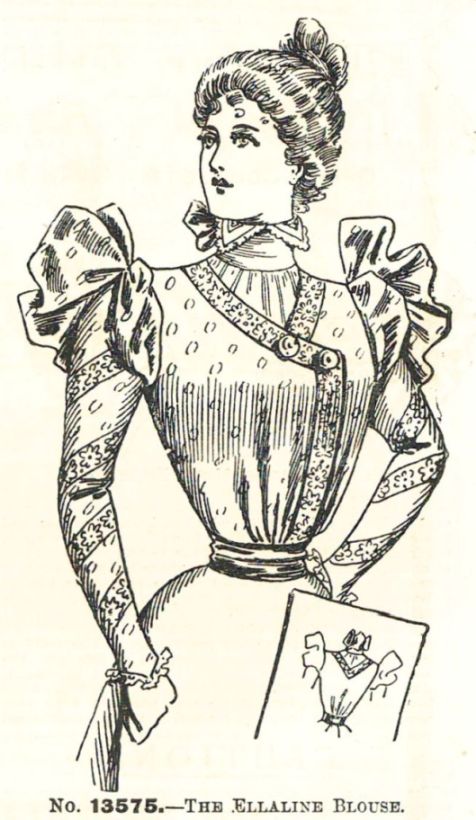
The "Phyllis Blouse" designed for two materials "such as chequered, flowered or plain silk or satin, crȇpon, cachemire, &c., combined with plain soft silk or chiffon". Excess fabric is "gathered" at the waist and the shoulders.
And lastly, a "bodice"—"The Henrietta Bodice"! The corselet and the "Zouave part" of this design are to be made of coarse lace over coloured silk or satin and the band collar mounted on canvas. The whole is fastened down the centre with hooks and eyes.
Thursday, May 28, 2020
Tea Gowns (1890s and 1900s)
"And now let us seriously consider the question of the tea-gown from its varying aspects, and see how it is misunderstood and how it can form the ideal of all that is best in dress feminine. For here we can vanish the practical, and let art have her say without a backward glance at utility. What I mean is, we cannot trail about the London streets in the flowing garments of beauty; but in our drawing-rooms, when the tea-urn sings at five o'clock, we can don these garments of poetical beauty.
"... Fashion you can cast to the wind if you please, and impart meaning and intention in every fold, in every line of this garment of mystery which can be a very complete reflection of the personality of the wearer."
![]() |
| The Delineator, November 1890. "Ladies Japanese Tea Gown" Figure no. 476L |
"The Gown is composed of an under-dress of white India silk and a Kimono or Japanese dress of figured India silk. The underdress has a full, flowing skirt, which depends from the edge of a fanciful body and is trimmed down the center of the front with a handsome jabot of Italian lace."
![]() |
| The Delineator, May 1896. Ladies Tea Gown, Pattern no. 8333 |
"LADIES' TEA-GOWN—The tea-gown is especially handsome in the present combination of black peau de soie bearing large figures in subdued coloring, cream satin and figured maize taffeta, with lace net, lace edging, ribbon and insertion for decoration."
![]() |
| The Delineator, September 1898. "Ladies Watteau Tea Gown", Pattern no. 1851 |
"LADIES WATTEAU TEA GOWN—Rich dark plain satin, and plain and figured light satin form the handsome combination here pictured in the tea-gown, and the trimming is original and pleasing, consisting of wide ribbon in a novel bow arrangement and narrower ribbon frilled and edged with lace."
![]() |
| McCall's Magazine March 1901. Tea Gown pattern no. 6442 |
"LADIES TEA GOWN—White challis patterned with pale blue and green made this artistic tea gown or wrapper. The pattern is cut with a deep pointed yoke back and front, of pale blue silk entirely covered with white lace insertion, joined by beading run with velvet ribbon, and finished with a deep ruffle of lace... Entirely covering the center closing is a full jabot of white lace."
![]() |
| The Lady's Realm, March 1904 |
"At this season of the year the tea-gown holds an important place in the society woman's wardrobe—not the picture frock, which is more or less decolleté, but the warm and cosy wrapper, which is yet smart enough for dining in. Some light, soft fabric, accordion-pleated and made very simply with a big collar or fichu, is charming, and this is a useful garment to wear over a separate slip."
Mrs Eric Pritchard, "London and Paris Fashions", The Lady's Realm, (March 1904)
![]() |
| The Delineator, August 1906, Pattern no. 9412 |
"9412—A tea-gown for mid-Summer combining daintiness and comfort is here portrayed in embroidered wash voile with lace and ribbon, in linon with German Val insertion and edging, and also in French challis with buttonholed edges."
![]() |
| The Delineator, June 1909. Pattern no. 3083 |
"A more elaborate lounging -robe is shown in No. 3083, a ladies' tea-gown or wrapper. The wrapper may be made in the round length or with the medium sweep and with the high, collarless or open neck. The body of the wrapper is tucked to the fancy-shaped yoke and falls from the bust in graceful folds. There are two styles of elbow sleeves, those which are left flowing and those which are gathered into the bands, as well as the full-length leg o' mutton sleeves. The fancy shaped bolero may be omitted if desired..."
While tea gowns were worn until the early 1920s, they were at their most fashionable in the last years of the nineteenth century and the first decade of the twentieth. As women's clothes became less constricted and their lives more active the tea gown fell out of favour. Other styles took its place, including lounging pyjamas in the 1920s and 1930s and hostess gowns in the 1950s and 1960s.
Tuesday, March 17, 2020
Found Online: La Mode Pratique (1894)
Thursday, September 26, 2019
A History of Blouses - Part 1 (1890s)
In the 1890s the blouse and skirt combination almost became a uniform for the 'New Woman' of the era. It was worn by women for playing sports, for undertaking further education and for working in the new white-collar jobs that were opening up to women.
![]() |
| Koch & Co. catalog, 1892 |
The earliest versions of the blouse were tunic-like garments, usually descending below the waistline over the skirt and belted in. A popular type of blouse was the "Russian" blouse, fastening on one side at the shoulder like a Russian peasant's tunic—but not noticeably Russian otherwise.
"Blouses are quite as much worn as ever, and now seem to be made of everything, the most recent fancy being velveteen. The other day I saw a maroon-coloured one which looked very warm and comfortable, and was becoming as well. In fact, it seems difficult to distinguish between a bodice and a blouse, except that the latter differs from its accompanying skirt, and is rather more decorative than a bodice would be."
"Girls' Attire : The Newest and Best", by The Lady Dressmaker in The Girl's Own Paper, 24th of November 1894
By the middle of the decade the blouse was being styled in imitation of men's shirts (and called the shirt-waist in America). Any resemblance was mostly superficial however. Women may have adopted collars and cuffs—and even ties!—with their blouses, but the sleeves were always fashionably cut, and the bodices always lined and often boned."There is no doubt about the popularity of the blouse. From the highest to the lowest everyone seems to wear it, and it is wonderful what numerous forms it can take... I have before spoken of the wonderfully beautiful colours in which it is now produced, and the pale hues for evening wear being very remarkable in tone and texture.""Girls' Attire : The Newest and Best", by The Lady Dressmaker, in the Girl's Own Paper, 29th of June, 1895
![]() |
| Photo by A. Poulson, Goulburn N.S.W. between 1893-1895 |
A glance at those almanacs of trade, the shop windows, tells us that the shirt waist, the summer girl's first favorite, has come again to charm all beholders with its freshness. It has profited by its last summer's association with the most fascinating of her sex, and presents itself to an expectant throng in all the beauty and attractiveness that it learned from the girl of the seashore and mountains.
Quite as coquettish as its wearer, and knowing full well the value of all its pretty conceit, it easily holds first place in woman's wear for the summer season of '96. It no longer relies upon its simplicity for its charm, and most elaborate are some of the newer styles shown in the smart shops. Two notable changes from last season's designs are in evidence - the very decided Bishop sleeve and the detachable collar and cuffs of spotless white.
Carson-Pirie Monthly, Mid-March 1896
![]() |
| Delineator, November 1890 |
"No. 3551—The blouse is here represented made of light dress goods and dark velvet... the girdle is deeply pointed at the top and bottom of the front and back... the closing being made at the left side with hooks and eyes. The girdle is lined with silk and interlined with canvas, and all its seams and closing edges are boned. The blouse may be worn beneath or outside the skirt, as preferred. The blouse is appropriate for wear with any of the fashionable walking-skirts..."
"No. 3549—The blouse, which may be worn beneath or outside the skirt, as shown in the engravings, is in this instance pictured made of a pretty variety of dress goods and velvet to match. It is made over a smooth-fitting lining, which is slightly shorter than the outside... The upper part of the blouse consists of a deep yoke... The lower portions are joined by side seams which are made separately from those of the lining... The outside is closed with hooks and loops... and at the neck is a deep rolling collar that flares at the throat..."
![]() |
| Delineator, May 1896 |
![]() |
| Weldon's Ladies' Journal, June 1897 |
![]() |
| Weldon's Ladies' Journal, June 1897 |
![]() |
| Delineator, September 1898 |
![]() |
| Photo by E. Squire, Hawera N.Z. circa 1898 |
Every season we are regularly told that the blouse and the shirt are going out of fashion, and every year they seem to become more popular.
Sunday, August 4, 2019
"Autumn Cycling Costumes" in the Delineator (September 1898)
The "safety bicycle" was invented in the late 1880s. With the addition of pneumatic tyres in the early 1890s it turned cycling from a dangerous sport (think of the penny farthing!) into a pastime that could be enjoyed be almost everybody. It was an especially liberating recreation for women, who suddenly found themselves able to roam at will upon two wheels.
Of course there was also the problem of what to wear. Some women wore versions of their ordinary day dress (though there was always the danger of getting one's long skirt tangled in the bicycle chain). Some daring souls essayed bloomers—but there was always the danger of seeming immodest and inviting the ridicule of strangers. Then there are the bicycling outfits depicted below, which seem to be a compromise between mobility and decorum.
But at this point I think I'll just quote the Delineator at length on the topic of the "well-bred" cyclist, and let them have the last word on what she was wearing:
"Cycling has become more and more a universal pastime, and the approach of Autumn heralds many new devotees who will enjoy its delights. In order to appreciate to the full the pleasures of cycling it is essential to be properly and becomingly gowned, and the well-bred woman will plan her costume upon neat, simple lines and choose serviceable materials and colors. Trimmings, when used, consist of braid and buttons, and in some instances velvet or silk is inlaid in the collar or cuffs. The tailor finish is always in good taste and most satisfactory. Cheviot, covert in plain and two-toned effects, homespun in various colorings, meltonette in serviceable colors, whipcords and suitings having plaid backs are among the materials suitable for making cycling costumes. The skirts are planned to look equally well whether the wearer walks or is mounted, and those which are in the best taste are about seven or eight inches shorter than the ordinary walking skirt. Low shoes are preferable to the high boots, since they afford greater freedom to the ankle. Golf stockings are worn with low shoes and also with three-quarter shoes, the fancy colored tops being turned over the shoes. Cycling gloves have kid fingers and palms and are of silk net at the back, though gloves of dogskin or heavy kid are quite appropriate."
"The corsets to be worn when cycling are short and do not compress the body. Hats suitable for this purpose are of soft felt in Alpine style having a soft trimming of silk wound about the crown, or with a simple band and quills at the left side. Tam-O'Shanter caps of the material used for the costume are worn, as are military caps. Thoroughly up to date are the modes shown in the following group of figures."
Wednesday, June 12, 2019
"Le Petit Echo de la Mode" (November-December 1890)
![]() |
| 16 Novembre 1890 |
"Si il reste peu de choses á noter dans les nouveautés en toilettes preparées pour la saison d’automne, en revanche chaque jour voit éclore de ravissantes fantisies concernant la coiffure. La chapeau est l’object d’une etude sérieuse et d’un effort puissant d’imagination, aussi cet art charmant du chiffonnage est-il poussé á l’extrême sous les doigts habiles de nos modistes. Ce sont de véritables fées, qui composent ces riens coquets et seyants qui encadrent si délcieusment le visage d’une jeunne femme, de fantaisies de toutes sortes, les grands chapeaux qui sont le triomphe de la saison.
"Les formes les plus diverses sont toutes en faveur, et la mode n’a pas de preference, soit que l’on choississe le grand sombrero en feutre pelucheaux ombragé de plumes, soit Louis XI en feutre ras, soyeux comme le chapeaux masculin, avec noeuds et plumes posês devant et en cache-peigne, ou mieux encore le Louis XV brodé á jours de fil d’argent et inondé de plumes d’autruche; sans oublier la petite toque si précieuse en voyage, et qui l’on voit en drap, en fourrure, avec noeuds de velours et tête on ailes d’oiseau couvrant le fond."
(Incidentally, fashion journalism must be one of the few branches of reporting where one is expected to be upbeat and and find nice things to say! Everything is "elegant" and "beautiful"—one seldom, if ever, hears a new fashion described as "ugly" or "unflattering"!)
![]() |
| 30 Novembre, 1890 |
"Nous pouvons, sans craindre de trop nous hâter , prédire un succés longument assuré aux robes de drap pendant la saison hivernale. Rien en effect, dans tous les lainages qui font nouveaté, ne peut attendre la perfection d’un costume fait ave cette souple et si élastique étoffe qui se drape et s’ajuste sur le buste en en faisant valoir la perfection.
"Avec le drap, citons encore les gros lainages bourrus et poilus qui sont de haute fantaisie et nous habillent aussi á merveille, tells que le poil de chévre, le tissue zibeline, le thibet mélangé , les neigeuses et les pékins velours et laine brochés de pois, de losanges, de grands ovales sur fond camalieu ou sombre; beaucoup de dessins en ce genre, mais peu de fleurs."["We can, without fear of being too hasty, predict a long-lasting success in the cloth dresses during the winter season. In fact all the new woollens are expected to perfect a costume made with this supple and so elastic fabric that drapes and adjusts itself to the bust emphasising its excellence.
![]() |
| 7 Decembre, 1890 |
In December the haut monde starts returning from the country for the Paris winter social season. Le Petit Echo de la Mode describes the fashions suitable for dinner parties:
"... La toilette de dîner, n’est plus maintenant une toilette á part. On s’habille avec elégancé mais simplement pour un dîner sans cérémonie. Ce qu’il faut, ce que la robe en soie, en crèpe de Chine ou en dentelle, soft du plus pur style, et que la fantaisie qui dirige la mode y soit mêlée. Les gracieuses formes Anne d’Autriche et Louis XIII ont un succés réel dans le moment. La ruché qui encadre le cou et rehausse les épaulettes a un cachet d’une grande distinction.
"Les grands dîners réclament les toilettes du bal. Nous avons vu ainsi plusieurs robes d’une élégance extrême, et le gout qui ont présid leur exécution. Une entre autre, en brocart rose de Bengale, semblait sortir de main des fées : le tablier, recouvert de tulle, était brodé de jais rose ainsi que corsage, du plus pur Louis XIV."["... The dinner dress is no longer a separate costume. We dress with elegance but simply for a dinner without ceremony. What is needed is a silk dress, in crepe de Chine or lace, soft and in the purest style, and that the whimsy that directs the fashion is mixed. The graceful forms of Anne of Austria and Louis XIII have a real success at the moment. The ruche that frames the neck and enhances the shoulder pads has the stamp of great distinction.
Wednesday, June 5, 2019
Le Petit Echo de la Mode (May-June 1890)
"Le beau temps nous est revenue, et malgré quelques nuages inquiétants et le vent qui soufflé encore, personne ne s’occupe de ces intermittences; et petits et grands fêtent les printemps."
["The good weather has returned to us, despite some disturbing clouds and the winds that still blow. No one cares about them; and young and old celebrate the spring."]Anyway, on to the fashion!
![]() |
| 18 Mai, 1890 |
"Mais cette jupe à plis langoureux s’ouvre sur un panneau qui n’est qu’une jonchée de fleurs brodées. On veit des jacinthes roses sur crêpe de Chine mousse; les grélots du muguet font merveille sur crêpe de Chine bleu acier, et les lilas de Perse s’harmonise avec la jolie teinte Ophélie ou dahlia. Il y a ainsi une foule de combinasons de nuances des plus heureuses, et nous ne pouvons qu’applaudir au gout qu régit la mode, toujours plus fin, plus adorable à chaque nouvelle saison.
"On revient aux dentelles, et comme toujours c’est avec furie qu’on les emploie..."
["But this skirt with languid folds opens on a panel that is littered with embroidered flowers. We've seen pink hyacinths on crepe de chine moss; the bells of the lily of the valley are wonderful on steel blue crepe de chine, and the Persian lilac harmonizes with the pretty hue of Ophelia or dahlia. There is thus a multitude of combinations of the happiest shades, and we can only applaud the taste that governs the fashion, always finer, more adorable in every new season.
We return to lace, and as always, it is with passion that we use it..."]
![]() |
| June 8, 1890 |
"On voit des quantités de chapeaux oùla note verte domine, des robes avec des manches aux formes exentriques et couvertes de broderies. L’or, l’argent, ruissellent sur les vêtments et les costumes; puis, sans raison autre que la fantaisie la scène change, c’est une autre nuance que l’on adopte, un disposition de garniture qui fait fureur. L’uni est remplacépar l’ecossais, et vite chacun s’empresse de suivre cette idée nouvelle. Costumes, vêtements, ombrelles, noeuds, arborent les coleurs écossaises. Dans le moment tout est à la Walter-Scott. C’est une orgie de nuances charmantes, mais que l’on doit surtout laisser aux enfants.
"La faveur est aux soies molles. Cette souplesse dans le tissu fait merveille pour les draperies du corsage et le plissé éventail qui termine la jupe. Nous avons vu ainsi une robe de pongé écrue. La jupe, drapée légèrement devant, était plate sur les hanches. Derrière, elle s’ouvrait sur un èventail aux plis fins et réguliers, donant ainsi une ampleur trés grande au costume."
["You can see the amount of hats where the green note dominates, dresses with sleeves with eccentric shapes and covered with embroidery. Gold, silver, dripping on apparel and costumes; then, for no reason other than fantasy the scene changes. One adopts another shade, another arrangement of trimmings that is all the rage. Plain fabric is replaced by tartan, and everyone hastens to follow this new idea. Costumes, clothes, sunshades, knots, display the tartan colours. In a moment everything is à la Walter Scott. It's a charming profusion of colours, but it must be left to the children.
"Soft silks are in favour. This flexibility in the fabric is perfect for the bodice draperies and the pleated fan that finishes the skirt. So we saw a laid-out ponge dress. The skirt, draped slightly in front, was flat on the hips. Behind it, it opened on a range of fine and regular folds, thus giving a very large scale to the costume."]
![]() |
| 22 Juin, 1890 |
Left: Dress in ivory peau de soie. Right: Siberian dress in old rose and cream barege.
"L’éclectisme étant le maitre cette saison, on porte toutes les couleurs possible, du bleu, du jaunne, du mauve, des tons feu, vert ou brique. Impossible de renseigner mieux nos aimables lectrices sur les nuances à la mode, et nous leur conseillons, pour être admirablement mises, d’étudier avec une couturiére habile ce qui ira mieux à leur taille et au genre de leur beauté. C’est ainsi qu’agit la femme élégante, et l’on peut être assure que cette maniere de faire est celle qui réussit le mieux.
"Il semble qu’on n’ait jamais vu tant de fleurs; et on se demande somment de frêles jeunes femmes peuvent porter une moisson pareille sur leurs têtes. Les grands bords des chapeaux en sont charges. On fait de belles et larges fleurs et d’immenses feuilles en velours de plusieurs tons de vert."
["Eclecticism being the master this season, we wear all possible colours, blue, yellowish, mauve, fire tones, green or brick. We could not better inform our kind readers about the fashionable shades, and we advise them, to be well-dressed, to study with a skillful dressmaker what will be best in their size and their kind of beauty. This is how the elegant woman acts, and one can be assured that this way of doing is the one that succeeds the best.
"It seems that we have never seen so many flowers; and we wonder how fragile young women can carry such a harvest on their heads. The brims of the hats are loaded. We make beautiful large flowers and huge velvet leaves of several shades of green."]