Showing posts with label Christian Dior. Show all posts

Saturday, December 18, 2021

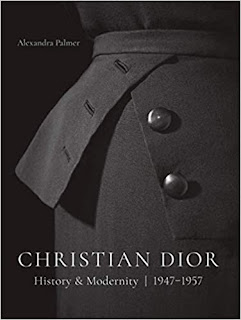
"Christian Dior: History & Modernity, 1947-1957" by Alexandra Palmer


Alexandra Palmer has authored a number of books about Christian Dior.  This one is a peculiarly specific book: not a biography, nor a history of the Dior label, nor of Dior's collections and designs.  Instead it is an in-depth look at the Dior garments held by the Royal Ontario Museum, and it delves into the design and construction of each piece of clothing, how its original owner acquired it, and how she adapted and wore it.

Palmer begins by exploring how Christian Dior's postwar designs were constructed, from the way they were cut to the final embellishments added to them.  Can I just say, that after reading this I've put Dior's clothes into my "lovely to look at, but I definitely wouldn't want to wear them" category?  Each garment was shaped and reinforced with facings, linings and canvas and horsehair padding.   The wearer herself was frequently re-shaped by built-in, boned, corsets and "waist-cinchers".  Lastly, some dresses (particularly the evening ones) had such complicated fastenings that the wearer needed help in getting dressed!

The garments held by the ROM were often altered by their original  owners.  At least one wearer reduced the number of bones in the bodice of her dress.  Others added straps and modesty pieces to their dresses, shortened sleeves, and did more mundane alterations such as letting garments in or out, and raising and lowering hems.  Dior was generally generous in his hem and seam allowances.

Here we come to the meat of the book.  The second (and larger) part of Christian Dior: History & Modernity, 1947-1957 looks at each piece of Dior clothing in the museum in chronological order.  Each chapter starts with the history of the model, continuing with some background on how the original owner acquired and wore it, how it was constructed, and how it differs from the model originally shown in Dior's collections.  Each chapter contains photographs of the garment from the museum collection, and may also include pictures of the in-house sketches of the designs, fashion and press photographs of the original models, photographs of the clothes being worn by the original owner and technical sketches and patterns showing how it was constructed.

All in all, a book not only for those who enjoy exploring the technical details of fashion, but for those who want to know what happens to haute couture after it leaves the catwalks and makes its way into the wide world.

Alexandra Palmer
Christian Dior: History & Modernity, 1947-1957
Toronto: Royal Ontario Museum, 2018
ISBN: 9780888545213

Thursday, July 23, 2020

Overalls by Christian Dior (Elle, Aout 12 1947)


Elle must have patted itself on the back when it got this—a pattern for overalls from newly-famous designer Christian Dior.  Below are the instructions and the pattern diagram as the originally appeared in the magazine.
Grace aux confidences de Christian Dior, la coupe d’une salopette n’aura plus de secrets pour vous.  Il vous faut seulment 4 m. 25 de cottonade en 1 metre de large pour une taille 42.  Il vous faut surtout reussir les trois petits «trucs» du grande couturier qui feront le chic de votre vetement.
1.      Le droit fit est la clef de voúte de la coupe.Pliez le tissue en double dans le sens de la lisière et placez les différents morceaux du patron (que vous aurez étabil sur papier ou mousseline) suivant le schema.    Respectez bien le droit fil, car de lui depend en grande partie l’aplomb du vétement.
Coupez sur tissue simple les poches, ceintures et poignets.Laissez 3 cm. environ pour les couturs et 7 cm pour les rentrés du devant du corsage.
2.      Deux pinces et deux plis font de tailleFaites deux pinces d’un cm. de chaque côté dans le dos et deux plis souples de 2 cm de profondeur de chaque côté du devant.
Par ces pinces et ces plis vous maintiendrez l’excés d’ampleur á la taille, sans trop adjuster le pantalon sur les hanches, une salopette devant rester souple.Pour l’agrafage, partie devant, appiliquez sur l’envers les pattes avec boutonnieres et partie dos, appiliquez sur l’endroit les pattes portant les boutons.Faites la couture du milieu devant et celle du milieu dos (coutures anglaises).Réunissez le devant au dos par les coutures de côté (coutures anglaises) en laissant une ouverture de 15 cm. de chaque côté.
Fermez la couture intérieure des jambes.Piquez á cheval les ceintures devant et dos et faites une boutonniére á chaque extrémite de celle du devant; posez les boutons.Au bas des jambes, rentrez 10 cm á l’intérieur et retournez 5 cm. en revers sur l’endroit.Placez la poche á droite du pantalon.
3.      Le jeu de pinces de l’encoture finit le corsage.Faites deux pinces d’un centimétre de demi du profondeur de chaque du côté de la taille dans le dos et une petite pince d’un centimétre et demi du profondeur de chaque du côté de l’encolure.  Devant, faites 2 pinces d’un centimétre du profondeur de chaque du côté.  Assemblez épaules et côtés par des coutures anglaises.
Appliquez le col sur sa doublure, retournez-le et montez-le á cheval sur l’encolure.Rentrez les devants, faites les boutonniéres et cousez les boutons.  Appliquez la poche du côté gauche, ourlez le bas du corsage.
Fermez les manches.  A 7 cm. de la couture, faites une fente de 7 cm. également.  Appliquez tout autour une patte qui consolidera l’ouverture.  Posez les poignets á cheval, chaque bout dépassant d’un centimétre et demi environ l’ouverture de la manche.  Montez les manches.


Now for my rough and ready (though hopefully understandable) translation of the instructions.  If anyone can do a better translation please let me know!

Thanks to the confidences of Christian Dior, the cut of overalls will have no secrets for you.  You only need 4.25 metres of 1 one metre wide cottonade for a size 42.  Above all, you need three little "tricks" of the great designer to make your clothes chic.
1. The right fit is the key.Fold the fabric double in the direction of the selvage and place the different pieces of the patern (which you will have drawn up on paper or muslin) according to the diagram.  Observe the grain, because on it largely depends the balance of the clothing.
Cut pockets, belts and cuffs on plain fabric.  Leave 3 cm. approximately for the seams and 7 cm for the tuck at the front of the bodice.
2. Two darts and two folds make it fitMake two darts of 1 cm. on each side in the back and two soft pleats 2 cm. deep on each side of the front.
By these darts and these pleats you will control the excess width at the waist without adjusting the pants too much on the hips, overalls having to remain flexible.
Sew the middle front seam and the middle back seam (French seam).
Join the front to the back by the side seams (French seams) leaving an opening of 15 cm. on each side.  Close the inside seams of the legs.
Stitch the front and back sashes and make a buttonhole at each end of the front one; put on the buttons.
At the bottom of the legs tuck 10 cm. inside and turn over 5 cm. in reverse on the spot.
Place the pocket to the right of the pants.
3. The neckline dart set finishes the bodice.Make two darts, half a centimetre deep on each side of the waist on the back and half a centimetre deep on each side of the neckline.  In front, make two darts one centimetre deep on each side.  Sew shoulders and sides together with French seams. 
Apply the collar to its lining, turn it over and mount it on the neckline.
Attach the front, make the buttonholes and sew on the buttons.  Apply pocket to the left side and hem the bottom of the bodice.
Close the sleeves.  At 7 cm. from the seam make a slit of 7 cm.  Apply a tab all round that will strengthen the opening.  Place the cuffs, each end protruding about a centimetre and a half beyond the sleeve opening.  Roll up the sleeves.
And in the "you learn something new everyday!" department, today I discovered that "French seams" and "des coutures anglaises" are the same thing!