Showing posts with label WWII. Show all posts

Monday, June 1, 2026

Australia's Lost Department Stores IX: McDowells (Spring & Summer 1941-42)

McDowells was one of Sydney's smaller department stores, and like so many others, began as a drapery in the 19th century.  It was founded as John McDowell and Partners in 1889, and became McDowell and Coogan in 1893 when one of the original partners dropped out.  In 1895 it became McDowell and Hughes, when Hughes bought out Coogan, finally becoming McDowells Ltd in 1917.  

McDowells prided itself of old-fashioned service and providing value for money.  Staff often spent their whole careers there, and discipline was considered to be firm, but fair.  (That didn't stop one enterprising manager stealing 70 dozen pairs of stockings from his employer in the early 1920s!)  Notably, McDowells refused to reduce the pay of its employees during the Great Depression.

McDowells did a lot of business via mail-order catalogue, which brings me to this publication from 1941.


The front cover hopes "for a brighter year!" but history tells us that they would be disappointed.  Meanwhile they were advertising a "FROCK you will love to wear to any function" in "SHEER GEORGETTE", a "FLORAL FROCK" in crepe with a silhouette "emphasised by the drama of a WHIRL OF PLEATS", a "WASHING FROCK attractively styled in ... a good quality LINEN LIKE FABRIC" and lastly, a dress cut with "9 complete Gores" in a "Flower-splashed distinctive SUEDE CREPE".

It's a fairly good selection of early wartime fashions, but as wartime economies bit clothes would become less generous in their use of materials.  Tucks, pleats and 9-gored skirts would no longer be allowed.

Monday, May 25, 2026

Vogue Pattern Book (June 1940)

 War or no war, Vogue Patterns was still capable of producing glamorous and sophisticated patterns.  Illustrated on the cover of the June 1940 Vogue Pattern Book is pattern S-4189 for a skirt, a blouse and a jacket.

S-4189——RIDING HABIT JACKETS will make your town suit look crisply English and pay homage to the flared-hip silhouette above a slim skirt.

Suits and separates would remain staples during the war years, though as time went on the cut of this jacket would be seen as wasteful.

This is the British edition of Vogue Pattern Book.  It would have gone to press around the time of Dunkirk, and subsequent issues during the Battle of Britain and the Blitz.  Though the patterns would have been the same as the ones in the American edition, the war crept in via the editorial content.  This issue warns readers of possible fabric shortages as British manufactures are exported to pay for the war effort. The October issue warns readers of a possible purchase tax on paper patterns (a tax had been imposed on clothes that month) while the December issue exhorts them to be economical.

Eventually, due to paper shortages, the British edition of Vogue Pattern Book would cease publication as a separate magazine, and would not resume until some years after the war.

Monday, September 22, 2025

Australian Home Journal (September 1940)

 If Woman's Journal looked to Paris for its fashion news, the Australian Home Journal sought inspiration from Paris.


First up: costume jewellery as worn by the stars:

The Stars' Glamour Gadgets
Glamorous gadgets are favourites in the costume jewellery field, and unlimited variety is suggested to Miss and Mrs. movie fan who follows the style leadership of film favourites.  Bracelets, necklaces, clips and boutonnieres rival each other in originality and imagination, with dressmaker trimmings equally decorative.

Australian Home Journal was always happy to turn to designers for advice— in this case, a film costume designer.  Dolly Tree's credits for 1940 included Young Tom Edison and Strike Up the Band.

"Shorts" for Sports
"No matter what the sport—who the girl—the shortest route to smartness in sports is by way of shorts," says Dolly Tree, M-G-M fashion designer.  1940 finds shorts in top place.  Shoulders may be covered, waists nipped in, but legs remain uncovered for the athletic Miss.

For more mundane use, the magazine suggested some popular dressmaking materials. 

Floral patterns are in the front line of dress ideas; spots will be seen everywhere, and checks, while not so prominent as last season, will still have a good following. 

... And of course, some suggestions for things to make with those materials:

Skirts and Blouses
For all-round practical wear, skirts and blouses have come into their own again, and for simple day clothes they are just the thing.
It is to the diversity of changes that the different combining of several blouses and a skirt give that make these garments so popular.

Practicality and making a little go a long way some to be the watchwords here!

Monday, March 10, 2025

Australian Home Journal, March 1940

 Let's take a look at another issue of Australian Home Journal—this time from the war years.  As usual it's full of advice for women who are both fashion-conscious and budget-aware.


Dearer Materials.
Quite a number of mothers are wondering if the dress materials will be dearer this season.  Yes, they will be dearer, there is no question of that, and they must remain dear for a long time.  Exchange, freights and war risks have added to the cost of all imported goods, and Australian-made materials are also advancing in price.

 World War II is only a few months old, but it's already having an effect on prices.  Things will only get worse in the coming years. 

Monday, October 28, 2024

Little Black Frock (Woman and Home, January 1945)

 Woman and Home was a magazine targeted towards British housewives.  It contained the usual mix of recipes, household advice, knitting patterns, fiction—and of course, fashion.

By January 1945, however, fashion was pretty thin on the ground.  Even if the magazine's readers had the coupons to buy new clothes, there was very little in the shops for them to purchase.  In this article, Woman and Home comes to the rescue with an article with suggesting ways of making over a worn dress.  All you need is a few sewing skills and a shabby little black frock!


You could alter the neckline and add trimming in worn spots:
Sketch No. 1 shows it with the high neck cut in a "V", the worn underarms covered with curved bands of black satin and a satin tie-belt with a soft bow.  The bands are outside-stitched on to the frock at each side, with the upper bands lapped over the lower ones, and the back the same as the front.

Monday, June 17, 2024

Concerning Coats IV (1940s)

 Last (southern) spring I paused a series of posts I was writing about coats, saying that I'd pick it up once the weather turned cold again.  Well winter has well and truly arrived.  I'm picking up the narrative thread in the 1940s.

With the first half of the decade dominated by war, practicality and economy were the fashionable watchwords.  

Farmers, Autumn-Winter 1940

Four coats and two fashionable ways of wearing them 1940.  On the left, swagger style (in marl coating and boucle wool).  On the right, also in marl and boucle, two belted coats, with necks that could either be worn buttoned up as shown, or open as revers.  "Shoulders are smartly squared... Featuring the new tucked and flared umbrella skirt."

Monday, July 10, 2023

Australia's Lost Department Stores IV (Murdoch's, Spring-Summer 1942)

 Unusually—perhaps uniquely—Murdoch's began as a store selling menswear.  Opened in 1893 as "Murdoch's, Hatter and Mercer" on Park Street, Sydney, it catered exclusively to men and boys for the first thirty years of its life.  (They advertised a wonderful line of goods for "Our Boys in the Trenches!" during the First World War.)  Women began to edge into the picture in the 1920s by way of ladies' "Surfo" brand "bathing costumes".  By the end of the decade it was possible to buy women's accessories from Murdoch's, including gloves, handkerchiefs, handbags and perfume!

Murdoch's was no doubt aware that women did a lot of the purchasing for their menfolk when they placed this advertisement in 1939:

Ladies!  When you alight from the tram, train or 'bus at Park Street to meet a friend, make Murdoch's Rest Room, on the Second Floor, your rendezvous.

Murdoch's introduced a ladies' tailoring department in July 1939, but it seems to have only fully embraced selling women's clothes during World War II.  Perhaps with so many men off fighting, or "making-do" with the clothes they had at home, Murdoch needed to find new customers.


THE 3 SMART GIRLS on FRONT Cover
THE LASS IN PINK—wears a most attractive frock of Sundek linen ... a splendid garment for everyday, Summer wear.  Built on tailored lines, with smart V piece inlet into bodice.  Trimmed with covered buttons.
HER COMPANION looks smart in frock of Striped Wemco Sheer.  Popular shirtmaker style with pockets, contrast buttons and buckle.  Pleat in back of bodice to give extra freedom.
THE YOUNG LADY on the extreme right is smartly clad in a guaranteed "Betterknit" frock... an up-to-the-minute style that you won't be able to resist!  Beautifully cut in shirt style, with two-way neck.
R.A.A.F.—(As illustrated on front cover.) Craftsman's Blue Cheviot tunic and trousers.

Murdoch's was purchased by Waltons Department Store in 1951, which was in turn taken over by Sears Roebuck (yes, the American firm) in 1955. Walton-Sears continued trading at Murdoch's old address until it closed in 1987.

Tuesday, May 9, 2023

Australia's Lost Department Stores III (Farmer & Co., Autumn & Winter 1940)

 Farmer's called its twice-yearly catalogue a "Fashion Book", so it's easy to tell that its main business was selling clothes.

It began in 1840 as a shop on Pitt Street, Sydney, offering "a well selected and fashionable stock of drapery goods".  The store prospered, moved to progressively larger premises over the years and becoming a limited liability company in 1897.  By the beginning of the twentieth century shoppers were visiting a large, six-storey building on the corner of Market and Pitt Streets; a decade later Farmer and Company had acquired land and expanded into adjacent George street.  By 1937 Farmer's was able to boast that its store occupied one and a quarter acres of land!

Lest you think that size was all the Company had to brag about, they also proudly announced an art gallery (the Blaxland Galleries on the eighth and ninth floors of the George Street store), a commercial radio station license (from 1923), escalators (installed 1927) and from 1936, air-conditioning!


The cover of Farmer's Autumn & Winter Fashion Book for 1940 illustrates:

Left: UB40—A casual Swagger Coat, from cosy wool-boucle coating.  This swinging-style features square shoulders and neatly stitched collar.

Right: UB41—Swinging Swagger Coat in a soft, supple-wool coating.  Featuring Peter-Pan collar, square shoulders and four flap pockets.

Centre: LB55—Tailored, knitted Jumper Silk of pure wool.  Features smart straight neckline; yoke is trimmed with two tabs.  Plain, tailored skirt.

Sadly, after the war things didn't go so well for Farmer's.    Among other things, their customers were moving out to the ever expanding suburbs, making it harder for them to get to Farmer's city stores.  Farmer & Company tried following their customers, opening their first suburban branch in Gordon in 1960.   However, that didn't save the business, which was taken over by Myer in Melbourne in 1961.  No longer an independent entity, Farmer's continued trading in Sydney as "Farmer's" until 1976, when Myer re-branded its Sydney stores with its own name.

For those wanting to investigate further, Farmer's Spring and Summer Fashions catalogue for 1897 is available online.

Tuesday, February 28, 2023

Women Wearing the Trousers in WWII

 By the start of World War II, "slacks" were well established as casual and leisure wear for women in the Western world.  However, they were not considered suitable for street or work wear, and certainly not for formal wear.  Would the World War change these attitudes?  Would a combination of shortages, war work and the threat of air-raids make more practical clothing acceptable?

Changes came first to places where the war was closest:

So if you would like to know what the autumn London fashions are I'll tell you.  Smart women are wearing the slacks and sweaters and scarves they bought to wear on holiday abroad or in the country, because if they are in London they are busy working, and those sorts of clothes are quickest to put on and stay neat.  Or they are wearing the uniform to which their training has entitled them.
The Home: An Australian Quarterly, November 1939

Vogue Pattern Book, August-September 1941

However, a whole year later, bifurcated garments were still being depicted as leisure-wear in Australia:
The Trouser Trend...
Basking on the beach ... in a bare-midriff pyjama suit of striped jersey... For summer lazing—voluminous red slacks printed with huge white and yellow leaves... Designed for active sports... deep blue slacks in a heavy shantung... Entertaining at home in a Persian-inspired pyjama suit...
The Australian Women's Weekly, November 20 1940

Wakes catalogue, Winter 1942

In June 1942, the Australian Women's Weekly surveyed "business girls"  to find out how they planned to dress on clothing coupons:
Only a little more than half favour slacks for work, even if employers favoured them.
Miss Audray Stafford of Marrickville, junior clerk, would wear a slacksuit to the office if her employer allowed her.
"But as I'm not sixteen, although I've been dressing myself for nearly two years, I'd probably have to ask my mother for the coupons."
Australian Women's Weekly, 13 June 1942

Walter Field catalog, Fall 1942

Trousers were a practical way of dealing with stocking shortages, but women were still (mostly) reluctant to wear them in an office setting.  Reporting from England:
Woman continues to be a contrary creature.  She clamoured for trousers at work.  'You can wear trousers,' says Whitehall, 'you have our full permission.  Does she wear them?  Certainly not.  'They are not the thing,' she says.  Someone had the curiosity to comb through Whitehall's government departments the other day and found three girls out of many hundreds working in trousers.
At the other end of London, one of the girl bus conductors put on a pair of trousers instead of the regulation skirt because she had no more coupons to buy stockings and she lost her job.  It's a mad world.
ABC Weekly, 14th of February 1942

Wakes catalogue, Summer 1942-43

For heavy or industrial work women started wearing overalls.   

Why don't designers of overalls for women use a little common sense?  Women's overalls are designed the same as men's.  A woman's body is not designed the same as a man's, but designers of overalls apparently do not realise what vast anatomical differences there are.  For a start, women's overalls should be made with a tailpiece similar to kiddies' rompers instead of buttoning down the front.
The Australian Women's Mirror, November 23 1943

McCall Style News, April 1943

For your shift on the assembly line, for your gardening, for just plain sports—a slacks suit in three pieces.
McCall Style News, April 1943

The Australian women's weekly decided to present their own, more feminine version of clothes to be worn on the factory floor:

Briskly tailored, yet ultra-feminine coveralls made of sturdy cotton.  Note the capacious pockets and ankle straps to prevent slacks from catching in machinery.  Note too, the cheery flashes of colour.  In pre-war days you would have included these overalls and slacks in your holiday wardrobe.  Now they are ready, like the women they clothe, to do an important job of war work.
The Australian Women's Weekly, 13 March 1943

(Note: I have yet to see pictures of women actually wearing this design.  Perhaps working women had neither the time nor the materials to make "ultra-feminine coveralls"!)

Montgomery Ward, Spring-Summer 1944

Married in Overalls 
MANY wartime brides dispense with formal wedding dress, but few are quite so informal as a lass who works as a welder at one of England's biggest shipyards.  She was married during the lunch hour.  She wore blue overalls, a leather jacket, and an orchid.  The groom, a ship fitter, wore khaki overalls and a steel helmet.
The ABC Weekly (December 25, 1943)

National Bellas Hess catalog, Fall-Winter 1944

By the end of 1943 some "fashion leaders" were forecasting for postwar fashions:
It is safe to predict that many women will adopt the mode of wearing slack suits.  Before the war slacks were restricted to sport and country wear.  To-day millions of women throughout the world are wearing slacks.
The Australian Women's Weekly, December 25 1943

However, in more conservative neighbourhoods, "slacks" never quite caught on:
There are, however, still places in which slacks are taboo and where the the sporting of them brings the wearer up against quite a few problems.
Believe it or not, the first drawback, according to the slacks wearers, was that they were conspicuous.
"Surely not!" I scoffed.  "Not in this day and age."
"Just you wear a pair into town on a weekday," they said.  "On a Sunday or a holiday, anyone can wear slacks to town and no one takes notice, but to wear them into town on an ordinary shopping day is to call attention to yourself in no small way."
Matronly shoppers, they contend, turn, stare in disapproval, and make the rudest remarks.  Kindly old gentlemen sitting next to you on trams turn and give a lecture on womanly charm.  Sailors, home product and allied, seem to be attracted to slacks-wearing women, and whistle and talk as though the slacks were the bell-bottomed ones that made male and female fellows-in-uniform.
The Australian Woman's Mirror, December 12 1944

The article goes on to describe the difficulties "slacks" wearers encountered in courts, union meetings and restaurants!  With attitudes like that, it's no wonder that women had to wait nearly thirty years after the war for trousers to become normal wear.  Instead of adopting "slack suits", women's fashions became exaggeratedly feminine in the immediate postwar years.

Tuesday, September 27, 2022

Found Online: Winns Catalogs IV (Early 1940s)

 We've now reached the War years as we continue to tell the story of popular fashion through the medium of Winn's Catalogues.  (You can also access them via the State Library of New South Wales website here.)

Autumn and Winter 1940

After years of winter catalogue covers featuring the best Winn's had to offer in coats, the store kicks off the new decade by advertising dresses and suits.  From left to right:
Smartly Tailored Frock in All-Wool Jersette, featuring the new neckline—Gored skirt—effectively trimmed bodice and belt.
Man Tailored Two-Piece Costumes in All-Wool Boucle.  Coat is fully lined and finished with two pockets.  Skirt has inverted pleat.
A Becoming "Dressmaker" Suit in Fine Quality All-Wool Jersette.  Coat is trimmed with the new novelty pin tucking—gored skirt.
However, the coats aren't entirely neglected.  You can find plenty of them for sale on page 17.

Summer and Christmas, 1940-41

Since these catalogues were published in wartime, it will be interesting to see how the war affects the clothes sold by Winn's.  So far there don't appear to have been many changes, either on this cover or inside the catalogue.  (If you look at page 17 of this issue you can see a selection of women's trousers on offer, but it's clear they're meant for holiday wear rather than doing war work!)

Autumn and Winter 1941

For the first time we see photographs taking the place of drawn models on the cover of Winn's catalogue (an innovation which didn't last the war years).  Also of interest: Winn's is featuring separates (at left "cosy brushed all-wool cardigan jumpers" and "popular sun-ray pleated tartan skirts") as well as more formal one-piece dresses and suits.  (Centre: "smartly tailored frock in all wool jersette" and right: "a becoming two-piece jumper suit in wool jersette".)  Separates really came into their own during the war years, as women could extend their wardrobes by mixing and matching individual garments.

Summer and Xmas, 1941-42

The Australian summer of 1941, and the things are about to get serious for people Downunder as Japan enters the war and strikes south.  This catalogue, however, was almost certainly issued before Pearl Harbor, and its cover advertises the usual warm-weather mix of summer "frocks" and frivolous hats.  From left to right we have:
SMART... TWO-PIECE in Sheer-Sak—trimmed with cornelli work, cuffs of white...
ATTRACTIVE Sheer-Sak... bodice is trimmed with ... richeleau work...
INEXPENSIVE with a dressy air—colourful Florals are ... fast washing...
 
Autumn and Winter 1942

Separates are very much in evidence in the Autumn and Winter catalogue of 1942.  Clearly the marketing people at Winns thought they were more appealing to the average wartime consumer than dresses and suits.  Clothes rationing was introduced in Australia in June 1942, but this catalogue was clearly released before then because the garments advertised are only priced in money, not in ration coupons.

Spring and Summer 1942-43

NOTICE TO CUSTOMERS
Our Mail-Order customers will be well aware of Wartime difficulties in regard to supplies.
However, Winn's have always valued highly their extensive Mail-Order Trade, and have always aimed to look after their country clients.
To be assured of Catalogue supplies, in the main the goods catalogued have been bought early, and are already in stock.  How long supplies of some lines will last, we are unable to judge.  In most cases it will be impossible to obtain further deliveries, so that customers are asked in the case of Frocks, Hats and such goods to make a second choice in color, or indicate another garment as a second choice.
They weren't joking about supply difficulties.  Paging through this catalogue I can see a number of items over-stamped with the words "Sold Out", including, on page 22, a "Coat Frock in White Pillow Cotton, Link Cuffs, slightly soiled"(!) 

Autumn and Winter 1943

All the clothes on this cover are priced in coupons as well as in pounds, shillings and pence.

Clockwise from top:
LADIES' ALL WOOL FLANNEL COAT, fully lined Art. Silk, boxey style finished with two pockets... 27 coupons.  Hat... 3 coupons.
LADIES' 2-PIECE FLANNEL COSTUME.  Coat is lined and has two pockets.  Skirt has pleat in front... 23 Coupons.
LADIES' ALL WOOL BASQUE JUMPER CARDIGANS, with fancy stitch self-coloured trimmings... 7 Coupons
Spectator SPORTS BLOCKED FELT.  Shaped crown.  Snap brim will turn up or down at back.  Contrast trimmings of cut out Felt and ends... 3 Coupons.
As you can see, the coat and suit were the most "expensive" items.  However, even more utilitarian garments had their coupon price.  For example, both "Bib and brace" overalls advertised on Page 6 and "Farmerette" overalls on Page 12 would set the wearer back by 6 coupons!

Spring and summer 1943-44

You wouldn't know there's a war on by the designs on the cover of this summer catalogue, except "Sold Out" is stamped over the fancy floral frock on the left ("Gaily Coloured Floral Frocks of British printed spun cotton") and once again, everything has a coupon value.  The little girl's dress on the cover only costs 6 coupons, as opposed to the adults' 13. 

Navigating one's way around clothes rationing must have been quite a task.  If you check the hosiery on Page 19 you'll see that even the most basic pair of rayon stockings would set the purchaser back 2 coupons.  That seems a small amount compared to the ration value of a coat or a dress, but when you consider how many pairs of stockings the average woman must have got through before the war you realise how carefully she had to manage not to blow her entire coupon budget on them during the war!

Spring and Summer, 1944-43

The State Library of New South Wales is missing its copy of Winns catalogue for Autumn and Winter 1944, so we have to skip straight to Spring and Summer 1944-43.  For some reason the artist who designed this cover decided to pose his ladylike models in a stable.  I'm not sure whether he was trying to illustrate wartime farm chores, or looking forward to a postwar racing season!  

In spite of the narrow wartime silhouettes of these dresses, there are a few touches that would be further developed after the war, in particular the emphasis on hips with ruffles and peplums.  From left to right:
Dressy Frock of Imitation Linen.  Tunic effect, bodice opens to waist, pockets and collar bound with White, various designs on grounds of Blue, Rose, Gold or Green.
Maids' [i.e. Teenagers'] Frocks of Plain Imitation Linen, bodice is trimmed with contrasting stitching, two pockets, gored skirt.
Attractive Figured and Floral Art. Silk Frocks.  Various multi-coloured designs, Apron style. 

Sunday, August 14, 2022

Suits VI (National Bellas Hess, Fall-Winter 1944-45)

 On the cover of this wartime National Bellas Hess catalog is a suit echoing the uniforms worn by women in the armed forces (and auxiliary services).  The look is tailored and no-nonsense, the emphasis is on practicality.


The Man-Tailored SUIT
Smartly styled and expertly tailored of our best ALL new Wool Shetland-weave, handsome, firm textured—keeps its shape through active wear.  Classic three-button jacket, with darts at the waist for slim, feminine lines; inner flap pockets; full Rayon lining.  The trim-fitting skirt is box-pleated front and back; one-button waistband concealed placket.

The Popular "Boy" COAT
Young, easy to wear, comfortable.  Smartly tailored of rich, firm-bodied All new Wool Shetland-weave, on trim-fitting straight lines.  Single breasted front with wide revers, tailored welt seaming, two deep inset flap pockets, arm straps for over-the-shoulder wear.  Rayon lined, warmly interlined.
With rayon blouse, felt hat and leather gloves.

Monday, May 30, 2022

"It's Smart to Restyle" (McCall Style News, July 1945)

Now for another round of WWII restyling—courtesy, once again, of McCall's Patterns:


"MCCALL 1064—Printed Pattern for Making Over the Tops of Old Dresses...With this new "conservation pattern", turn an old dress into a smart makeover.  Cut any of the yokes or lower waist sections shown, from the two master patterns for blouse fronts and backs.  Results: the high-style, two-tone effect, achieved with contrasting fabric."
I have another version of the same pattern from 1944 posted here—re-using and "making-do" clearly applied to pattern companies as well as home dressmakers!  This illustration of the pattern includes ideas for making over sleeves and accessories as well as the bodices.

Saturday, January 15, 2022

Bargains! (Walter Field, Fall-Winter 1942)

 Walter Field of Chicago specialised in low-budget clothing, so can be taken for granted that the clothes advertised in their catalogues weren't made of the highest quality materials.  The snazzy suit on the left, for example, was made of "18% reused wool, 12% cotton, 70% rayon".  The "shag" sweater in the middle was made of cotton, and the coat on the right was "50% reused wool, 20% rayon, 30% cotton".

However, in wartime America the quality of consumer goods at any price level slipped.  One historian writes: "Woolen clothes, rugs, and blankets disappeared from department stores as production of wool for civilian use virtually ceased", and continues

"Fifty-five percent of the respondents to an American Home Economics Association survey complained about the deterioration of clothing and shoes.  New dresses pulled out at the seams, shoes would not stand up under heavy wear, and stockings came with shorter leg lengths and tore out at the top.  One shopper purchased a white rayon blouse that on the first wearing pulled out at the seams, and on the first washing shrunk and had to be given away to a friend.  Housewives spent extra time sewing simply because the material wore out so quickly."

D'Ann Campbell.  Women at war with America: private lives in a patriotic era  (1984)

There was no clothes rationing in the United States during World War II, but apparently no quality control either.  This was in contrast to its ally Britain, which combined strict clothes rationing with stringent quality control


Saturday, September 4, 2021

Fashions from McCall Style News (September 1940)

Sometimes it's nice to just take a snapshot of what women were wearing at one point in time. Here's an image-heavy look at the styles of  81 years ago, courtesy of one of McCall's monthly pattern pamphlets.
 

Coats, nipped in at the waist or flaring out, trimmed with fur cloth (not fur, as indicated in the header).


Suits, a 1940s standby.  These have some decidedly military touches (in particular, the pockets!) which show which way people's thoughts were trending.


A slim-fitting coat and a suit which really is trimmed with fur (as opposed to "fur" cloth).


Smart shirt-waisters with panels and pleats—also pockets!  


This is described as an "informal" evening gown, for satin or lame.   The neckline, front and back, is comparatively modest.

Also for evening: a dress with "wide straps" and a "slightly full" skirt, baring more flesh at the shoulders and back.


Dinner dresses, at the left in velvet, at the right with bows. 

Tuesday, July 13, 2021

"Home made brassiere" - 1940s style (Stitchcraft, May 1942)


 (As wartime shortages started to bite in the shops, women were encouraged to start making things for themselves.  This pattern for a bra is one example.  It could be made from scraps of material—and note that it only uses a small amount of scarce elastic and no metal needed for munitions!)

MATERIALS: Small piece of material, matching cotton, piece of elastic, one button, ribbons for shoulder straps.


Draw up a piece of paper into 2-inch squares and sketch the shapes with the outline in the same relation to squares, as shown on small draft.  This will fit a 34-inch bust, to make smaller or larger sizes, draw the squares very slightly smaller or larger than 2 inches.

Cut out in double material allowing ¼ inch turnings, also cut a strip 2 by 28 inches for the bottom edge.  Join edges marked in dotted line with a tiny french seam and press flat.  Turn narrow hem down two short straight front edges and faggot together (see diagram 1) tacking to brown paper with edges ⅛ inch apart.

Tack narrow hems on wrong side round outer edges and hem with shell edging (see diagram 2).  Sew straight strip across bottom edge, first on right side then turnover and slip hem on wrong side.  


Stitch a button at one end and insert loop of narrow elastic in the other end.  Attach ribbon shoulder straps to front points and the end of the band.

Saturday, June 19, 2021

Walter Field Co. Catalog (Fall-Winter 1944-45)

I've tried, but  I haven't been able to find any background information on "Walter Field Co." in Chicago.  The firm seems to have issued catalogues between the 1920s and the 1950s.  Judging by the prominent display of the words "Bargains" and "We Pay Postage" on each cover, I'd say Walter Field  specialised in selling inexpensive clothing by mail.  I browsed through some "big book" catalogues of the same era, and decided that the clothes in this little book were roughly comparable in price to the cheaper garments offered by its bigger rivals.

Here we have a couple of budget versions of fashionable wartime styles.  The coat on the left is made of a mixture of wool and rayon, and has a collar made of dyed rabbit fur.  The suit on the left is made of cotton fleece and rayon, and is unlined.  It was probably washable (unlike more expensive suits made of wool which would have to be drycleaned).  Hopefully it would not become too crumpled or shrink when washed!

Sunday, June 6, 2021

"Siren Suit" (Wakes, Summer 1942-3)


Strictly speaking, a "siren suit" was a one-piece garment, rather like a  jumpsuit.  They were designed as warm garments that could be donned quickly when the air raid sirens went—hence siren suit.  This "jacket-and-slacks suit" in "crease-resisting art silk linen" was

"designed to form an essential part of your defense program, a lounging lovely to make an equally complete background for relaxing or busy hours." 
In other words it was not intended for wearing while doing hard labour, or dodging bombs.  

Is it just me, or does this outfit look like some of the pants suits fashionable in the 1970s?

Friday, November 20, 2020

A Decade of Dresses, Part 3 (1940s)

 For most of this decade the clothes women wore were constrained by rationing, regulations and shortages.  During the war patriotic women would ideally renovate and wear last year's frock rather than splash out on a new dress, and until the end of the 1940s fashion changed slowly if at all.

One type of dress was particularly popular through the war and afterwards.  If I had to label the 1940s I would call it the era of the shirtwaist dress.  We're going to see a lot of these in this post.

Vogue Pattern Book, August-September 1940

To kick off the new decade, a classic "shirtwaister" on the cover of Vogue Pattern Book.  A shirtwaist dress was defined as a dress with a waist seam which buttoned up at the bodice like a man's shirt.

Australian Home Journal, January 1941

These dresses from 1941 include the ubiquitous shirtwaister among other styles.  The silhouette hasn't changed since the late 1930s, and these patterns allow for a relatively generous use of material in the form of tucks, pleats and gathers.

Bestway Fashions, April 1942

This is a British magazine, but the comparatively austere fashions of 1942 were not only limited to the UK.  All the allied countries—including the US—had detailed regulations dictating how clothes could be constructed and how much material could be used in any one garment.   The rules laid down such things as the depth of hems, the width of seams and how many pockets could be added to a garment!

McCall Style News, April 1943

Here we have an American pamphlet published by the McCall Pattern Company in 1943.   The dresses in this illustration have the same tendency towards skimpiness as their British counterparts in 1942.  Skirts have risen to the knees (which was about as high as they could decently go in the 1940s) and have narrowed with just enough ease for walking.  Shoulders are still broad, but puffed sleeves are no longer in evidence.  Decoration has become minimal.

Montgomery Ward, Spring and Summer 1944

In 1944 Montgomery Ward offered this pair of classic plaid shirtwaisters for sale, designed to conserve materials and labour.  

Easy Dressmaking, 1945

Here we have just reached—or very nearly reached—the end of the war, and a tiny celebratory note of frivolity has crept in.  One version of this frock is a fairly plain shirtwaist, with white piping on the cuffs and collar as the only ornament, but the other has added a feminine touch with a small frilled peplum.

Easy Dressmaking, mid-summer 1946

Life was still far from back to normal in 1946, but there is some evidence that women were trying to move away from the more severe styles of the war years to something more feminine.  This dress is fairly typical of 1946.  The skirt is still only knee length, but it is fuller than its wartime predecessors and big pockets are placed in a way to make the hips seem larger and more rounded.  This particular dress is also made in a big, splashy flower print and ornamented with bows—lots of bows.

Wakes catalogue, Spring 1947

1947 was a big year in fashion, with Christian Dior launching his "New Look" in the Northern spring.  This was everything wartime fashions were not, with padded hips and unpadded shoulders, nipped-in waists and most of all, long and full skirts that used a lot of material.  Other designers quickly followed his lead, but it took the producers of mass-made ready to wear longer to make the change—as seen in the picture above.  No doubt they didn't want to retool and throw out their current stock.  However, I wonder how well these pretty (but by this time old-fashioned) dresses sold?  Wakes' potential customers must have be able to compare them to the latest styles in the magazines.

National Bellas Hess Midsummer Sale Catalog, 1948

... And just like that, we're in the 1950s.

Well not quite.  However, by 1948 a version of Dior's "New Look" became available to the general public and elements from this—the long full skirts and nipped in waists—were to become the defining look of the 1950s.  Only the broad shoulders on these dresses remind us that in fact they were made in the 1940s.

Wakes catalogue, Spring-Summer 1949

And to finish up, two frocks on the cover of Wakes catalogue that look very much forward into the 1950s—and yet the discerning eye can see that the models are still wearing shirtwaist dresses!


Saturday, March 7, 2020

A History of Blouses Part 6 (1940s)

The first half of this decade was dominated by World War II—the second by the recovery from the war.  Fashion became subordinate to the war effort.  Blouses, like all other types of clothing, were affected by this—though in the early months of the war it was still very much "business as usual".

"BLOUSES are just as stylish, if less fluffy, than last Summer.  Plenty of muslin, organdi, crepe de chine, that adopt more or less the chemisier style, have a little lace frilling, and mostly lingerie fronts, adorned with open-work and tucks."
The Draper of Australasia, June 1940

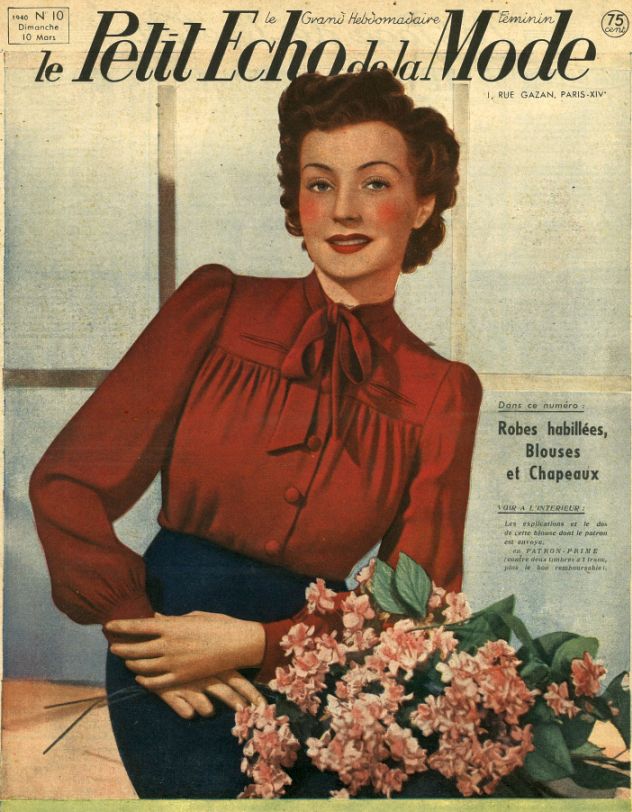
Le Petit Echo de la Mode, Mars 10 1940
K. 90505.  Blouse en satin.  De chaque coté du devant, elle se fronce dans une découpe au-dessus de lanquelle se place un petite poche fendue.  Encolure, nouée.
McCall Style News, March 1941
4087.  A three-button blouse, softly tailored.  It is gathered below the shoulders at front and back.  High or low neck.
4091.  This blouse can be made with or without sleeves.  Belted at back to hold it in nicely.
4106.  A very smart tucked-bosom overblouse—just waistlength.  Narrow double-breasted buttoning.  Made on fitted waistband.
4124.  Shoulder-to-shoulder shirring beneath two rounded yokes.  Short V neckline.  A grand suit blouse.  Slender sleeves.

Wake's, Spring-Summer 1942-3

Dazzling White Classics
 Two impeccably tailored-shirt waists, typifying to perfection the trend towards smarter simpler beauty.  Both with new, wide rever'd collars; generously gathered yoke action backs, waists double-darted front and back for bulkless fit.  Trimmly stitched collars, cuffs, pocket flaps. Strongly sewn and neatly pinked seams.
 As the war continued, blouse styles became almost severely practical.  They began to resemble men's (open-necked) shirts, recalling the days of the "New Woman" and her shirt-waist.  Ornamentation (embroidery, tucks, lace) was not only considered wasteful and unpatriotic, but actually made illegal in some countries.

Australian Home Journal, June 1943

Blouses from Oddments.  You can make new blouses from a large patterned scarf square, the best parts of a man's shirt, and from coloured and fancy linings of discarded garments.  Smaller pieces of material will make backless fronts.  Give them collars, or fasten with bands buttoning at the nape.
Make Do and Mend (Board of Trade, 1943)

Montgomery Ward catalog, Spring-Summer 1944
5. BOLD AND BRIGHT... Screen printed Rayon Jersey; shirred yoke, 1 flap pocket.
6.  FRUIT-OF-THE-LOOM... Well-known Rayon in a muted screen print.  Has a delicate and Summery air.  Deep collar and front opening prettied with embroidered eyelet ruffling.
One of the real advantages of the blouse during wartime was it could be made out of odds-and-ends of materials—remnants, salvageable parts of a worn out dress, scarf squares.  There were some blouses made out of even stranger scrounged materials, such as the examples below.

Blouse made from an escape map, held by
Smithsonian's National Air and Space Museum

"A young girl working in a government drawing office was given an old linen map, which she boiled to remove the starch and printer's ink.  'Then I washed it, dyed it with a fourpenny dye.  Ironed it.  Cut it out from a much-used blouse pattern.  Made it up with a fivepenny reel of cotton and used the buttons from an old dress.  Result—one new wearable garment.  Total cost ninepence—no coupons.  I was very proud of this blouse.'"
From Norman Longmate, How We Lived Then (Chapter 21)

A new or refurbished blouse could brighten up an old outfit!

Easy Dressmaking for Spring, 1945
Our Free Pattern this month is planned to cut five simple, smart and popular blouses that are ideal for wear with a modern suit.  Here are blouses for all occasions, from the tailored shirt to the frilly little model that is dressy enough for a party.
Our models have been specially planned so that they can be cut from the least possible amounts of material.  Search your drapers for remnants from which you can make them.

Australian Home Journal Winter Fashions, 1946

Shortages did not end with the war.  While fashion designers were still deciding which way to jump, women were still having to make do and mend.

"PARACHUTE BLOUSES

When material, formerly parachute cloth, was recently released, textile manufacturing firm of Aschers engaged artists to experiment with designs suitable for blouses and evening wear.

Printing of designs succeeded only after many failures, but nylon garments attracted much attention when exhibited at Dorchester Hotel, London, recently.

All were in pastel colours except a new pink (Ophelia) and a bright cyclamen.

Apart from small patterned prints with outlined violets on a cream ground and other contrasts in the same pattern, the designs were mostly large flowers or bold outlines and crazy patterns.  Some show free sketches of different rooms in a house—including a bar—all in one dress length."
Northern Times, 29 March 1946


"ACCORDING to fashion decrees every suit is given a harem of blouses, one of which should be giddy, and maybe with stripes, dots, plaids, checks, done in bright colours. Some of the new blouses are essentially fresh and Spring-like.

ONE of the attractive points about this fashion is that a change of blouse, a simple and inexpensive thing in itself, will put a completely new-aspect on a single suit.

Choose a smart, semi-tailored suit with a plain blouse for the morning, and the same can be worn for the afternoon with a frivolous model of taffetas or quilted satin, which is now much in vogue. The woollen jumper which is seen in bright colours, striped, embroidered, and with fancy patterns, is a useful item, and must not be forgotten when choosing your blouse harem."
Hobart Mercury, 28 March 1946.

McCall Style News, January 1947
6749.  A drop-shoulder blouse.  The front yoke is simulated by a tuck edge.  It buttons down the back and the round neck is faced.
6750.  The front panel gives you a chance to do special things with stripes.  Round neck and cap sleeves, and back buttoning.
6748.  Here is a tailored shirtwaist with shoulder shirring and bishop sleeves to give it softness.  Front buttoning.
By the end of the decade fashion took a turn for the nostalgic, the feminine and the romantic.  This did not mean the abandonment of blouses, however, as separates and suits were too practical and too entrenched in women's wardrobes to discard.  It did mean that it was possible to experiment with new styles once again.

Butterick Fashion News, December 1948

4719.  "The Yoke blouse"
4721.  Tailored blouse.  "Quick and Easy" to sew.
4720.  Curvaceous bib yoke on a soft blouse.
"Blouses have definitely become glamorous.  The severe skirt collar and long sleeves have given place to frills and trimmings of all kinds.  Printed material is most fashionable for blouses at the moment."
Central Queensland Herald, 6 January 1949 

Vogue Pattern Book (British ed.) Autumn 1949
6351.  Natural sloping shoulderline to cut effectively in plaid taffeta or cotton.  Beneath the mandarin collar you can button it as high or as low as you please.
6736.  Notched horizontal tucks crisply tailored in crêpe or spun rayon.
6849.  Casual blouse with a Chinese air for clinging rayon jersey.  Forearm sleeves.
6541.  Dart detailing for a soft yoke effect.  Illustrated in a polka-dot silk.
6817.  Trim tailored shirt blouse in striped poplin.  Push-up, flared-cuff sleeves.
5843.  In dark wool jersey, this is a top for anything from slacks to dinner skirt.
6628.  Below a mandarin collar, a deep tucked yoke like a dress-shirt front.
6837.  Kimono-sleeved blouse, fastening like a man's shirt without the collar.
6704.  Three box pleats take well to moss crêpe.  Turn-down or band collar.

"Blouses are Important
 
Blouses form one part of a woman's wardrobe that is not subject to seasonal and fashion changes.
 

No wardrobe is really complete without several blouses, for they are appropriate to so many occasions, and meet the needs of housewife and business girl alike, as well as the woman who has more leisure time for social outings. 

There's no age limit to the wearing of blouses, either. Matron or maid finds them to her liking and advantage, choosing a style best suited to her taste and to the outfits for which she requires them as a complement. 

No tailored suit is complete without a blouse, and after winter wear a suit is given a new lift when the warmer days of Spring come by crisp-fresh looking blouses in white, pastels, or other colors. 


Many women prefer the look of a blouse even in winter, wearing one with a cardigan beneath a suit jacket instead of a woollen jumper."

Weekly Times (Melbourne), 8 June 1949