Showing posts with label Vogue patterns. Show all posts

Monday, October 5, 2026

Vogue Printed Pattern News, 1959

 I'm now roughly three-quarters of the way through my survey of the mid-twentieth century.  And what better way to say farewell to the 1950s than a selection of Vogue Patterns, as depicted on the covers of Vogue Printed Pattern News?  They show most of the main looks of the year, as interpreted for home dressmakers.

Marvellous way to embark upon the new fashion year... this slim wool jersey dress in a brilliant explorer-blue. 9651

Monday, July 27, 2026

Vogue Pattern Book (British edition, Autumn 1949)

Since I began the decade with a Vogue pattern for a suit which could be worn as separates, I thought I'd end it with a Vogue pattern for a dress and jacket that looks like a suit.

ON THE COVER.  Matched colour—contrasted texture: an oatmeal jersey dress buttoning from neck to hem at back; oatmeal tweed jacket.

 Fitted and buttoned down the back—the very reverse of wartime practicality!

1949 saw the end of clothes rationing in Britain (it ended a year earlier in Australia).  The British edition of Vogue Pattern Book, which had been subsumed into Vogue magazine was once again being published separately.  Britain was still a long way from being a consumer society, but it was on the road to recovery.

Monday, May 25, 2026

Vogue Pattern Book (June 1940)

 War or no war, Vogue Patterns was still capable of producing glamorous and sophisticated patterns.  Illustrated on the cover of the June 1940 Vogue Pattern Book is pattern S-4189 for a skirt, a blouse and a jacket.

S-4189——RIDING HABIT JACKETS will make your town suit look crisply English and pay homage to the flared-hip silhouette above a slim skirt.

Suits and separates would remain staples during the war years, though as time went on the cut of this jacket would be seen as wasteful.

This is the British edition of Vogue Pattern Book.  It would have gone to press around the time of Dunkirk, and subsequent issues during the Battle of Britain and the Blitz.  Though the patterns would have been the same as the ones in the American edition, the war crept in via the editorial content.  This issue warns readers of possible fabric shortages as British manufactures are exported to pay for the war effort. The October issue warns readers of a possible purchase tax on paper patterns (a tax had been imposed on clothes that month) while the December issue exhorts them to be economical.

Eventually, due to paper shortages, the British edition of Vogue Pattern Book would cease publication as a separate magazine, and would not resume until some years after the war.

Monday, May 11, 2026

New Fashions For You and Your Home (Singer, Fall-Winter 1938)

 Shown below is part of Vogue Pattern No. 8129, an evening dress "with a redingote over an independent slip-dress".  This is clearly the "slip dress"part of the design.  A small illustration of the "redingote", made up in lace, is inside the magazine.

Back in my very first post for this year I mentioned the introduction of the first backless evening dresses during World War I.  In they 1930s they were almost de rigueur in formal evening gowns, though they could be covered up by garments like the redingote included with this pattern.


All in all, there seems to have been quite a variety in evening fashions in 1938!  The Australian Home Journal reports:
In the evening we see princess dresses with drapings that stress the wearer's slenderness; further, there come dresses which cling till the knees and then start into greater width; some skirts are slit and somewhat cut away in front, trailing at the back in a line, and there are also reminiscences of the Empire, the Directoire and the 1889 style.
Australian Home Journal, May 1938

Monday, January 15, 2024

Fun In The Sun (Vogue Patterns, January 1948)

Recently I got hold of a Vogue Patterns counter catalogue from 1948.  Needless to say I'll be posting a lot of scans from it in the future!  For today I thought I'd start with some pictures of bathing suits and beachwear from the catalogue's "Work and Play" section. 

5766 One-piece Bathing Suit

A one-piece bathing suit with interest added by shirring.  The pattern was designed to be made up in either rayon or wool jersey.  By the 1940s there were swimsuits made of new, water repellant fabrics—such as lastex—but they don't appear to have been available for home dressmakers.

Sunday, August 21, 2022

Suits VII (Vogue Pattern Book, 1955)

 The skirt suit was as popular as ever in the ladylike 1950s.  In 1955,Vogue Pattern Book devoted fully half of its covers to suits.

February-March 1955
"This spring it's pale tweed (like this butter yellow) for suits (like this tapered box jacket suit).  Noteworth: the collar that rolls away from the neckline, the low-placed belt.  Vogue Pattern S-4573."

August-September 1955
"A twelve-month-of-the-year investment... the good little jersey suit.  Here in a bold herringbone in black and white.  News: the bare neck, the spark of red in the hat and gloves.  Vogue Pattern Number S-4625."

October-November 1955
"Tweed, the seasoned green of an early autumn countryside... a suit as relaxed as a day in the country.  News... the follow-through of polished green leather accessories... the park of sky-blue.  Vogue Pattern No. S-4638."

Saturday, April 16, 2022

In Glorious Black & White (1972)

 What colours do you imagine when you think of the 1970s?  I see brown and orange, with a dash of olive or avocado green and a bit of murky yellow to liven things up.  In reality, of course, people weren't strictly confined to earth tones during the 1970s.  In that spirit, and in keeping with my recent "colours" theme, I present these images of clothes in classic black and white from 1972.

Lana Lobell, Spring 1972

From Lana Lobell's spring catalogue we have daisy-printed skimmers in black and white.  The dress on the right is in polyester crepe, the one on the left is made of cotton!

Crimplene "Young Originals", 1972

An advertisement for "Crimplene" in the last days before the material moved from the category "fashionable" to the pigeonhole of "dowdy".  The dress is from the Australian label "Lemona" and it is accessorised with very 1970s bright green platform shoes and a matching floppy sunhat.

Style Pattern Book, Summer 1972

Style Pattern 3628 is made up in a white fabric with black polka dots—a fairly simply pattern for a fairly simple look. 

Vogue Patterns, Summer 1972
 
Vogue Patterns also goes for black dots on a white background for Pattern 8355.  "Take the excitement of dots..." the caption begins, 
"Deck that feeling with the season's most significant comback: ruffles.  Trail them all around a wrapped evening dress and stand them at the neck.  At last you can look exactly the way you feel... very romantic, very feminine."
Dots must have been "in" in 1973.  Other photographs in the same section of the magazine shows a black evening dress with white polka dots, and white dress with red!

Thursday, March 10, 2022

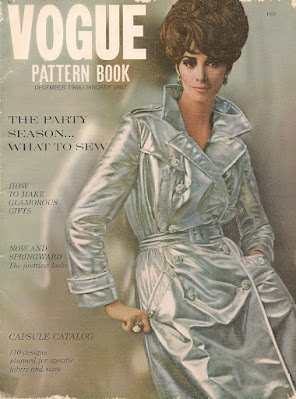
Vogue Pattern Book, December 1966-January 1967

 With an early winter snapping on the heels of an Australian summer that never quite was, I think it's time to look at coats—like this dazzling specimen below.

Vogue pattern 6970 is for an evening coat in "shimmering silver... with classic trench coat lineage".  It's made up in nylon with a Thermolam underlining.  Very sixties... and dig the model's funky beehive hairdo!

Friday, March 19, 2021

"What To Wear To Work" (Vogue Patterns, Early Spring 1985)

 There was no way I was going to get out of the 1980s without a post about a suit.  It was, after all, the era of the power suit.

This version, designed Joseph Picone, is a classic which could almost be worn today.  I could have picked a more exaggeratedly eighties example, but in the end I went with this one because... the model was wearing a Walkman.  For those not old enough to remember, Walkman was the first personal audio device, the ancestor of today's portable media players.  First released in the West earlier in the decade, the Walkman became a quintessential 1980s accessory (and had a star turn in 1985  in Back to the Future!)