Showing posts with label fabrics. Show all posts

Monday, November 3, 2025

Styles of '65: Stretch Pants (National Bellas Hess, Spring-Summer 1965)

 In the 1960s, the fashionable look was slim, sleek and figure hugging.  It was also active, so the problem became combining a tight fit with clothes that moved.  Enter stretch pants, made possible by postwar developments in man-made fibres.

H.  VERTICAL STRETCH tapered leg cotton-nylon pants; stirrups, side zip.
J. DACRON-COTTON stretch pants fit the way you want them with never a wrinkle showing!  Vertical stretch Dacron polyester-cotton knits—laminated to acetate , keeps shape.  Band waist, side zipper, foot straps.
K. STRETCH DOESKIN... creamy-soft matte knit of acetate-nylon bonded to acetate... gives such s-m-o-o-t-h fit!  Food straps, side zipper.  Hand washable.
L.  CHECK STRETCH.  Action ready cotton-nylon pants in swinging checks.  Stretch horizontally.  Tapered, side zip.
M. STRETCH DENIM.  Look, gals... something new's been added to pet pants... a fashiony button front!  Denim weave cotton and nylon, designed to stretch in width only.  Plenty of action-room... but they keep that tapered sleek fit you're looking for!
N. STRETCH JUMP-ALL for smoothest, curviest shaping!  Cotton-nylon jump-all stretches up, down.  Back zip, tapered, stirrups.

Most of these stretch pants are made of cotton blended with synthetics (the cotton presumably to let the garments breathe, while the synthetics provided the s-t-r-e-t-c-h.)  Nylon appears to be the most popular material, with polyester and acetate coming a distant second.

You'll also note that the designers have borrowed from ski and active sportswear: foot straps and stirrups to anchor the pants down.

Monday, September 30, 2024

What We Wore in '74: Polyester Double Knits (JCPenney, Spring and Summer 1974)

 Mostly it's the styles that define an era, but sometimes the material they're made of is just as important.  What muslin was to the Regency and "art silk" to the 1920s, polyester double-knit was to the 1970s.  It was stretchy and easy-care—hence it's popularity—but it was also sticky and smelly, unbreathable and uncomfortable.  It went out of fashion after a few years, but meanwhile the shops and mail-order catalogues were filled with a dazzling array of polyester garments.  Like, for example, this selection from JCPenney.


At left: Tailored shirt-style body suit (in polyester double-knit), long sleeveless vest (in polyester double knit), knitted check pants (in polyester double-knit).  Centre: Short sleeve tunic top in polyester double knit.  Kick-pleated pants in polyester double-knit.  Right: Tunic top in 2 sleeves length in polyester double-knit.  Knitted pattern pants, in polyester double-knit.

Monday, September 9, 2024

Lady's Coat, Lady's Frock... (Everylady's Journal, September 1926)

 ... Child's Frock (4 years)

These patterns demonstrate how women's clothes had been simplified by the middle of the 1920s.  The "lady's frock" (illustrated under the coat at left, and on its own at right) was made up of only three pattern pieces; the front and the back of the bodice and the skirt.

Friday, June 16, 2023

Video: From Shoddy to Superfine

I'm trying something new this post, and linking to a video!


This talk was given on the 15th of June at the National Library of Australia: "From shoddy to superfine: a material history of Australian wool with Dr Lorinda Cramer".   She held one of National Library's Fellowships in 2023, and is discussing the results of her research into the use of Australian wool in fashion.  It's a fascinating topic, and she has some great slides to go with it!

Sunday, January 29, 2023

On the Beach in Orlon (1966)

 If you browse through any fashion magazine from the 1960s and 1970s, you will find full-page advertisements from the manufacturers of synthetic fabrics.  Unless you look closely, however, you won't notice the fashion labels that are printed in a smaller font down the bottom of the page.  It would appear that the big corporations and the smaller dress manufacturers had struck a deal: the big corporations would use their big advertising budgets on full-page glossy ads, and for a share of the publicity the small dressmakers would provide the clothes that would turn the pictures into exciting fashion shoots.

This particular campaign—which ran full eight pages in Vanity Fair—was shot on the beaches of Guadeloupe.  Clearly money wasn't much of an object when DuPont could send models and photographers to the Caribbean so they could advertise Orlon!

Here we have a beach cover-up (in the form of a "banner-striped vestee") by Ashpool and Twiddy

 A "shirtwaister" from Brilkie—in Orlon, of course!

"BairnsWear" provides this dress in "queen-sized check".

Tootal provided the shift dress above.


A dress by Charles Creed.  Creed, originally a London couturier, closed his fashion house in 1966 to concentrate on running a wholesale business specialising in knitwear.


Another sleeveless shift dress, this time by Lavinia.

A dress in "Raschel knit".  Style D.525/Q by Dobett.


And lastly, a casual dress from Shar-Cleod, another firm specialising in knitwear.

Friday, April 22, 2022

Sixties Spy Silliness ("Rondelle" Jersey, 1965)

 Spies were everywhere in pop culture in the 1960s.  They were in books, they were in movies, they were movies adapted from books, they were in movies parodying the movies adapted from books, and they were on TV.   Even comic books and advertisers got into the act.

From the height of the spy craze comes this advertising layout, promoting the wonders of "Rondelle" jersey, and some of the ready-to-wear fashions that were made with it.  Rondelle was a fabric combining Dicel (acetate) with nylon, manufactured by Courtaulds Limited.


A reasonable amount of flair and imagination went into creating this spread, so it's worth taking a closer look at these pictures and the advertising copy that accompanied them!


Training to be a spy meant that I had to learn to defend myself.  I learn quickly.  Now I can throw a sixteen stone man without ruffling my hair or my Rembrandt two-piece, style 386.  It's available in black with either gold or silver stripes, sizes 12-16 and costs 9 gns. approx.

The fastest gun west of the Iron Curtain.  I have to do three hours target practice every day.  And I have to learn to carry a gun without spoiling the line of my dress—a Rembrandt, style 390.  It comes in either black and gold or black ad silver.  Sizes 12-18 and costs 9 gns. approx.

The art of shaking a tail is being able to alter your appearance—fast.  Business-like glasses, different hair, another dress—my own mother wouldn't recognise me in my ice blue Susan Small knitted dress, style W388X.  Made in Rondelle jersey it is also available in emerald or fawn in sizes 10-16.  Costs 6½ gns.

Part of the art of persuading P.M.'s to part with state secrets is this dress.  A Charles Creed creation, style D738, patterned in bronze (it comes in peacock or midnight, too).  In sizes 12-16 and costs about 6 gns.  The rest is technique—and natural talent!

I've just climbed a ten-foot wall, then up a creeper and in through this third-storey window.  I look as if I came by lift—a spy can't allow her clothes to tell tales!  Ideal for assassinations is this 'Mandarin' dress by Charles Creed.  It comes in bronze, peacock or midnight.  Sizes 10-16 and costs about 6 gns.

Opening a safe without a key is childs play, if you're quiet and careful.  And I've always wanted to take up photography!  Perfectly suited to slipping away with the blue-prints is my Bairnswear, style 2012, two-piece in black flecked with turquoise—though I could have bought it in tan or green as well.  Sizes 38", 40" and 42" and costs £8.19.6.  Size 44" costs a little more—£9.9.0.

The said it was important to get on really well with your opposite number.  This lesson was fun, though the rendezvous was strictly business.  On assignment: a dress in peacock and emerald by Walker Reid (it comes in bronze and red, too), made in Rondelle jersey, style D984.  Price about £6.15.0.  Available in hip sizes 36"-40".
So there you go—lessons in how to be a (well-dressed) spy!  Of course it went without saying that the creators of this advertisement hoped people might buy some of the clothes they mentioned as well!

Saturday, January 22, 2022

Man-Made Fibres V: 'Ban-Lon' and 'Helanca' (Vanity Fair, May 1962)

 Picking up where we left off a couple of months ago, we come to the fibres trademarked under the names Ban-Lon and Helanca.

Ban-Lon, 1962

"'Ban-Lon' and 'Helanca' are both stretch yarns made from specially processed Nylon which becomes soft and bulky.

"They can be used on their own but they also blend very well with wool and other fibres.

"Used for stretch pants, socks, underwear, swimwear, jersey fabrics and knitwear.  Have all the easy-care quality plus super-fit."

Friday, November 12, 2021

"Serviceable Raincoats" (Philipsborn catalog, Fall-Winter 1909-10)


It's raining all down the East coast of Australia, and I've spent the last few days staring out the window waiting for it to stop.  Meanwhile, my mind has turned to raincoats, so here is a selection from 1909.

Though they are cut on fashionable lines, they are slightly less ornamented and more, well, serviceable than ordinary coats of the era.  They are made of "rubberized" materials (from left to right, rubberized mohair, rubberized taffeta, rubberized silk bengaline, Watercress silk moire and rubberized grosgrain moire).  Rubberisation was a method of waterproofing fabrics by coating them with rubber.  First developed by a Scotsman, Charles Macintosh, in 1823, the earliest "macintoshes" were heavy and smelly (reeking of a combination of trapped perspiration and rubber).  They went in and out of fashion quickly—only to regain favour as technical advances made rubberised material lighter and less odorous.

The first raincoats for women were produced in the 1870s, around the time when the kind of women who could afford them were starting to live more active lives.  From the beginning they were designed along simplified but fashionable lines—like the examples above.

Saturday, November 6, 2021

Man Made Fibres IV: Acrylic Fibres (Vanity Fair, May 1962)

 Real Life (TM) made it impossible for me to update this blog for a couple of weeks, but now I'm back and ready to bring you the next in our "Man Made Fibres" series—Acrylic.

Courtelle, 1962

 '
Acrylic Fibres.  Courtelle  is British.  Acrilan is of American origin, but is now made in Ireland.  Orlon is America, Leacril is Italian.'

Courtelle, 1962

 'The Acrylics make very good partners to wool because they look and feel like wool but add extra  qualities such as easy washing, shape retention, crease resistance and quick drying.  They also pleat durably.'

Courtelle, 1962

 
'You find the Acrylic fibres mainly in knitwear, either mixed with wool or in 100% qualities.  They are soft to the touch and do not shrink.  They can be either shaggy or so fine that they feel like silk.   They are lovely in jersey.  Acrilan also blends with wool to make tweeds and suitings which have a soft handle combined with all the easy-care qualities.  Acrilan carpets are long wearing and stain resistant.'

Courtelle, 1962


Tuesday, October 12, 2021

Man Made Fibres III: Crimplene (Vanity Fair, May 1962)

 Now for the latest in our series from Vanity Fair about "Man Made Fibres".  This time it's Crimpline!  It was launched in 1959 and (judging by the advertisements in my collection) was still comparatively rare in 1962.  It seems to have been most popular from the mid-sixties through to the early seventies when it was gradually replaced by newer polyester fibres.

Ladies Pride in "Crimplene" 1962

"'Crimplene'.  A Terylene yarn processed specially for knitting.
'Crimplene' is a synthetic yarn with high bulk and low stretch suitable for knitting.
You find it in jersey garments, knitted sweaters and cardigans, and knitting yarns.  It launders easily and never loses its shape."

Saturday, September 11, 2021

Man Made Fibres II: Terylene (Vanity Fair, May 1962)

 Continuing our series on synthetics we come to Terylene.  Terylene is a type of polyester.

Terylene, 1962

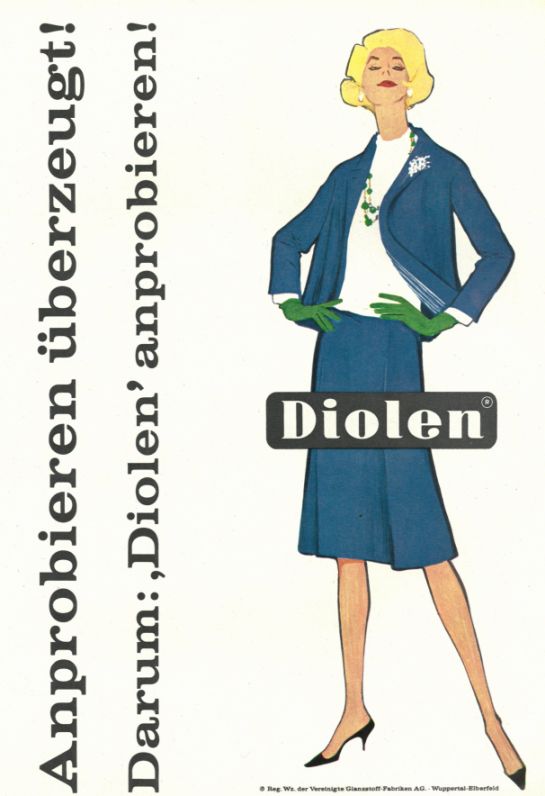
"'Terylene'.  Another pure synthetic yarn made from chemicals.  It is a British invention but is made under licence in other countries and by different names.  You may occasionally see it in imported goods such as Dacron (American), Diolen (German), Trevira (German), Tergal (French), Tertial (Italian)."

Diolen, 1962

"'Terylene' has several tremendously important qualities.  It pleats durably, it has complete stability, which means that garments made from it do not "seat" or stretch.  It is very hard wearing, washes easily. dries quickly and dyes well.  It is, of course, crease resistant."

Terylene, 1962

"'Terylene' is one of the best fibres for mixing and blending with other yarns.  It has an excellent partner in wool worsted and this is where you knew it first in durably pleated skirts and slacks that kept their creases.  Now it is helping to make linen more practical, to give cotton lawns an easy-care quality and you also meet it in many pure forms such as the new and versatile 'Terylene' lawn, net curtains, etc."

(Growing up in the 1970s I only ever heard Terylene mentioned in the context of curtains.  Since the decade was awash in polyesters, I can only conclude that newer brands had overtaken it as a fashionable fabric.  The latest advertisement for Terylene in my collection is dated 1966!)

Saturday, August 28, 2021

"Man-Made Fibres" I : Nylon. (Vanity Fair, May 1962)

The postwar years were the golden years of synthetic fibres: their "easy care" properties were considered little short of miraculous and there seemed to be new ones on the market every year.  If you flick through any fashion magazines or catalogues from around the years 1955 to 1975 you'll find hundreds of references to them, often going under confusingly different brand names.

Luckily for us, the fashionistas of the time were equally confused, which is why Vanity Fair published a quick guide to "Man-Made Fibres" in May 1962.  I'm going to take the fabrics one at a time, starting with Nylon.

Bri-Nylon, 1962

'Nylon.  This is a pure synthetic fibre made from chemicals.  You find it under the British names of Bri-Nylon, Bri-Lon and, imported goods under various names such as Perlon (German goods), Lilion (Italian), Nylsuisse (Switzerland) and others.

'Nylon yarns were the first pure synthetics that we ever knew.  It was the first yarn to give us easy-care qualities in washing and ironing and the first yarn to make us understand what long wear really means.  It will not shrink or stretch.  Avoid washing in boiling water.

'Mainly in stockings and warp-knitted lingerie.  In both these sections it dominates the market.  You also find Nylon in dress nets, lace, quick-dry sweaters, jersey fabrics, swimsuits, bras and girdles, party dress materials, sheets and as a strengthening reinforcement in many other items such as socks, woollen fabrics and carpets.'

Bri-Nylon, 1962

Kayser, 1962

Bri-Nylon, 1962

Bri-Nylon, 1962


Sunday, December 13, 2020

"Feel The Quality - Fabrics Casual Through to Formal" (David Jones, 1964)

 While browsing David Jones' catalogue from Spring-Summer 1964 I discovered that the store had pasted tiny fabric samples into its dressmaking materials pages—and that most of them still remained!  Sadly, I can't invite my readers to "feel the quality" of the samples with me, but I can scan them so you can appreciated the colours and weaves of these textiles.  

So without further ado, I present to you the hottest fabrics of 1964!


EVERGLAZE FINISH
2C5: Textured cotton
is firmly-woven, mini-care, makes lasting kiddies clothes, pretty dresses.  White, pink, hot pink, aqua, orange, tangerine, chartreus, lemon, turquoise blue.  


COTTON TWEED
2C7: Fashion right—ideal for making smart summer suits and separates.  Cool and wonderfully washable, such a new look.  In apricot, orange, rose pink, light blue, turquoise, aqua.


COTTON SHANTUNG
2C8: Satin-backed and drapes easily.  Light, cool, washable and crease-resisting.  White, pink, blue, beige, taupe, apricot, mauve, lemon, lettuce, turquoise, aqua, orange, tangerine.


TETRON BATISTE
113C5: Economical 45” width in this fabric that is also easy to permanently pleat.  Pretty and cool, drip-dry.  Floral patern in white on blue, aqua, pink, lemon, green.


TETRON TAFFETA
113C6: Suited to summer
, it's so easy to care for, a delight to wear.  Will permanently pleat, more width at 44".  All over design in white on mauve, blue, pink, gold.


RAYON BROCADE
113C11: For those special occasions.  Easy to handle at only at D.J’s.  White ground with raised design in pink, gold, aqua, mauve.


TEXTURED SUITING
113C15: ‘Tootal’ rayon—so many uses, such wonderful value.  White, black, apple green, bone, pink, aqua, navy, yellow, brown.


PRINTED FIBRAINE
113C16: Open weave rayon is a dream to look after, makes up so well.  Muted all-over pattern in pink, golden brown, aqua, green.


PLAIN FIBRAINE
113C17: New interesting weave
in quality rayon for shifts, suits.  Lavender, pale blue, hot pink, bone, olive, turquoise, lime, citrus.