Showing posts with label 1930s. Show all posts

Monday, May 18, 2026

"What the Parisienne is Wearing" (Woman's Journal, May 1939)

 I'm going to have one last fling with the frivolities of Haute Couture, before I settle down to the years of austerity, rationing and "make do and mend".  And it seems that the designers of 1939 were also having a last fling in the shadow of war.  Moma Clarke wrote in the May issue of Woman's Journal:

All the Paris dressmakers have "gone" womanly in the most feminine sense of the word... Schiaparelli announces that "women are ladies again".  One dares not reflect on the interim.  Better not...

It's one of the minor what-ifs of history: if there had been no Second World War, would fashion have given us a "New Look" a decade earlier than it did?

On to the designers—and we have some familiar names at this point.


Summer fashion plans have turned topsey-turvey. Instead of a plain suit with a figured blouse it is the other way about, and a gaily flowered tailor-made is the order of the going.  Jean Patou makes this delectable suit of brown and white figured crêpe with a white crêpe blouse, and the blue flowered ensemble of glazed cotton with a white piqué waistcoat.  Never have pastel shades been so loved.  A dress and coat matching in a pastel coloured crêpe is as chic as anything can be—especially when trimmed with scalloping, as in this lovely pastel blue dress and coat by Patou.

Patou died in 1936, but the house he founded lived on.  I have no information on who actually designed these dresses. 

Monday, May 11, 2026

New Fashions For You and Your Home (Singer, Fall-Winter 1938)

 Shown below is part of Vogue Pattern No. 8129, an evening dress "with a redingote over an independent slip-dress".  This is clearly the "slip dress"part of the design.  A small illustration of the "redingote", made up in lace, is inside the magazine.

Back in my very first post for this year I mentioned the introduction of the first backless evening dresses during World War I.  In they 1930s they were almost de rigueur in formal evening gowns, though they could be covered up by garments like the redingote included with this pattern.


All in all, there seems to have been quite a variety in evening fashions in 1938!  The Australian Home Journal reports:
In the evening we see princess dresses with drapings that stress the wearer's slenderness; further, there come dresses which cling till the knees and then start into greater width; some skirts are slit and somewhat cut away in front, trailing at the back in a line, and there are also reminiscences of the Empire, the Directoire and the 1889 style.
Australian Home Journal, May 1938

Monday, May 4, 2026

Hats For Summer (Le Petit Echo de la Mode, 13 juin 1937)

What smart outfit doesn't need a hat to complete it?

A few posts ago I showed you a typical hat from the beginning of the decade: close fitting and brimless.  These hats from 1937 seem to have gone to the opposite extreme, with wide brims and very shallow crowns.  (The crowns are so shallow that the artist depicting these hats makes it look as if the models have had the tops of their heads sliced off!)

The hats are worn tilted over one eye, and as we can see from the right-hand figure, held on by a band passing around the back of the head.


POUR L'ÉTÉ

Grande CAPELINE de paille fine, avec calotte basse ceinturée d'un ruban.  Bouquet de petite fleurs multicolores.

CANOTIER avec cache-peigne en fleurs de velours.  Voiletts posée un arrière.

[FOR SUMMER

Large straw hat with a low crown tied with a ribbon. Bouquet of small multicolored flowers.

Boater hat with a velvet floral comb cover. Veil draped at the back.]

Straw was the most popular material for summer hats, with felt being more commonly worn in winter.


Monday, April 27, 2026

Woman's Journal, March 1936

 In 1936, Woman's Journal introduced their Model Pattern Service.  The magazine boasted that 

Every design is now made up in fabric by an expert cutter and fitted on a living mannequin... Only when it is perfect in every detail is it made into a paper pattern...

 Of course this would be reflected in the price of the patterns! 


A TRIO FOR AFTERNOON

Finely pleated and stitched part of the way, are the front and back panels of the slate blue dress.  It has touches of white at the neck, slit front and belt.  The rust-red crêpe dress has unusual shaped inlets in the Raglan sleeves, outlined with black silk braid, while a waist length jabot, mongrammed and buttoned, gives a touch of distinction to the grass-green woollen dress.

Monday, April 20, 2026

Australian Home Journal, April 1935

 Here we have reached the mid-point of the 1930s.  It's worth stopping here to look back at how the fashions of the decade developed, and forward to see how they're progressing.

In 1930, fashions were ladylike and—dare I say it?—a little bit droopy, with skirts falling softly in godets from a yoke beneath the hips.  A couple of years later, and fashions start to get intensely feminine, with frills and ruffles decorating the necklines and shoulders of women's garments.  In 1935 we can see the start of a shift in styles, with skirts becoming straight and shoulders squared.  Frills haven't been entirely abandoned, but they have been moderated.  Eventually this silhouette would evolve into the square "military" look prevalent in World War II.


The Australian Home Journal, as usual, noticed these changes and communicated them to its readers:
Fashion's Dress Decrees
Figures are to be rather more statuesque, waists a little larger, less fussiness about the neck and shoulders and not so many detachable parts...
The Slim Sihouette
The line remains slim, long and simple, occasionally accentuating the bust with trimmings...

 More detailed and specific suggestions were made for different types of garment.

In Brief
Dark blouses worn with lighter coloured skirts are again shown in the season to come...
Fashion Pointers
Buttons of wood or metal are as fashionable as those covered with material...
A New Suit
You can make your last year's brown tweed suit into a perfectly new and up-to-date morning and country outfit if you add to it a bright green velveteen shirt-blouse with wide cuffs that go outside your coat.

However, in 1935, Hollywood was not only enjoying its Golden Age, but had become a major (if not THE major) source of fashion information for the general public.  Women wanted to know what the stars were wearing, both on and off the screen.  Australian Home Journal was willing to oblige.

Furs Too
Furs dyed to match your gown is one of the new fancies of designers, and Myrna Loy introduced one of the first ensembles of this type.
Her royal blue dinner gown, worn at at recent function, was trimmed with a large cape of royal blue fox.
Joan's Novelty Bag
An evening bag, eighteen inches long and twelve inches wide, has been designed for Joan Crawford's use in her new M-G-M starring production, "Forsaking All Others."
The bag is fashioned of black velvet.  It is an envelope style and features two three-inch cuffs of white pique on either side...
Mauve for the New Season
Most conspicuous amongst Hollywood's winter fashions is the choice of mauve material...  Appealing particularly, is a gown worn by Sylvia Sidney, star of Paramount's "Behold My Wife."  It is a dinner ensemble of wool and metal cloth.  The skirt is the new shade of violet or mauve with a decided bluish cast.  The top of the dress is of the same hue in metal cloth.  Huge epaulettes of beaver, dyed to the same tone, trim the little jacket.

This last is interesting, because Miss Sidney's gown would most certainly have been shown in black and white on the silver screen!  Some Hollywood publicist must have decided that women would be really interested in the details of colour and fabrics for this dress.

Monday, April 13, 2026

"Special Lingerie Issue" (Roma's Pictorial Fashions, March 1934)

 Sometimes I have to search for the material I post on this blog, sometimes I just stumble across it, and sometimes it comes as a gift!  With that, I want to thank the friend who gave me a big bundle of 1930s dressmaking magazines.  The magazine below is the first in the collection to be blogged, with many more to come.

Roma's calls this a "Special Lingerie Issue", and it does have several pages devoted to lingerie patterns... but it also dedicates a few pages in its colour spread to bridal fashions.  The lingerie is presented as part of the bride's trousseau, though I'm sure that many a non-bride tried making up the patterns.


The free patterns available with this issue of Roma's Pictorial Fashions are shown on the left side of the cover.  Working clockwise, they were for a nightdress, a petticoat, a chemise, closed knickers (at the botton of the cover), open knickers and a bra.  The pattern for the robe on the right was not included with the free patterns, but could be bought for the bargain price of ninepence.

Strangely, lingerie wasn't discussed in the magazine, but the editors do offer some advice on fashion in general.  It seems that in 1934 accessories and trimmings were the main points of interest:

Fashion is very quiet about its tube-like silhouette, but it is very talkative about accessories.  It is the way you trim your frock, the way you set on your scarf or your hat, that makes you a chic woman these days.

As to hats—they seem to change over-night!  A little difficult the new hats, one must admit, but veils come to the rescue.  The new small cap is a gay affair that is a cross between a soldier's forage cap and a revolutionary bonnet.  It just perches on the side of your well-set coiffure, while attached to it, and shooting out all round like a modern halo, is one of the new stiff horsehair veils of the same colour...

Scarves!  The idea of the moment is to have a quite plain, sleek little woollen frock, and at the high, round neck to put three or four tabs, one on either shoulder, one in front, one at the back—north, south, east and west!  Through these you slot your scarf—in as many different ways as there are days of the week...

When you are choosing any new dress or suit of the tailored or sports variety, do not forget to plan for lots of buttons and as many pockets as you can carry.  These are the right trimmings...

Once again, this ties into the theme of economising in hard times. It was obviously much cheaper to ring the changes with one dress and multiple scarves than to maintain an extensive wardrobe! 

Tuesday, April 7, 2026

"Woolly Jumpers" (Bestway no. 442, 1933)

 "Knitted jumpers are once again at the height of fashion," begins the introduction to Woolly Jumpers

"but with what a difference from the loose, shapeless models that were previously in vogue!  The newest and smartest models fit every bit as perfectly as garments made from cloth, and they are knitted in an endless variety of dainty and attractive stitches, forming the most original designs and patternings."

Legend has it, that home-knitting became a popular hobby after World War I, as women who spent the war "knitting socks for soldiers" sought a new use for their needles.  Over the course of the 1920s, knitted garments changed from being mainly sportswear to becoming fashionable daywear.  These woolly jumpers from Bestway fit the fashionable lines of the 1930s perfectly, skimming the figure but not squeezing or constraining it.

Since my last few posts touched on the need for economy in hard times, I should comment that knitting books like this one enabled skilled knitters to achieve a stylish look at a low cost!


The jumpers depicted on the cover are described, going clockwise from the top left:
A TRIUMPH IN KNITTING
A PERFECT LITTLE JUMPER WHICH SHOWS THE HEIGHTS THAT HAVE BEEN ATTAINED IN MODERN KNITTING, BOTH IN SHAPING AND IN PATTERN WEAVING
A JUMPER AND CAP TO MATCH
Very slimming and particularly smart is the effect of the stripes in this simple waisted jumper.  The pattern is knitted in herringbone fashion with points arranged at the centre back and front and on the top surface of the sleeves.  The jumper is most attractively worked in a three-colour scheme, three shades of the same tone being blended in the stripes.
SMART AND SO PRACTICAL
A JUMPER FOR EVERYDAY WEAR IN A LIGHT OPEN STITCH WITH A STRIPING TO MATCH THE NOVEL JABOT AT THE NECKLINE

Monday, March 30, 2026

"Modèle de Jean Patou" (Modes & Travaux, Avril 1932)

 From mass produced fashion to haute couture... Up to the mid-1950s, Modes et Travaux always featured a model from one of the great Paris designers on its cover.  In April 1932 this was a dress and jacket ensemble by Jean Patou.  Unfortunately, Modes et Travaux didn't provide any information about the outfit, so I am unable to determine what it was made of and where and when it was supposed to be worn.

Vogue did give us some details about Patou's Spring 1932 collection, from which I summarise: high waists, a liberal use of blue and elaborate belts (all of which can be seen here).


Modes et Travaux did dedicate several pages to giving an overview of the Spring collections (though it didn't single out any particular designers).

Monday, March 23, 2026

Chicago Mail Order, Fall and Winter 1931-32

 The social historian in me can't help noticing that nearly half (if not more) of the garments listed in this catalogue are advertised as reduced in price compared to the same or equivalent garments in the previous winter catalogue.  The slump was clearly starting to bite retailers as consumers cut back on spending.

The page below shows a selection of mass produced but stylish coats.    The big fur collars rising above the backs of their wearers' necks were particularly fashionable in the 1930s.  These examples, however, are either made from cheap furs, dyed to look more expensive, or "fur cloth" of various types.  


Regal Two-Tone Collar
A.  ... Fur effect "Queen Anne" and cuffs in stunning two-tone combination trim this stunning coat of Velotone About Two-thirds Wool, a lovely suede finished fabric...
Of Fashion-Favored Snowflake Crepe
B. ... A wealth of style and beauty at little cost!  A beautiful Wool-and-silk "Snowflake" Crepe, a warm spongy fabric.  Soft, fluffy Badger-Dyed Mountain Lamb Fur used generously to form two-way collar and smart cuffs.
With Overcuffs and Plastron Collar
C. ... Enormous value!  Gorgeous new collar and cuffs of lustrous fur-effect fabric resembling Baronduki fur.  Of warm Tricot Velotone.  About Two-thirds Wool with the fashionable suggestion of a ribbed weave.
Tabbed Plastron Collar
D. ... Supreme in style and value!  Beautiful warm dressy coat of a new All Wool pebbly-textured spongy Monotone Crepe that is in for a big year.  Gorgeous plastron collar of Larkin Lamb Fur dyed to resemble beaver with an extra "tab"!
"La Mode Modern"
E. ... A reproduction of a Parisian model!  Of All Wool warm Pebbly Monotone Crepe, one of the season's loveliest fabrics.  Fur effect fabric resembling Broadtail forms Tuxedo collar...
Novel Trim
F. ... Stunningly chic, its brim rising to "heights of beauty".  A snug-fitting "dressy" creation of smooth Luxurio Quality Wool Felt, edged with grosgrain ribbons...

As a bonus, there is a hat advertised at the bottom of this page!  It's typical of the early 1930s, fitting close to the head like the cloche hats of the 1920s, but no longer pulled down over the wearer's forehead.  It's also noticeably asymmetrical, a trait which would remain popular in very different styles of headgear throughout the decade.

Monday, March 16, 2026

"For Christmas 1930" (Weldon's Ladies' Journal, Christmas and New Year 1930 & 1931)

A year on from my last post, and my how the fashions have changed!  Fashion changes between 1920 and 1970 could best be summed up as "hemlines and waistlines" and both changed dramatically between 1929 and 1930.

The centre spread of this issue of Weldon's Ladies Journal depicts a wonderful selection of styles from 1930, both for day ("In the daytime—neatness in style and material—bright colours—demure little folded collars—fresh and crisp, white and gay") and for night ("Romantic evening frocks—clinging lines—subtle velvets—gleaming satins, thistledown chiffons, georgettes and nets").


83660
HERE is a new idea—a jacket suit of black marocain lined with chiffon.  The frilly collar and cuffs are soft and becoming.
831942
CHIFFON or printed rayon georgette in yellow and black would suit this new blouse which has a handkerchief collar.
836443
IDEAL for the red or fair-haired girl is this brown crêpe de chine frock, made on crossover lines tying unexpectedly at the right side.
836573
A GOOD idea for your Christmas dance frock, in turquoise blue Courgette.  The bolero, draped hips and floppy bows are becoming.
836553
THIS graceful white satin evening frock, made on classical lines, needs no trimming other than some well-chose jewellry.
836563
SHORT black or brightly coloured capes are worn with evening frocks.  This one is of black velveteen with white fur and lining.
836583
DEEP-SEA-BLUE satin combined with deep-sea-blue net makes this very lovely evening gown.
836593
WHY not try the Grecian style for a change?  This gown carried out in bright yellow georgette, is enhanced by its belt and drapery.
836613
A DRESS in which to pay your "Merry Xmas" calls.  It is of a festive green jersey with white georgette collar and jabot.
836623
RED wool crêpe for this frock with the folded collar and ends of white georgette.  The skirt has a novel shaped hip-yoke.

Fashionable clothing had suddenly grown more mature.  One of Vogue's less youthful correspondents had this to say about the changes in style:

Débutantes might be wearing similar clothes, but I was no longer competing with them.  Such a costume actually demanded that I walk more slowly to be in rhythm with the swing of the long, flaring coat, instead of with tired legs in beige coloured hose, tripping the measure of knee-length flapper skirts.  I could sit down with no thought of dragging my short skirt desperately and ineffectually over my knees every few seconds or else letting it go at that and appearing undressed and ridiculous.

"The Fashionable Forties" by Grace Hegger Lewis, Vogue, 8 December 1930

Vogue wrote for a well-to-do readership, of course.  I sometimes wonder how less prosperous women managed these extreme fashion changes at what was the beginning of the Depression.  Did they try to remodel their old "flapper" dresses?  Was there a desperate outburst of home dressmaking as women tried to replace their entire wardrobe economically?  Were their flapper dresses relegated to home wear as they tried to keep up with the Joneses in public?  Of course the really poor in the Depression weren't worried about keeping up with the fashions.  Having enough clothes to stay warm and decent would probably be all that they could hope for.

Monday, November 10, 2025

"April's Lady in Paris" (Woman's Journal, April 1939)

 Let's take another look at high fashion in the days leading up to the Second World War.

We shall be seeing many stripes this season —worked straight, slantwise or as you will.  Anny Blatt, who makes these fascinating knitted models, has caught the fever with charming results.  There is the neat tailormade in red and black stripes for the daring and debonair, and a delightfully youthful dress in stripes of grey, cornflower blue and wine red, simulating pleats at the hem.  The almond green rib knitted suit has a graceful hip-length cape which doubles its advantages.

Monday, September 15, 2025

"In France, Poise Counts" (Woman's Journal, January 1939)

 "It is with a sigh of real gratitude I register the passing of ugly hats", opines Moma Clarke in the January 1939 issue of Woman's Journal.

The danger of the hour lies in the short, tight skirt.  If a girl has legs too sturdy and hips at all broad, a very short, tight skirt can be unsightly.  A good many flared skirts are worn and as many pleated ones. Coloured dresses look cheerful at a tea or bridge party, high necks persist, and long, tight sleeves are worn more than any others.  They give a nice slender line to the figure and admit of a good splash of brightness in a bracelet at the wrist...

As discipline is the mot d'ordre of the day for all of us, I make no excuse for bringing it to the fore in such things as dress and fashion.  You simply cannot be well dressed if you are not disciplined...

Little did she know just how much discipline would be required in the near future, and how little fashion would count in the great scheme of things!

But back to 1939.

Alix, better known for her postwar label of "Madame Grès" was once described as a "columnar" designer, who used pleats and draping to create vertical effects reminiscent of Ancient Greece.  Here she is in a more conventional mode, but still using pleats to create a slender effect.


A skirt which sways like a willow in the wind is Alix's tribute to grace, and so she puts her fullness in the front of her skirts to make them swing gently in movement.  This grey duvetyn model is perfect in its simplicity and slim line.  The ideal background-to-accessories dress.  The rust coloured woollen frock has a skirt as straight at the back as the front is full, a kindergarten bib, and a Scotch belt—delightful mixture!  More tartan comes in the unusual full gathered blouse, which goes beneath a black suit, and has its basque front pulled through a slot in the jacket.

Monday, July 7, 2025

"French Fashions Reflect Events" (Woman's Journal, December 1938)

With war clouds gathering, there were plenty of "events" to "reflect" in late 1938.  However, the writers of a fashion column in a women's magazine weren't really interested in reflecting on them (in their Christmas issue, no less!)  Instead, they wrote about the latest designs from the great Paris fashion houses—including the fashions illustrated below.

The dress and coat that will lunch you charmingly in town then transport you to the country—still looking in the picture—are a difficult couple to find.  Molyneux's ensembles have just the right touch of perfect simplicity.  There is this pleated shirt frock of brick woollen, or the purple three-piece of a neat jumper suit beneath an equally neat fitted coat.  Very charming is also the beige jersey dress that shows its pleats under a delightful coat lined with moleskin and complete with hood.

From the mid-1930s to the end of World War II, Molyneux was a London-based designer, with branches in Monte Carlo, Cannes and Biarritz.  He began his fashion career working for Lucile in the years before the First World War.

Monday, June 16, 2025

Australian Home Journal, June 1939

 Unusually, the June 1939 issue of Australian Home Journal included an evening dress among its free patterns:

Evening Frock, 4921
Evening frocks look smart in bouffant effect from the hips, and the bodice moulded to the figure, a la early Victorian models.  Skirt is six-gored and gathered round the waist.


More typically, the magazine contained its usual assortment of fashion tips and tricks.  Reversible coats were coming into vogue:

Hard Wearing Coats
The most important place is presented to the hard-wearing warm coat worn for morning, sports and travelling purposes.  Here one notes the new supple winter tissues with reversible wrongside, held in some contrasting tone or having checked or plaid pattern...

Small waistlines were the latest thing.  If war hadn't intervened, we might have got a "New Look" a full ten years earlier than we did. 

How is Your Waistline?
If it is small, exaggerate it with a full bodice, wide, tight waistband, and an extremely full skirt.  That is the fashion advice of Robert Kalloch, noted Hollywood designer for Columbia studios.

Velvet? Very glamorous, very Hollywood.

Velvet Popular
Go in for velvet in a big way, and if it's black, so much the better.

 And a brief look at the shape(s) of things to come:

 Boleros and Tunics
Practical garments for winter wear!  Among the favourites are simple street dresses, besides suits and ensembles...
Bolero, tunic, jumper and tightly-fitting princess dresses come in many interpretations and are very different in cut, colour, fabrics and finish.

Monday, May 26, 2025

"Paris Plays With The Eternal Feminine" (Woman's Journal, November 1938)

 Now for another look at high fashion in the final months leading up to World War II.

Creed
A year of browns, but all sorts of warm, alive browns, and a year of long coats, and all sorts of outlines in coats.  These three from that great tailor Creed show one fitted, and two straight and concealing.  There is a Magyar cut in the tweed coat on the left with a silk cord fastening twisted round the golden seal collar.  The centre model, in a brown that Paris calls brick, is one of those neat tailored sports coats of which no one tires.  The third model shows the new trim waist and the favourite seal fur on blue and beige tweed.

"Creed"was a French firm founded by an English tailor in the 19th century.  In 1938 most of the fashions produced by Creed were designed by the founder's son Henry and his grandson Charles.  Looking to the future, Charles Creed relocated to London after the fall of France, where he became the the first elected member of the Incorporated Society of London Fashion Designers.

Monday, April 21, 2025

"All-Day Frocks" (Weldon's, 1934?)

 This publication doesn't have a date, but the original owner cut some of the free pattern pieces out of newspapers.  Searching Trove for some of the articles printed on the pattern pieces ("RAILWAY PILFERING.  Forty Bottles of Beer Stolen") I managed to date them to 1934.  This would indicate that Weldon's All-Day Frocks pattern brochure was published no later than 1934 (though it could have been published a year or so earlier!)

6248—Smart Dress with Draped Collar.
6249—Pretty Dress with Puffed Sleeves. 
Two delightful frocks, so easy to make and smart in any of the lovely Ferguson crêpes—such as crêpe Fersyl or Rosemary crêpe, or in Courtauld's satin, etc., either plain or patterned weaves, such as San-Toy.
The editors of this catalogue made a lot of suggestions for brand-name fabrics! I leave it to my readers to decide whether they were paid promotions or not.

Monday, March 17, 2025

"Paris Smiles" (Woman's Journal, July 1938)


Here is the first in a series about high fashion in the months leading up to World War II.  

Recently I got hold of a bundle of issues of Woman's Journal from the late 1930s.  Each issue of this British magazine, marketed to a well-off, middle-class readership, contained several pages of colour fashion illustrations.  Some depicted clothes that you could buy, some that you could sew.  But always a few were dedicated to showing the latest designs from the couturiers of Paris.  
As to styles, they are very youthful.  You can have your skirt for the morning tight and short, or short and pleated, with your coat cut to suit your figure—that is very important.  Some girls look right with a hint of a waist-line, others don't.


Paquin


Woman's Journal described these as: "For romantic evenings when we dine out of doors by the light of the dipping sun."

Adorable dress and bolero in bluebell-coloured shirred chiffon with big hat to match, or full skirted white chiffon with fascinating trimmings of tiny jet sequins.  More loveliness in a dress and jacket of yellow organdie—the yellow of sun-ripened corn.

Madame Paquin founded the House of Paquin with her husband in 1891.  She was known for her "rich, glamorous, romantic" clothes during the Belle Epoque and her "tango dresses" during the 1910s.  However, by 1938 she was no longer in charge of the business having retired in 1920.

Monday, February 24, 2025

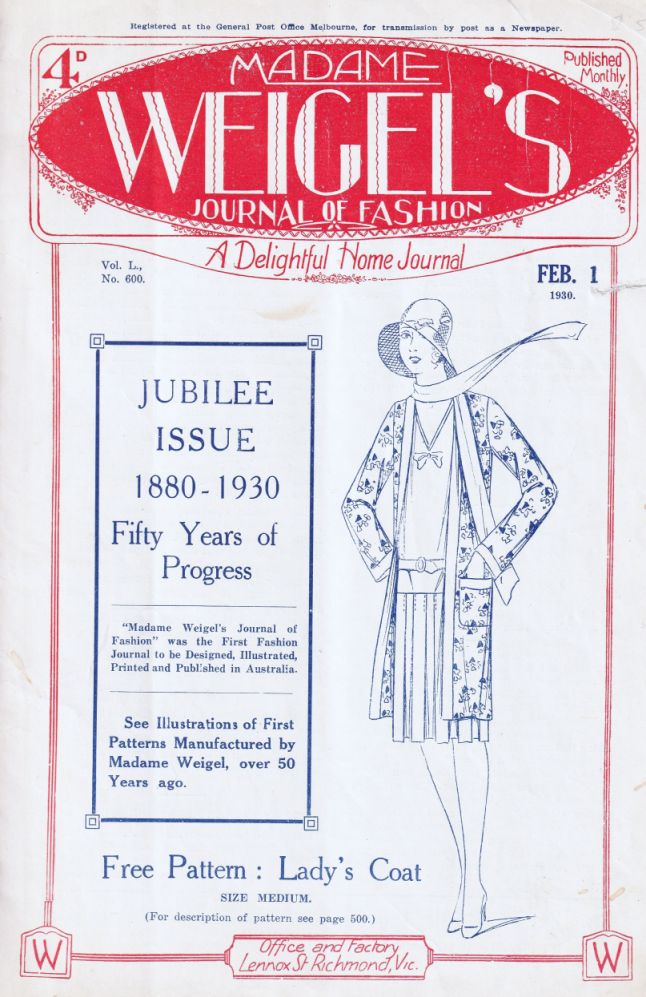
Madame Weigel's Journal of Fashion (February 1930)

 I bought this copy of Madame Weigel's Journal of Fashion at the same time I acquired the copy of Cassell's Family Magazine I wrote about last week.  Madame Weigel's Journal was published to promote Weigel's patterns, and this issue celebrated its 50th anniversary under the proprietorship of Johanna Weigel (yes, there really was a Madame Weigel!)

Inside the magazine are pictures and descriptions of fashionable clothing as worn by middle-class Australian women.  At this stage, only a couple of months into the 1930s, styles looked very much as they belonged in the 1920s.  But change was on the horizon, as noted by Madame Weigel's London correspondent: 

It is really extraordinary to see the way in which fashions have changed since last season.  It is very seldom that such a definite change is made in such a short time, and it is very bad for our purses, although most advantageous for the designers.  But last summer's frocks really can't  be persuaded to do duty again this winter; their whole line is wrong.  All the new frocks fit the figure very closely to the hips, and the waist-line and the hip-line are tightly defined, while below the hip-line the skirt flares out into draperies and panels and flounces.  You have to be thin to wear these dresses successfully, and yet you mustn't be too thin, for there must be a suggestion of curves.

But there's a caveat:

Of course I am only talking about evening frocks and very special afternoon dresses.  For morning and street wear and for sports there is not much change to report; skirts are still short and, for the most part, straight hanging.

"Letter From London by an Australian

Now onto the patterns!


First, the free pattern for a "Lady's Coat" (size medium).

Monday, December 23, 2024

"Romance Returns to the Mode" (McCalls, March 1934)

 Merry Christmas, everyone!  And as we count down the hours to Christmas 2024, let's take a look at the evening fashions of 1934.  As you can see, sophistication was the last word in evening styles—though younger women sometimes chose to wear girlish frills instead.  

Incidentally, the fashion illustrations of the day were even more exaggeratedly distorted than fashion illustrations usually are.  While tall, slender models are favoured in most eras, the legs of these models are so long that you would have to reduce their length by a third to approximate the proportions of an ordinary woman.

No. 7714.  This Véra Boréa will take you to dinner and the dance with a romantically modern demeanor.  The skirt falls smoothly to the floor, outlining the contour of the figure on its way.  The sleeves are fluted; the back cut out appealingly. 
No. 7700.  The neckline swathes the throat discreetly, the sleeves taper subtly to a slim wrist, leaving your audience totally unprepared for the cowl that drops breathlessly in back, the godets that trail into a train.  It's a fashion for gala occasions!

Monday, November 25, 2024

"Your Easter Outfit" (Home Fashions, May 1933)

Who wouldn't want a little something to cheer themselves up in the midst of the Depression?  For women who weren't quite destitute, but had to watch the pennies, Home Fashions offered an opportunity to create this economical spring wardrobe in 1933.  All the patterns described were offered for free in the May issue of their catalogue (though doubtless they hoped that their readers would buy some new patterns from the catalogue too!)

The newest jacket suit, a gay little blouse, a coat-frock, an afternoon dress, and a tennis dress, all made up for under 55/-.

I do not supose there is one of us who hasn't set her heart on having a brand new outfit for Easter.  So I set out this month to show you how you can defy the "depression," and set yourself up with the  most entrancing and comprehensive new outfit for Easter, spending no more than you would on one mediocre ready-made garment!

(I'm going to leave out the editor's suggestions for specific fabrics (which came complete with prices).  The magazine was having a cross-promotion with Ashley Russell Fabrics, whose main store was located in London.)

ABOUT THE DESIGNS
First let me tell you about the designs.  These include a coat-frock in soft, dove-grey woollen with a detachable shoulder-cape and gauntlets in pale yellow—one of the latest colour schemes.  The frock is quite a simple shape, with a four-piece skirt and plainest of bodices, but the skirt is cut with the new corslet waist-line and this, with the fashionable caped shoulders, makes the dress into a little model...
...Next in our outfit is one of the new collarless jacket suits.  We suggest for it soft brown woollen, worn with a gay blouse in brown and white chevron-striped silk, though another colour scheme could be used if brown isn't your particular fancy.  The blouse has the popular scarf neck-line tying in a bow in the approved way.  A slimming, wrap-over shape is the skirt, cut in three pieces and showing a corslet waist-line effect.  The jacket, being collarless and rever-less, is as simple as can be to make, and the blouse is an easy, sleeveless shape, but the chevron stripes give it real chic...
The afternoon frock is made in rose and white printed artificial crêpe de Chine, and shows the new elbow-length puff sleeves.  It achieves the popular broad-shouldered effect very gracefully by means of an added fichu-cum-cape, crossing over front and back alike.  Apart from this and the sleeves, the frock is the same simple shape as the coat-frock...
The final item, the tennis frock, we suggest you copy in spun silk...