Showing posts with label fashion designers. Show all posts

Monday, May 18, 2026

"What the Parisienne is Wearing" (Woman's Journal, May 1939)

 I'm going to have one last fling with the frivolities of Haute Couture, before I settle down to the years of austerity, rationing and "make do and mend".  And it seems that the designers of 1939 were also having a last fling in the shadow of war.  Moma Clarke wrote in the May issue of Woman's Journal:

All the Paris dressmakers have "gone" womanly in the most feminine sense of the word... Schiaparelli announces that "women are ladies again".  One dares not reflect on the interim.  Better not...

It's one of the minor what-ifs of history: if there had been no Second World War, would fashion have given us a "New Look" a decade earlier than it did?

On to the designers—and we have some familiar names at this point.


Summer fashion plans have turned topsey-turvey. Instead of a plain suit with a figured blouse it is the other way about, and a gaily flowered tailor-made is the order of the going.  Jean Patou makes this delectable suit of brown and white figured crêpe with a white crêpe blouse, and the blue flowered ensemble of glazed cotton with a white piqué waistcoat.  Never have pastel shades been so loved.  A dress and coat matching in a pastel coloured crêpe is as chic as anything can be—especially when trimmed with scalloping, as in this lovely pastel blue dress and coat by Patou.

Patou died in 1936, but the house he founded lived on.  I have no information on who actually designed these dresses. 

Monday, March 30, 2026

"Modèle de Jean Patou" (Modes & Travaux, Avril 1932)

 From mass produced fashion to haute couture... Up to the mid-1950s, Modes et Travaux always featured a model from one of the great Paris designers on its cover.  In April 1932 this was a dress and jacket ensemble by Jean Patou.  Unfortunately, Modes et Travaux didn't provide any information about the outfit, so I am unable to determine what it was made of and where and when it was supposed to be worn.

Vogue did give us some details about Patou's Spring 1932 collection, from which I summarise: high waists, a liberal use of blue and elaborate belts (all of which can be seen here).


Modes et Travaux did dedicate several pages to giving an overview of the Spring collections (though it didn't single out any particular designers).

Monday, November 10, 2025

"April's Lady in Paris" (Woman's Journal, April 1939)

 Let's take another look at high fashion in the days leading up to the Second World War.

We shall be seeing many stripes this season —worked straight, slantwise or as you will.  Anny Blatt, who makes these fascinating knitted models, has caught the fever with charming results.  There is the neat tailormade in red and black stripes for the daring and debonair, and a delightfully youthful dress in stripes of grey, cornflower blue and wine red, simulating pleats at the hem.  The almond green rib knitted suit has a graceful hip-length cape which doubles its advantages.

Monday, September 15, 2025

"In France, Poise Counts" (Woman's Journal, January 1939)

 "It is with a sigh of real gratitude I register the passing of ugly hats", opines Moma Clarke in the January 1939 issue of Woman's Journal.

The danger of the hour lies in the short, tight skirt.  If a girl has legs too sturdy and hips at all broad, a very short, tight skirt can be unsightly.  A good many flared skirts are worn and as many pleated ones. Coloured dresses look cheerful at a tea or bridge party, high necks persist, and long, tight sleeves are worn more than any others.  They give a nice slender line to the figure and admit of a good splash of brightness in a bracelet at the wrist...

As discipline is the mot d'ordre of the day for all of us, I make no excuse for bringing it to the fore in such things as dress and fashion.  You simply cannot be well dressed if you are not disciplined...

Little did she know just how much discipline would be required in the near future, and how little fashion would count in the great scheme of things!

But back to 1939.

Alix, better known for her postwar label of "Madame Grès" was once described as a "columnar" designer, who used pleats and draping to create vertical effects reminiscent of Ancient Greece.  Here she is in a more conventional mode, but still using pleats to create a slender effect.


A skirt which sways like a willow in the wind is Alix's tribute to grace, and so she puts her fullness in the front of her skirts to make them swing gently in movement.  This grey duvetyn model is perfect in its simplicity and slim line.  The ideal background-to-accessories dress.  The rust coloured woollen frock has a skirt as straight at the back as the front is full, a kindergarten bib, and a Scotch belt—delightful mixture!  More tartan comes in the unusual full gathered blouse, which goes beneath a black suit, and has its basque front pulled through a slot in the jacket.

Monday, July 7, 2025

"French Fashions Reflect Events" (Woman's Journal, December 1938)

With war clouds gathering, there were plenty of "events" to "reflect" in late 1938.  However, the writers of a fashion column in a women's magazine weren't really interested in reflecting on them (in their Christmas issue, no less!)  Instead, they wrote about the latest designs from the great Paris fashion houses—including the fashions illustrated below.

The dress and coat that will lunch you charmingly in town then transport you to the country—still looking in the picture—are a difficult couple to find.  Molyneux's ensembles have just the right touch of perfect simplicity.  There is this pleated shirt frock of brick woollen, or the purple three-piece of a neat jumper suit beneath an equally neat fitted coat.  Very charming is also the beige jersey dress that shows its pleats under a delightful coat lined with moleskin and complete with hood.

From the mid-1930s to the end of World War II, Molyneux was a London-based designer, with branches in Monte Carlo, Cannes and Biarritz.  He began his fashion career working for Lucile in the years before the First World War.

Monday, May 26, 2025

"Paris Plays With The Eternal Feminine" (Woman's Journal, November 1938)

 Now for another look at high fashion in the final months leading up to World War II.

Creed
A year of browns, but all sorts of warm, alive browns, and a year of long coats, and all sorts of outlines in coats.  These three from that great tailor Creed show one fitted, and two straight and concealing.  There is a Magyar cut in the tweed coat on the left with a silk cord fastening twisted round the golden seal collar.  The centre model, in a brown that Paris calls brick, is one of those neat tailored sports coats of which no one tires.  The third model shows the new trim waist and the favourite seal fur on blue and beige tweed.

"Creed"was a French firm founded by an English tailor in the 19th century.  In 1938 most of the fashions produced by Creed were designed by the founder's son Henry and his grandson Charles.  Looking to the future, Charles Creed relocated to London after the fall of France, where he became the the first elected member of the Incorporated Society of London Fashion Designers.

Monday, March 17, 2025

"Paris Smiles" (Woman's Journal, July 1938)


Here is the first in a series about high fashion in the months leading up to World War II.  

Recently I got hold of a bundle of issues of Woman's Journal from the late 1930s.  Each issue of this British magazine, marketed to a well-off, middle-class readership, contained several pages of colour fashion illustrations.  Some depicted clothes that you could buy, some that you could sew.  But always a few were dedicated to showing the latest designs from the couturiers of Paris.  
As to styles, they are very youthful.  You can have your skirt for the morning tight and short, or short and pleated, with your coat cut to suit your figure—that is very important.  Some girls look right with a hint of a waist-line, others don't.


Paquin


Woman's Journal described these as: "For romantic evenings when we dine out of doors by the light of the dipping sun."

Adorable dress and bolero in bluebell-coloured shirred chiffon with big hat to match, or full skirted white chiffon with fascinating trimmings of tiny jet sequins.  More loveliness in a dress and jacket of yellow organdie—the yellow of sun-ripened corn.

Madame Paquin founded the House of Paquin with her husband in 1891.  She was known for her "rich, glamorous, romantic" clothes during the Belle Epoque and her "tango dresses" during the 1910s.  However, by 1938 she was no longer in charge of the business having retired in 1920.

Monday, March 3, 2025

Styles of '65: Paisley Prints (Vanity Fair, February 1965)

 It's time to take a walk on the wilder side of the fashions of 1965!  Vanity Fair (the version published in London between 1949 and 1972) had always marketed itself to the "younger, smarter woman".  By 1965, with youthful styles in the ascendant and London starting to swing, Vanity Fair had a front row seat to the newest and grooviest in fashion.


Head over heels in love with prints: paisley in pink is a clinging dress in Tricel jersey with headband and stockings to match; paisley in blue is a loose sweater topping a slim skirt, headscarf and stockings to match.  All by Martha Hill.

To a modern eye, these outfits look like tunics worn over leggings.  However the "leggings" are  described as "stockings"—not "tights"—implying that that they are separate garments held up by some kind of garter belt.  The models' skirts, however, fall well above their knees.  This is the dawn of the age of the miniskirt, though at this stage it had yet to percolate out from London and Paris to the wider world.

Martha Hill was a fashion designer and skin care specialist.  Described as having a "kooky manner" she was in fact a generation older than the baby boomers, and started designing in the 1930s.  However, her clothes hit a sweet spot with the young trendsetters in the 1960s and 1970s.  Which goes to show, I suppose, that it's never too late to have one's time in the sun.

Monday, December 30, 2024

Exhibition: Style & Spirit - The Fashion of Chester Weinberg

 As Covid recedes into the past, it becomes possible to visit exhibitions once again.  And as luck would have it, there was a particularly interesting little fashion exhibition at the David Roche Gallery in Adelaide while I was in town.

Left: Dress (Resort 1971).  Right: Evening Dress (Spring/Summer 1968)

Called, "Style & Sprit: the Fashion of Chester Weinberg",  this exhibition followed the career of a once-prominent designer who fell into obscurity after he died of an AIDS related illness in 1985.  However, before his career was cut short he produced glamorous but wearable designs to dress the rich and fashionable of New York.

Wednesday, January 4, 2023

"A Dress To Make By Guy Laroche of Paris" (Woman's Journal, January 1958)

 Couture was not for everyone: even in the 1950s only the super-rich could afford one-off, custom-made designer garments.  However, less wealthy women also wanted to wear the latest styles from the salons of London and Paris.  How did they do it without breaking their budgets?  Well, they might have bought mass-produced copies of couture fashions.  The couture houses made a large part of their income by licensing copies, and further down the line there were people selling pirated copies of the copies.  The materials and the workmanship were poorer, but the general style remained.

Alternatively, the would-be fashionista could have made her own version of a couture garment, using an authorised pattern.  In January 1958 Woman's Journal offered its readers the chance to buy one such pattern (Model Pattern 3556) based on a design by Guy Laroche.  The interesting thing is that the magazine printed a photograph of the original dress as well as a photograph of a version made from their pattern.

Below is the original model we bought and photographed in Paris.  A romantic short evening dress—young as a dream—full-skirted and low-backed.  To get the effect of this warp-printed satin, an excellent material to use would be Jacqmar's warp-printed satin-cotton.

 And ... we show our copy of this charming dress made in beautifully plain duchesse satin... The bodice front of the dress continues round the back to form a strap and ties with a large bow at the back of the neck , while the full skirt forms pintucks down the panels , and the seams are double stitched to give a gored effect to the skirt.

POINTS TO NOTE

  1. The full skirt is gathered into waist, and pin tucks are stitched on the wrong side to give a gored effect.
  2. The bodice front has a round neck line, and is cut with extensions which are joined to the wide tie-ends to make the large bow on the nape of the neck.  The small, cap sleeves are cut in one with the front and completed with two-piece underarm gussets.
  3. The back of the bodice is cut into a low V which is partly filled by the bow.  It is fitted with darts and the waist edge of the bodice extends ¾-inch below normal waist line.

Thursday, November 24, 2022

"Dressing Up For South East Asia" (Sydney Morning Herald, March 20, 1978)

 Sometimes blog fodder just falls into your lap—in this case literally, when I opened a book and a news clipping someone had cut out over 42 years ago fluttered out.  It's a little snapshot of late seventies fashion at its best.  These fabulous designs seem to be a far cry from the polyester and disco fashions of popular memory!

The team that will fly off soon to dazzle the East with our Couture fashion: left to right, producer Brian Hawes, model Zorica, co-ordinator Julie Bolton, models Di Parkinson, Petrina Devlin, Alan Lewis, Denise Austin; front row, models Rakanne, Steve Trgo and Dianna Gray.

By Mary Wilkinson
Fashion Editor

ONE of the most ambitious attempts to put Australian fashion on the South-East Asian map takes place in a few weeks.

For the first time, audiences in Hong Kong, Singapore, Kuala Lumpur and Jakarta will have a chance to see couture-level clothes by designers such as Mel Clifford, Hall Ludlow and Indonesian-born Goet Poespa, now living in Sydney.

Couture furs by Berhard Hammerman and special designs by Carla Zampattia and George Gross will also be show.

Emphasis will be on elegance and there won't be a bikini in sight (though Speedo have provided some stylish one-piece swimsuits).

"I am not taking a skin show," said co-ordinator Julie Bolton, who has been working on the project for many months.  "It is a haute couture fashion show."

A jungle riot of blue, green and red birds on swirling cream georgette in this John Kaldor fabric, styled by Mel Clifford into a full floating cape over handkerchief-point top and long skirt.

It will be a "welcome back" for Mel Clifford, who recently returned to designing under his own label after working for a Double Bay boutique.

He has certainly come a long way from the young boy in Echuca, 250km from Melbourne, who left his job in a bank after seeing his first ballet from a touring company.

Mel trained as a dancer in Adelaide and won a scholarship for further study in England, where he joined the London Festival Ballet.

He was with the company for nine years, and after his return home in 1966 he started designing opera and ballet costumes for the Elizabethan Trust.

However, there is little trace of a theatrical background in his couture work; all is simple, subtle and restrained.

One of the Mel Clifford Designs to be shown in Asia; pure white double georgette, bare backed, superbly cut in a John Kaldor fabric.

Sydneysiders will have a chance to see the collection before it wings off on April 9.

A gala preview will be held at the Hilton Hotel on Monday and proceeds will aid the Australian Opera Auditions Committee (NSW).

Sunday, October 2, 2022

100 Years Ago (The Delineator, October 1922)

 Through this series I've been looking at the fashions of 1922 through the medium of Butterick patterns.  These fashions were everyday fashions, available to anyone with a bit of know-how and the money to buy the pattern and some material.  However, at this date the clothes worn by ordinary women ultimately derived from High Fashion, or Haute Couture, which was only worn by an elite few.  During the 1920s, and for some decades afterwards, fashion was set in Paris. Anyone who aspired to be in the least fashionable kept an eye on what was coming out of the great ateliers of France, which is why The Delineator dedicated a few pages each issue to fashion reportage.

Here are a few Paris designs as described in The Delineator in October 1922.

A narrow skirt of the new length wrapped around the figure, a bloused coat with a belt that rests upon the hip, a chin collar and a pair of excessively smart top boots of fine wrinkled leather and you have Drecoll's idea of a winter costume á la mode.  It is of beige poplatrefine, with a collar of mole.

Drecoll embroiders a primrose yellow velvet with arabesques of white porcelain and dull crystal beads.  A black chiffon scarf falls and flutters in a cascade held at the hip with great ornaments of black jet.  The body makes its own sleeve and the décolletage is the familiar Grecian line.

Patou's dresses are exceedingly simple, but they have an extraordinary cachet from their hand-work, often in the form of insertions of crochet silk that looks like fagotting, of braid or embroidery or of fabric trimming.  On a dress of velveteen he simulates bretelles on the blouse and a tablier on the skirt with insertions of narrow braid and hand embroidery.

With that nicety of design, Patou follows the lines of a plaited skirt with a tablier of narrow tucks in the lower part of the jacket of a Winter suit.  The coat blouses a little at the low waistline, the skirt is longer than last year, and the material is beige velours de laine trimmed with astrakan.

A coat that might be taken as the definition of the coat silhouette of the year is wide through the body, deep through the arm and narrow, but of the same width from its hip to the hem.  It is made of beige buracotta and is trimmed in cape effect at the back with bands of castorette.  From Béchoff.
Russian in line and color and a magnificence that stops just short of the barbaric is an evening cloak of red cloth lined with blue crêpe and embroidered with blue and silver tinsel thread.  The waistcoat and edging are of a brown fur called "mundel" or marmot and the coat is from Béchoff.

Wednesday, August 10, 2022

Suits V (Modes & Travaux, May 1931)

 The cover of this issue of Modes et Travaux depicts a suit by Lucile Paray in green and black wool, with a white blouse made of crȇpe marocain.


The suit displays the pared down chic that was fashionable in the early 1930s.  Style is achieved by cut rather than by ornament.  In typical early 30s fashion, the suit lightly skims the model's figure and reaches to around mid-calf.

"Lucile Paray" was another one of those inter-war fashion designers who has been forgotten today.  Though now obscure, in her time she was well-known enough for her work to appear in the pages of fashion magazines around the world, had her designs sold as paper patterns through a number of major pattern companies, and designed the costumes for one film (Samson, 1936).  In 1937 she merged her fashion house with "Jenny", only to close her doors for good in 1940.

Monday, February 14, 2022

"...de JENNY" (Modes et Travaux, September 1933)

 One of the pleasures of browsing old fashion magazines is discovering things and people that were well known to their contemporaries but somehow never make the cut into the standard histories.  With that I give you the designer "Jenny", who we first encountered in an article from 1922 I quoted at length earlier this month.  In it she is given equal space with her great contemporary Chanel, but unlike Chanel she has not become the subject of multitudinous biographies and exhibitions.  However she did make the cover of Modes et Travaux in September 1933 with this deceptively simple dress in velvet.


According to The Thames & Hudson Dictionary of Fashion and Fashion Designers Jenny's

"...House opened in Paris in 1909 by Jeanne Adele Bernard (1872-1962).  Specializing in elegant, aristocratic evening clothes and day dresses, throughout the 1920s Jenny successfully attracted a clientele of American and European women.  The house merged with Lucile Paray in 1938 and closed in 1940."

Saturday, January 8, 2022

Modes & Travaux (15 August 1930)

 The weather is hot and sticky, so this "création de CYBER en toile bleue brodée de pois blancs" ("creation of CYBER in blue canvas embroidered with white polka dots")  seems refreshingly cool and simple.

One of the pleasures of reading old magazines is discovering forgotten fashion houses and designers: flourishing in their day, but now seldom mentioned by historians or exhibitors.  Unfortunately, "Cyber" is so forgotten I cannot find any information about the house or designer!

Saturday, December 18, 2021

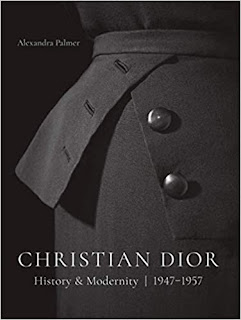
"Christian Dior: History & Modernity, 1947-1957" by Alexandra Palmer


Alexandra Palmer has authored a number of books about Christian Dior.  This one is a peculiarly specific book: not a biography, nor a history of the Dior label, nor of Dior's collections and designs.  Instead it is an in-depth look at the Dior garments held by the Royal Ontario Museum, and it delves into the design and construction of each piece of clothing, how its original owner acquired it, and how she adapted and wore it.

Palmer begins by exploring how Christian Dior's postwar designs were constructed, from the way they were cut to the final embellishments added to them.  Can I just say, that after reading this I've put Dior's clothes into my "lovely to look at, but I definitely wouldn't want to wear them" category?  Each garment was shaped and reinforced with facings, linings and canvas and horsehair padding.   The wearer herself was frequently re-shaped by built-in, boned, corsets and "waist-cinchers".  Lastly, some dresses (particularly the evening ones) had such complicated fastenings that the wearer needed help in getting dressed!

The garments held by the ROM were often altered by their original  owners.  At least one wearer reduced the number of bones in the bodice of her dress.  Others added straps and modesty pieces to their dresses, shortened sleeves, and did more mundane alterations such as letting garments in or out, and raising and lowering hems.  Dior was generally generous in his hem and seam allowances.

Here we come to the meat of the book.  The second (and larger) part of Christian Dior: History & Modernity, 1947-1957 looks at each piece of Dior clothing in the museum in chronological order.  Each chapter starts with the history of the model, continuing with some background on how the original owner acquired and wore it, how it was constructed, and how it differs from the model originally shown in Dior's collections.  Each chapter contains photographs of the garment from the museum collection, and may also include pictures of the in-house sketches of the designs, fashion and press photographs of the original models, photographs of the clothes being worn by the original owner and technical sketches and patterns showing how it was constructed.

All in all, a book not only for those who enjoy exploring the technical details of fashion, but for those who want to know what happens to haute couture after it leaves the catwalks and makes its way into the wide world.

Alexandra Palmer
Christian Dior: History & Modernity, 1947-1957
Toronto: Royal Ontario Museum, 2018
ISBN: 9780888545213

Thursday, October 21, 2021

"Mary Quant" by Jenny Lister

 Because of lockdowns and travel restrictions I was unable to go to an exhibition I particularly wanted to see this year.  Happily, I was still able to buy the book which accompanied the exhibition!


Mary Quant (by Jenny Lister, with contributions by Johanna Agerman Ross, Beatrice Behlen, Regina Lee Blaszczyk, Susanna Brown, Elisabeth Murray, Janine Sykes and Stephanie Wood) was written to coincide with an exhibition held at the Victoria and Albert Museum between April 2019 and February 2020.  It moved to Bendigo Art Gallery in Victoria in 2021, which is where I would have seen it if I'd been able to travel.

Mary Quant needs no introduction: she was most famous designer to come out of Swinging London.  In fact she could be said to have inspired the entire look of the era.  Though she began her career in fashion design in the late 1950s and continued working in the field until the early 1970s, her name is almost synonymous with the 1960s.  Any pop-cultural history of the decade will have to give at least a mention to the originator of the "Chelsea look" and one of the creators of the miniskirt!

Jenny Lister follows Quant's career from her early days running a boutique in Chelsea through to her later years as a "lifestyle brand".  Quant did not originally set out to design clothes.  She sold other people's designs in Bazaar: "clothes and accessories ... sweaters, scarves, shifts, hats, jewellery and peculiar odds and ends" creating a look that was more modern and youthful than the styles then prevailing in post-war Britain.

When she did dip a toe into design, she began by adapting Butterick patterns and making up the garments herself using fabric purchased from Harrods!  From these amateurish beginnings Quant eventually had her clothes made by a small factory, which in turn lead to the development of "Mary Quant's Ginger Group" and a deal in the U.S. with JC Penney.  In the late sixties she began selling fashion accessories and makeup, all branded with her daisy logo.  Her last collection for her Ginger Group was in 1975 and her business subsequently concentrated on licensing cosmetics, tights and furnishings.

While Jenny Lister follows Mary Quant's career chronologically, the other authors of this book contribute essays exploring tangential aspects of her work in depth.  Thus Stephanie Wood contributes a chapter on the women who modelled her clothes, Susanna Brown one on how they were photographed.  Regina Lee Blaszczyk explores Quant's business dealings in America.  Beatrice Behlen discusses the history of Quant's cosmetic range—"young, no nonsense, problem-solving and easy to use".  Janine Sykes dives into how the range was marketed, and Johanna Agernon Ross contributes a chapter on Quant's ventures into interior design.

So much for the text.  However this book accompanied an exhibition, so what about the pictures?  Well, besides many excellent contemporary illustrations and photographs, this book contains some excellent pictures of Mary Quant's clothes held in the V&A.  Many of garments were donated specifically for this exhibition as the museum

"in June 2018 invited the the public to lend or donate specific garments as designed by Quant to enable the Museum to represent a more comprehensive range of her designs...  Each of these garments is enhanced with details about the original wearer and their social background, why Mary Quant designs were specially chosen at the time, and the reasons for treasuring the garments for so long.  Over 1,000 people responded offering Quant cosmetics and other memorabilia, some contributing photographs of Quant garments being worn at this time."

There isn't room to squeeze all the stories and photos contributed into this volume, but those that have made it into the book certainly make it a little bit special!

Mary Quant by Jenny Lister
ISBN 9781851779956
London: V&A Publishing, 2019

Sunday, May 30, 2021

"Manteau de Pierre Cardin" (L'Officiel October 1962)


Our cold snap continues, so I thought it a good time to share this picture of a snug but chic woollen coat  by Pierre Cardin.  It fastens on one shoulder with a large button, and is completed by an attached scarf with fur trim.

Tuesday, April 6, 2021

"Style for All Seasons" by David and Elizabeth Emanuel (1983)"

 "There isn't a title 'style designer'," the Emanuels say in the introduction to this book:

"but there might well be, for style is not just different from fashion—it is almost its opposite.  We are far more interested in developing individual style in people than in making them follow the dictates of group fashion.  Almost by definition fashion does not last, but style does and it is consistent."

Nonetheless, at a remove of nearly 40 years the styles photographed for Styles for All Seasons seem so firmly of their era that they could easily have the dates they were made embroidered on their bodices.

The Emanuels met and married in art school, and started their own business upon graduating 1977.  In 1979 they decided to dedicate their business entirely to the production of couture, thus beginning their career of dressing the rich and the famous.  The times were with them as their romantic, feminine styles were just right for the zeitgeist of the late seventies and early eighties.

Their most famous design was for Princess Diana's wedding dress in 1981.


Described as a "fairy tale wedding" in most of the media and in this book, it's not surprising that the Emanuels would create a fairy princess-style dress for the bride—complete with puffed sleeves and a 25 foot train.  Less romantically, the Emanuels describe the security precautions they had to take in order to prevent the press getting a look at the dress before The Day, including locking the actual dress into a safe, and planting decoy scraps of material in their own rubbish bins to mislead investigators.
 

However, there was much more to this pair of designers than one wedding dress.  Style for All Seasons is basically an album showcasing the Emanuels' designs up to 1983, and while it doesn't go into any depth analysing them it does make it clear what influenced them.  At that stage in their careers the Emanuels obviously had a great love for the Renaissance, 1930s film design, and rococo fashions.  As a result, nearly all the clothes in this book were designed for special occasions—though there are a couple of pages of vibrantly coloured swimwear tucked between the covers!
 

Did I mention that this book is full of lots of pretty pictures?

The authors of Style for All Seasons were both under 30 when it was published, so the book is very much a time capsule focused on the beginning of their careers.  Spoiler alert: they broke up in 1990, and have pursued separate careers since then.  Both the Emanuels are still in design, however, and have branched out from fashion design to designing for the stage as well.  Given their theatrical flair I can only say, "How fitting!"

Sunday, February 28, 2021

"Australian Designers" (Harper's Bazaar Australia, Spring/Summer 1988)


It was photographed at Versailles, but the designer was Australian.  Based in Sydney, Robert Burton created this "beguiling strapless silk taffeta dressed trimmed with pink bows" for a mere $1,500—in 1988 values, of course!