This quintessentially sixties fashion is described as a "patio dress" (actually a long pair of culottes) designed for casual summer evening wear. It is an example of the move towards more informal styles during the decade.
Monday, February 14, 2011
Sunday, February 13, 2011
Distinction, 1970
The magazine is called Distinction, and the model on the cover certainly looks distinguished in her coat and skirt outfit by Nina Ricci.
Inside the magazine is full of straightforward fashion reportage but not much glamour: it contains lots of almost documentary-style black and white pictures with descriptive captions. This makes Distinction a fascinating resource for the fashion historian, but alas! it was in its final years in 1970. The magazine which carefully spelled out what was "in" and what was "out" became pointless in the chaotic "do you own thing" fashion world of the 1970s and eventually folded.
Friday, February 11, 2011
"Floral Frocks" by Rosemary Harden and Jo Turney
In the middle of last century almost every woman had a floral shirtwaist frock in their wardrobe. Floral Frocks: A Celebration of the Floral Printed Dress from 1900 to the Present Day covers the rise and fall of this garment through the 20th century, with a particular emphasis on the years between the late 1920s and mid-1960s. It summarizes the styles that were fashionable through the century as well as changes in textile design and clothing manufacture in this era.
What makes this book a particular pleasure to read, however, is the fact that the authors are interested in the floral frock as it was worn by ordinary women in work and play. Floral Frocks is thus more than a history of fashionable design. It is filled with snapshots and anecdotes from the original wearers of these dresses, making it a fascinating oral and social history of the mid-20th century.
The second (and smaller) part of the book covers the late 1960s through to today, and is rather more theoretical in its approach - and thus less appealing than the first part. It still manages to cover some interesting material, however!
(Woodbridge, Suffolk : Antique Collectors' Club, c2007. ISBN: 9781851495382)
Thursday, February 10, 2011
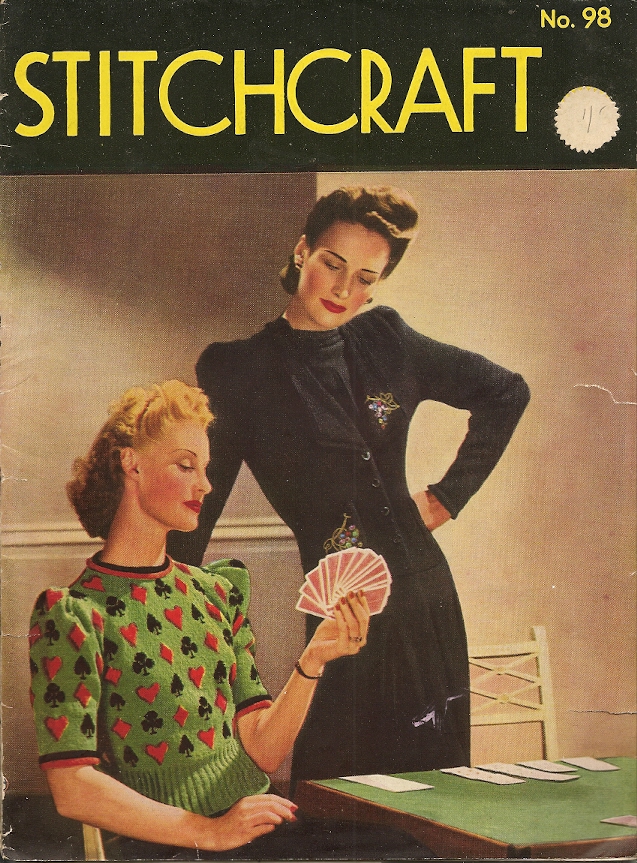
Stitchcraft, 1940
There's no date on this magazine, but by my calculations it was published in October 1940. It's hard to believe these two elegant card players were living in the middle of the Blitz!
Tuesday, February 8, 2011
Farmer's catalogue, Spring-Summer 1951-1952
Farmer's was a Sydney department store. The dress the model on the cover is wearing was made of screen-printed English cotton.
Monday, February 7, 2011
Stitchcraft, 1937
Though my efforts at knitting usually result in a tangled waste of wool, I have a rather large collection of these little craft magazines. This is mainly due to the wonderfully stylish photographs on the cover and inside. Of course Stitchcraft was published by Conde Nast (publishers of Vogue), so it's no wonder it has a touch of class!
Sunday, February 6, 2011
Lana Lobell catalog, 1968
The phrase "generation gap" was coined in the 1960s, and it was as true of fashion as any other element of the decade.
By 1968 modes were being set by the very young and the very radical, and the clothes worn by the not-so-young and more conservative tend to be overlooked in the histories of the era. This catalogue is aimed at such consumers. The clothes depicted within follow the trends without being extreme. On the cover the models wear modishly short, but not thigh-baring, skirts. Confusingly, though, they also wear hats and gloves, items soon to be worn only by the elderly or in the most formal of situations.
Subscribe to:
Posts (Atom)