Thursday, March 10, 2022

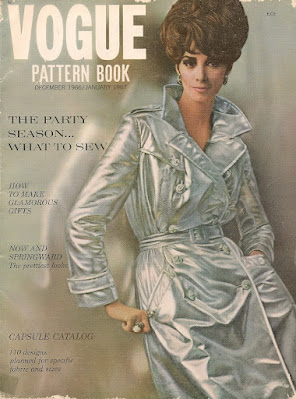
Vogue Pattern Book, December 1966-January 1967

 With an early winter snapping on the heels of an Australian summer that never quite was, I think it's time to look at coats—like this dazzling specimen below.

Vogue pattern 6970 is for an evening coat in "shimmering silver... with classic trench coat lineage".  It's made up in nylon with a Thermolam underlining.  Very sixties... and dig the model's funky beehive hairdo!

Saturday, March 5, 2022

"How To Put On A Corset" (McCall's Magazine, August 1908)

 This one speaks for itself!

National Cloak & Suit Company, 1908

 Much depends on the way in which a corset is put on.  The following hints may be useful:
Fasten the abdominal hooks first, lifting the body, with a long breath, at the same time, and holding the head well back.
After the top of the front is hooked, draw the looped laces from eyelets slightly below the waist, pulling the bottom of the corset much tighter than the top.
Through this simple means healthy breathing is permitted, for bodices are so loose that it is only at the waist and hips the figure needs to be held taut.
To keep the corset in good shape when off the person, many women use a block of wood, round which the corset is wrapped tightly and kept in place on the block with a ribbon or pins.  It is then wrapped in tissue paper to preserve cleanliness, and put away perhaps in a drawer faintly scented with orris-root.  There is no better perfume than orris-root for all the secret matters of woman's dress.

Tuesday, March 1, 2022

100 Years Ago (The Delineator, March 1922)

 For March I've decided to look at some typical fashion trends from 1922—as illustrated by these two day dresses that were available in Butterick patterns.  And since a picture paints a thousand words:


3584—[left] Latticed fabric trimmings on loose side panels creates a new version of the uneven hemline, and a new finish for fashionable wide sleeves.  The straight skirt of the dress is attached to the waist at a low line.
 3526—[right] Front and back panels are independent features of the slip-over dress... Kimono body and straight skirt which may be of a contrasting color meet at a slightly low waistline.  The dress closes under the left arm and may have a long body lining.

All the women's patterns illustrated in this issue of The Delineator share this loose, low-waisted silhouette.  Wide sleeves seem to have been popular as they appear on a majority of the garments.  The use of panels, long over-tunics and side-draping to give the impression of an uneven hemline is also common, especially on the more "dressy" dresses!

(The complete magazine is available on the Internet Archive.)

Friday, February 25, 2022

"The British Show A New Snap" (Life, August 15 1955)

 A decade before the "British Invasion" and the invention of Swinging London, a few American fashion buyers started to sense that something was happening with British fashion.  At this point Life magazine sat up and took notice, and the result was this article.  Notice how the models are all photographed against tourist-friendly typical English backgrounds!

U.S. BUYS FALL'S SLEEK STYLES

Best known in the U.S. for sturdy tweed suits and ball gowns designed for curtseying, Britain is coming across this fall with some slicked up stitching.  A group of U.S. fashion leaders, detouring to London on their regular trek to Paris, were pleasantly startled at the new styles show by London's regular wholesale manufacturers who sell their clothes "off the peg" (ready-made) at extremely reasonable prices.  Without losing any of their traditional workmanship, these highly wearable British clothes have added splashy colors, textured woolens, clinging jerseys and light-weight tweeds.  They are made into daringly form-fitting dresses or elegantly handsome coats and suits.  Enthusiastic word of London's fashion renaissance was traveling fast among buyers still in Europe and in a few weeks the first clothes would be in the U.S. to speak for themselves.

TIGHTLY FITTED DRESS made of flecked lightweight tweed has scoop neck and a beltless middle.  Made by Starke of London, it will cost $40 at Gimbels.

BULKY TWEED ENSEMBLE from Dorville consists of snug dress and coat (Gimbels $180).  It is worn outside house where Painter-Poet Rossetti lived.

LONG FITTED TORSO and gathered skirt make up a red wool jersey dress from Horrockses (B. Altman & Co., $50).  This is the Thames embankment with Houses of Parliament visible in background. 

BRITISH TAILORING is shown off in Matita's neat little suit of Yorkshire worsted in shepherd check which has a velvet collar and inset waistcoat (Filene's $100).  This is in the Burlington Arcade.

 FLECKED TWEED is used for Starke of London's two-piece dress with loose overblouse and knit sleeves (Gimbels, $40) worn with knit cap.  Striding figure is doorman of Connaught Hotel.

BRASH STRIPES of black and shocking pink brighten a classic knit blazer from Dorville Boutique (Filene's, $18) worn with a knit derby.  The scene is a cricket ground in Motspur Park.

 SPONGY TWEED is used by Spectator Sports for suit with leather tabs (Lord & Taylor, 100) worn here in a bright red outdoor phone booth.

It's just a shame that Life couldn't photograph these outfits in colour, because it sounds as if their vibrant colours were a large part of their fashion appeal!

Monday, February 21, 2022

Weldon's Ladies' Journal (March 1926)

 These fashions graced the cover of the March 1926 issue of Weldon's Ladies' Journal, advertising two "gratis patterns" that came with the magazine.  On the left is a "dainty afternoon dress" and on the right, a "smart house frock".  The afternoon dress is described as being a "Paris model [with] the new long roll collar and a Circular Skirt", while the house frock is described as being "designed on the new Flared lines, favoured by the Smart Woman". 

Both dresses display the latest fashionable silhouette for 1926 (as adapted for the home dressmaker).  These include a knee-length skirt flaring out from the hips by way of "pleats, circular insets, flares and ingenious draperies", a "slim, almost tight-fitting bodice" and narrow sleeves.  Nearly every costume in this pattern magazine follows the same lines with minor variations.

The editors of Weldon's Ladies' Journal take great pains to distinguish these latest styles from the dowdy fashions of 1925 which had straight skirts.  Vintage fashion collectors with a taste for the 1920s might find this information useful if they want to date their finds!

Monday, February 14, 2022

"...de JENNY" (Modes et Travaux, September 1933)

 One of the pleasures of browsing old fashion magazines is discovering things and people that were well known to their contemporaries but somehow never make the cut into the standard histories.  With that I give you the designer "Jenny", who we first encountered in an article from 1922 I quoted at length earlier this month.  In it she is given equal space with her great contemporary Chanel, but unlike Chanel she has not become the subject of multitudinous biographies and exhibitions.  However she did make the cover of Modes et Travaux in September 1933 with this deceptively simple dress in velvet.


According to The Thames & Hudson Dictionary of Fashion and Fashion Designers Jenny's

"...House opened in Paris in 1909 by Jeanne Adele Bernard (1872-1962).  Specializing in elegant, aristocratic evening clothes and day dresses, throughout the 1920s Jenny successfully attracted a clientele of American and European women.  The house merged with Lucile Paray in 1938 and closed in 1940."

Saturday, February 5, 2022

"The Great Ethnic Movement" (Elegance with Fashion, January 1971)

 According to my stats, a record number of people visited my blog in January.  While I have a long way to go before I reach influencer territory, I'm delighted that people are reading my blog—or at least looking at the pictures I've posted!  So here's a big "thank you" and "hello!" to everyone reading this.

Now to the meat of this entry.  The fashions of the early seventies were extremely eclectic.  Women had a choice of clothing ranging from doubleknit polyester pantsuits to "ethnic" inspired garments like the one below.


It is described in the magazine as an "African-style cotton dress in a brown, gold and maroon Batik print with a patchwork look wrapover skirt... by Anne Tyrrell at John Marks". 

Some people today might describe this as cultural appropriation, but in 1971 designs like this were clearly influenced by the countercultural movements of the era.  Members of the counterculture were seeking a more authentic, natural and liberated way of life.  This often went hand-in-hand with a romanticised view of the past and the developing world.  The movers and shakers in the fashion industry weren't necessarily interested in alternative lifestyles, but they happily appreciated (and appropriated!) the hippie aesthetic.  Hence designs like this, which combine patchwork prints, batik, beads and bangles into a chic and expensive "bohemian" look.