Wednesday, June 12, 2019

"Le Petit Echo de la Mode" (November-December 1890)

... And so we reach late autumn in our third and final look at Le Petit Echo de la Mode in 1890.  Parisiennes discard their light silk summer dresses for warm wool and velvet coats.  Our fashion columnist for Le Petit Echo de la Mode takes a look at the newest fashionable hats on November the 16th:

16 Novembre 1890

Coats for girls, children and women.  

"Si il reste peu de choses á noter dans les nouveautés en toilettes preparées pour la saison d’automne, en revanche chaque jour voit éclore de ravissantes fantisies concernant la coiffure.  La chapeau est l’object d’une etude sérieuse et d’un effort puissant d’imagination, aussi cet art charmant du chiffonnage est-il poussé á l’extrême sous les doigts habiles de nos modistes.  Ce sont de véritables fées, qui composent ces riens coquets et seyants qui encadrent si  délcieusment le visage d’une jeunne femme, de fantaisies de toutes sortes, les grands chapeaux qui sont le triomphe de la saison. 
"Les formes les plus diverses sont toutes en faveur, et la mode n’a pas de preference, soit que l’on choississe le grand sombrero en feutre pelucheaux ombragé de plumes, soit Louis XI en feutre ras, soyeux comme le chapeaux masculin, avec noeuds et plumes posês devant et en cache-peigne, ou mieux encore le Louis XV brodé á jours de fil d’argent et inondé de plumes d’autruche; sans oublier la petite toque si précieuse en voyage, et qui l’on voit en drap, en fourrure, avec noeuds de velours et tête on ailes d’oiseau couvrant le fond."
[If there is little left to note in the new costumes prepared for the autumn season, on the other hand every day sees the birth of enchanting fantasies concerning the hairstyle.  The hat is the object of a serious study and a powerful effort of imagination, so this charming art of rumpling is pushed to the extreme under the skillful fingers of our milliners.  They are real fairies, who make up these elegant and flattering things that frame the faces of young women so delicately, with all kinds of fantasies and the big hats that are the triumph of the season.

"The most varied forms are all in favor, and fashion has no preference, whether one chooses the large Sombrero in plush felt shaded with feathers, or Louis XI in close-fitting felt, silky like men's hats, with knots and feathers placed in front and on the crown, or better still the Louis XV embroidered in silver and covered with ostrich feathers; not forgetting the little toque so precious in travel, and which we see in cloth, fur, with velvet knots and a bird's winged head covering the brim."]

(Incidentally, fashion journalism must be one of the few branches of reporting where one is expected to be upbeat and and find nice things to say!  Everything is "elegant" and "beautiful"—one seldom, if ever, hears a new fashion described as "ugly" or "unflattering"!)


30 Novembre, 1890

Left: Large cloth coat.  Right: Dress in cobalt blue cloth. 
"Nous pouvons, sans craindre de trop nous hâter , prédire un succés longument assuré aux robes de drap pendant la saison hivernale.  Rien en effect, dans tous les lainages qui font nouveaté, ne peut attendre la perfection d’un costume fait ave cette souple et si élastique étoffe qui se drape et s’ajuste sur le buste en en faisant valoir la perfection. 
"Avec le drap, citons encore les gros lainages bourrus et poilus qui sont de haute fantaisie et nous habillent aussi á merveille, tells que le poil de chévre, le tissue zibeline, le thibet mélangé , les neigeuses et les pékins velours et laine brochés de pois, de losanges, de grands ovales sur fond camalieu ou sombre; beaucoup de dessins en ce genre, mais peu de fleurs."
["We can, without fear of being too hasty, predict a long-lasting success in the cloth dresses during the winter season.  In fact all the new woollens are expected to perfect a costume made with this supple and so elastic fabric that drapes and adjusts itself to the bust emphasising its excellence.

"With cloth, we can still mention the big and hairy woolens that are fantastic and also dress wonderfully, such as goat's hair, sable fabric, mixed thibet, snowy and Pekin velvet and wool.  They are embroidered with dots, rhombuses, large ovals on a monochrome or dark background; a lot of designs like this, but few flowers.]

7 Decembre, 1890


Left: Costume in vicuna and tartan.  Right: Visiting dress in black Siberian. 

In December the haut monde starts returning from the country for the Paris winter social season.  Le Petit Echo de la Mode describes the fashions suitable for dinner parties:
"... La toilette de dîner, n’est plus maintenant une toilette á part.  On s’habille avec elégancé mais simplement pour un dîner  sans cérémonie.  Ce qu’il faut, ce que la robe en soie, en crèpe de Chine ou en dentelle, soft du plus pur style, et que la fantaisie qui dirige la mode y soit mêlée.  Les gracieuses formes Anne d’Autriche et Louis XIII ont un succés réel dans le moment.  La ruché qui encadre le cou et rehausse les épaulettes  a un cachet d’une grande distinction. 
"Les grands dîners réclament les toilettes du bal.  Nous avons vu ainsi plusieurs robes d’une élégance extrême, et le gout qui ont présid leur exécution.  Une entre autre, en brocart rose de Bengale, semblait sortir de main des fées : le tablier, recouvert de tulle, était brodé de jais rose ainsi que corsage, du plus pur Louis XIV."
["... The dinner dress is no longer a separate costume.  We dress with elegance but simply for a dinner without ceremony.  What is needed is a silk dress, in crepe de Chine or lace, soft and in the purest style, and that the whimsy that directs the fashion is mixed.  The graceful forms of Anne of Austria and Louis XIII have a real success at the moment.  The ruche that frames the neck and enhances the shoulder pads has the stamp of great distinction.

"The big dinners require ball dress.  We have seen so many dresses of extreme elegance and taste in execution.  One among others, in pink brocade of Bengal, seemed to come from the hands of fairies: the apron, covered with tulle, was embroidered with pink jet as well as the bodice, in the purest Louis XIV style. "]

Wednesday, June 5, 2019

Le Petit Echo de la Mode (May-June 1890)

Here we have reached spring-summer 1890, or as Le Petit Echo de la Mode puts it:
"Le beau temps nous est revenue, et malgré quelques nuages inquiétants et le vent qui soufflé encore, personne ne s’occupe de ces intermittences; et petits et grands fêtent les printemps."
["The good weather has returned to us, despite some disturbing clouds and the winds that still blow.  No one cares about them; and young and old celebrate the spring."] 
Anyway, on to the fashion!

18 Mai, 1890

Left: Silk house dress in old rose, adorned with black velvet.  Right: Light tan costume in swanskin and darker silk.
"Mais cette jupe à plis langoureux s’ouvre sur un panneau qui n’est qu’une jonchée de fleurs brodées.  On veit des jacinthes roses sur crêpe de Chine mousse; les grélots du muguet font merveille sur crêpe de Chine bleu acier, et les lilas de Perse s’harmonise avec la jolie teinte Ophélie ou dahlia.  Il y a ainsi une foule de combinasons de nuances des plus heureuses, et nous ne pouvons qu’applaudir au gout qu régit la mode, toujours plus fin, plus adorable à chaque nouvelle saison.
"On revient aux dentelles, et comme toujours c’est avec furie qu’on les emploie..."

["But this skirt with languid folds opens on a panel that is littered with embroidered flowers.  We've seen pink hyacinths on crepe de chine moss; the bells of the lily of the valley are wonderful on steel blue crepe de chine, and the Persian lilac harmonizes with the pretty hue of Ophelia or dahlia. There is thus a multitude of combinations of the happiest shades, and we can only applaud the taste that governs the fashion, always finer, more adorable in every new season. 
We return to lace, and as always, it is with passion that we use it..."]


June 8, 1890
Left: Young girl's jacket in light beige.  Centre: Young girl's costume in dove and dark blue fabric, with grey braid.  Right: Costume in myrtle wool and darker velvet.

"On voit des quantités de chapeaux oùla note verte domine, des robes avec des manches aux formes exentriques et couvertes de broderies.  L’or, l’argent, ruissellent sur les vêtments et les costumes; puis, sans raison autre que la fantaisie la scène change, c’est une autre nuance que l’on adopte, un disposition de garniture qui fait fureur.  L’uni est remplacépar l’ecossais, et vite chacun s’empresse de suivre cette idée nouvelle.  Costumes, vêtements, ombrelles, noeuds, arborent les coleurs écossaises.  Dans le moment tout est à la Walter-Scott.  C’est une orgie de nuances charmantes, mais que l’on doit surtout laisser aux enfants. 
"La faveur est aux soies molles.  Cette souplesse dans le tissu fait merveille pour les draperies du corsage et le plissé éventail qui termine la jupe.  Nous avons vu ainsi une robe de pongé écrue.  La jupe, drapée légèrement devant, était plate sur les hanches.  Derrière, elle s’ouvrait sur un èventail aux plis fins et réguliers, donant ainsi une ampleur trés grande au costume."
["You can see the amount of hats where the green note dominates, dresses with sleeves with eccentric shapes and covered with embroidery.  Gold, silver, dripping on apparel and costumes; then, for no reason other than fantasy the scene changes.  One adopts another shade, another arrangement of trimmings that is all the rage.  Plain fabric is replaced by tartan, and everyone hastens to follow this new idea.  Costumes, clothes, sunshades, knots, display the tartan colours.  In a moment everything is à la Walter Scott.  It's a charming profusion of colours, but it must be left to the children. 
"Soft silks are in favour.  This flexibility in the fabric is perfect for the bodice draperies and the pleated fan that finishes the skirt.  So we saw a laid-out ponge dress.  The skirt, draped slightly in front, was flat on the hips. Behind it, it opened on a range of fine and regular folds, thus giving a very large scale to the costume."]

Somehow I suspect the ladies "dripping" in gold and silver embroidery, then suddenly throwing their entire wardrobes out to replace them with fashionable tartan were not the average readers of Le Petit Echo de la Mode!


22 Juin, 1890

Left: Dress in ivory peau de soie.  Right: Siberian dress in old rose and cream barege.


"L’éclectisme étant le maitre cette saison, on porte toutes les couleurs possible, du bleu, du jaunne, du mauve, des tons feu, vert ou brique.  Impossible de renseigner mieux nos aimables lectrices sur les nuances à la mode, et nous leur conseillons, pour être admirablement mises, d’étudier avec une couturiére habile ce qui ira mieux à leur taille et au genre de leur beauté.  C’est ainsi qu’agit la femme élégante, et l’on peut être assure que cette maniere de faire est celle qui réussit le mieux. 
"Il semble qu’on n’ait jamais vu tant de fleurs; et on se demande somment de frêles jeunes femmes peuvent porter une moisson pareille sur leurs têtes.  Les grands bords des chapeaux en sont charges.  On fait de belles et larges fleurs et d’immenses feuilles en velours de plusieurs tons de vert."
["Eclecticism being the master this season, we wear all possible colours, blue, yellowish, mauve, fire tones, green or brick.  We could not better inform our kind readers about the fashionable shades, and we advise them, to be well-dressed, to study with a skillful dressmaker what will be best in their size and their kind of beauty.  This is how the elegant woman acts, and one can be assured that this way of doing is the one that succeeds the best. 
"It seems that we have never seen so many flowers; and we wonder how fragile young women can carry such a harvest on their heads.  The brims of the hats are loaded.  We make beautiful large flowers and huge velvet leaves of several shades of green."]

Thursday, May 30, 2019

Le Petit Echo de La Mode (April 4th, 1890)

Le Petit Echo de la Mode ("The Little Echo of Fashion") was published from 1880 to 1983 (with a name change to Echo de la Mode in 1955).  For most of its publishing run it took the form of a tabloid sized weekly, concentrating on fashion (naturally!) and craft, with a dash of fiction, cookery and general advice thrown in.

I have a number of issues published in the 20th century, but I recently obtained some issues from 1890.  They're now the oldest ones in my collection!  I thought I'd share them with you over the next few weeks.  We begin with the 4th of April 1890:
"Cette nouvelle saison est le triomphe de la jaquette; on la voit partout et sa form simple et dégagée habille àravir.  Nous en donnons dans ce numero un charmant modele pour jeune fille.  Pas de broderies, ni de galon autour de ce gentil vêtement simplement piqué au bord.  …  
"Ainsi que nous l’avons dit, l’écossais domine, mais un écossais sobre et de bon gout, composéde peu de teintes se dégradant avec harmonie: rouge, mais et beige, bleu mousse et vert printemps, tout les nuances se fondent ainsi entre elles."
[Roughly translated, this reads:
"This new season is the triumph of the jacket; it is seen everywhere and its simple and unobstructed form dresses to delight.  We give in this number a charming model for young girl.  No embroidery, no braid around this nice garment, just stitched to the edge… 
"As we have said, tartan dominates, but a sober and tasteful tartan, composed of few shades dissolving with harmony: red, corn and beige, moss blue and spring green, all shades melting together."]
That vivid description of colour suddenly brings all those black-and-white engravings to life!

Like most other fashion magazines for the middle classes, Le Petit Echo de la Mode offered to sell dressmaking patterns to its readers.  The entire female half of the family was catered for, from toddlers to grandmothers.  Below are some examples:


Left: Dress for a lady in woolen cloth.  Right: a jacket-coat in charcoal velvet with light revers.


Left: White and black striped silk dress for an older lady.  Centre: Coat for little girl in grey wool.  Right: Costume for an older lady toilet in burnt red velveteen.


Left: Bridal costume in white satin and brocade.  Right: Velvet dress in heliotrope and cream satin.


Friday, May 24, 2019

"Handmacher Suits" (1955)

Handmacher-Vogel was an American manufacturer of women's suits.  It became well-known for (to quote Newsweek) "custom designs carried out by assembly line methods".   Strict quality control along with precise sizing meant that Handmacher Suits also became known as good quality garments sold for moderate prices (between $25 to $75, depending on styles and materials).

By the 1950s, Handmacher's reputation had spread abroad.  In late 1954 Moygashel (a firm based in Northern Ireland) signed a contract to produce Handmacher suits "under licence" for sale in the United Kingdom.  The advertisements below appeared in British magazines to promote the suits.


Thursday, May 16, 2019

Exhibition: The Krystyna Campbell-Pretty Fashion Gift (National Gallery of Victoria)

Jeanne Paquin, 1912
.... Or perhaps I should title this post "What I Did On My Autumn Holiday".

Krystyna Campbell-Pretty is a Melbourne philanthropist, and her gift to the National Gallery of Victoria is a $1.4 million collection of vintage haute couture acquired from Parisian collector Dominique Sirop.  The collection contains samples of the works of all the "big name" couturiers from Worth to Alexander McQueen.  It's now being exhibited at the NGV—for free!  


I was in Melbourne last week, so—need I say it?—naturally I went to the exhibition.  I went with a friend, who is more interested in craft than fashion, so while I admired the design, she admired the workmanship.  And there was plenty of both to enjoy.


The layout of this exhibition was unusual, in that it wasn't segregated from the rest of the collection in a separate wing or gallery.  Instead the curators decided to spread the displays throughout the 19th and 20th century British and European art collections.  This lead to some amusing and sometimes appropriate juxtapositions: a Dior day dress against a late-Georgian portrait of a lady in a white gown, a cluster of Art Deco evening wraps posed in front of a portrait of Nancy Cunard painted in 1919, and a couple of outfits by Yves Saint Laurent standing amidst a display of art and crafts furniture.  

(Unfortunately the layout of the exhibition, along with the lack of signage, made it a bit hard to navigate.  That's how we wound up starting in the middle of the exhibition, before realising it extended further back, both chronologically and physically!)

But what about the dresses themselves, you ask?


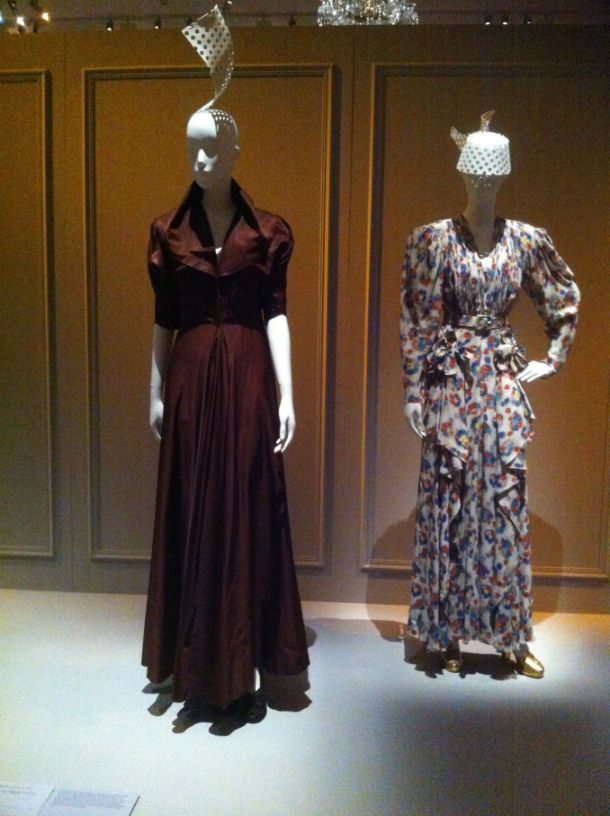
Schiaparelli, 1932-33 (left); Lelong, 1932 (right)
Need I say they were gorgeous?  They were.  The greater part of the collection was created from the 1910s to the 1960s, which is not only my special area of interest, but roughly covers the "Golden Age" of Haute Couture.  One large gallery was dedicated to fashions from around 1910 to 1939, with smaller galleries off either end leading to displays of 19th century costume on one hand, and 1940s and 1950s fashion on the other.


Dior, 1947 (left); Maggie Rouff, 1940 (right)
The clothes chosen for exhibition—especially the ones made before the war—tended to be mostly be either evening fashions, or clothes for gala occasions.  Even a display of  "little black dresses" at the centre of the main hall seemed to consist  mostly of  

little black evening dresses.  This is probably the result of natural selection: special occasion wear is more likely to be lovingly preserved than a skirt or an ordinary day dress (even if the day dress is made by a Parisian couturier!)  

On the other hand, tucked away in a corner there was one of Chanel's earliest designs: a casual jersey jacket, circa 1916!

One of the delights of this exhibition was a handful of works from fashion houses not well remembered these days, and seldom featured in the standard fashion histories.  I thus learned a bit about the houses of Boué Soeurs, Bruyére, Carven and Felix.


At front left: Jacques Heim, 1950
Another delight was a scattering of items from the National Gallery's research collection in glass cases.  These included magazines (including early, rare issues of Vogue, L'Officiel, Harper's Bazar and Gazette du bon ton).  They also included photographs.  Some of these were from the archives of glossy fashion magazines, but others were taken in-house (by Givenchy, for example) in order to prevent design piracy.  There were also sketches: everything from rough drafts of a designer's first ideas, through to annotated worksheets, and to polished drawings used to publicise a house's finished designs.  


Yves Saint Laurent, 1971
So to summarise:  "The Krystyna Campbell-Pretty Fashion Gift" is an exhibition any vintage fashion lover will enjoy.  It's on until July the 14th, so I encourage anyone who can visit it to do so!

For those who can't make it to Melbourne, there's a book!  Running to 307 glossy pages, it's excellent value for money, and can be purchased at the NGV's store.  It covers the history of high fashion from the late 19th century to the early 21st century, with brief essays on specific themes (the Jazz Age, for example, or evening dress in the 1950s) and on individual designers.  It is fill with high quality photographs (much better than my grainy shots taken with a phone camera) and features a brief interview with Krystyna Campbell-Pretty on how she came to donate her "Gift" to the National Gallery of Victoria.


  • The Krystyna Campbell-Pretty fashion gift / by Paola Di Trocchio; Danielle Whitfield ; Françoise Tétart-Vittu; Olivier Gabet.
  • Melbourne: National Gallery of Victoria, 2019.
  • ISBN: 9781925432596

Thursday, May 9, 2019

Wartime Fashions in Australian Home Journal Part VI (1945)

And at last we reach the final year of the war.  The editors of the Australian Home Journal start anticipating the frivolities of peacetime...

January 1945
Holiday Season
This holiday season the beaches and the mountains will be extremely active, regardless of restrictions on travel and hotel and guest-house "bookings".  People feel that the major part of the war is nearing its end and they can express their joy in colourful dressing at holiday resorts.  Aided by the gay range of dress materials they are certainly adding brightness to the atmosphere.  You cannot go wrong in colourful dressing; the drab, quiet folks who think otherwise are in a definite minority.

February 1945

Cutting-down
Here are ideas for turning grown-up's discarded garments into children's clothes, once you are certain they are past converting for their owners—
Bathing wraps can be made into children's dressing gowns.
Grey flannel trousers will make children's knickers and skirts.
Mackintoshes will cut down to a child's waterproof coat or cape with pixie hood to match.
Plus-fours would make two pairs of shorts for a schoolboy.
Pyjama legs will make children's vests.
An old skirt will make one pair of knickers and a little play-skirt for a seven-year old.
Vest and combination tops will make bodices on which a little girl's skirt or a small boy's knickers will button.
Washing-silk dresses make up into gay pyjamas for children.


March 1945


Paris Fashions.
The so-called Paris fashion news in some daily papers  is censored by members of French textile circles.  Without news from their own houses they dismiss 75 per. cent. of current newspaper stories as inaccurate vagaries from sources unaccustomed  to handle factual fashion news.  They are particularly critical of fantastic coiffure and millinery sketches appearing daily, which they stigmatize as "poor taste" at this stage of the war, and say they do not have the Paris hallmark.
... The reports that military notes inspiring first fashions from Paris, like hats copied from British and American helmets are also strongly discounted.  Opinion is that when real couturiers and important milliners present their first collections, there will be a swing away from war reminiscent fashions and concentration on pretty feminine clothes, because the whole world will be weary of uniforms.


May 1945

Suits Dominate.
Suits predominate and find expression for every occasion, from the tweedy sports type to one called "Holiday," made entirely in sequins plaided in vivid blue, pink , purple and fuschia.  Shoulders are still extremely wide, and jackets, for the most part, regulation length, with sleeves easy and approaching a modified dolman in a few of the dressier models.

August 1945

Knee-length Coats.
The new knee-length coats are high fashion and new.  Most of them are straight and simple; others have a defined small belt line to accentuate sharply the dashing depth and flare of the long peplum that, in turn, contrasts the straight and narrow skirt.
Hat Changes
Hat fashions bring in great changes.  Long forecast, big hats are now here, sponsored by all the biggest names in millinery designs in this country.
Each and every one of you is going to get a lot more hat for your money when you go out to buy that new bonnet. 


September 1945


Dress Display
At a recent dress display exhibition we noted the following—
More floor-length evening gowns than in years.
Woollen fabrics more vivid in colour and more daringly unusual in contrast and combination.
More individual detail...
No Shrinking
In America there is quite a boom in garments made of specially treated woollen fabrics which guarantee non-shrinkage.  So far, this process has be reserved for use by the armed forces.  There it has had a good test and has come out with flying colours; but now the War Production Board has allotted limited quantities for regular commercial production.

October 1945
Summer Fabrics.
Prints are given lavish display in a number of shops.  Screen prints of small flowers, polka dots, and stripes on crepes and rayon jerseys figure in the current showings.
The present shortage of plain coloured crepes has many women turning to the printed crepes, as "they want a new dress and are willing to make it from any material available."
Prints are also featured in spun rayons, and rayon shantungs.
Women are buying these rayons for house dresses in place of the cottons on which there is a definite shortage.


November 1945
The Alarmists.
We are being persistently told there is a cotton shortage coming.  One hardly knows whether this is propaganda or fact.  The end of the war and the return of service folks to their usual employment will certainly make an extra call on peacetime habilments; but on the other hand there will be much increased manufacture of light woollens, cottons, tweeds and the like...

... However it is obvious by the end of the year that even a nation as untouched by the war as Australia would need some time to return to normal.  (As a matter of fact, clothes rationing lasted until 1948 in this country!)

Wednesday, May 1, 2019

Patterns From Needlecraft Magazine (June 1929)

Tucked among the craft patterns in this vintage issue of Needlecraft Magazine, were a couple of pages advertising dress patterns (available through Needlecraft for 15¢ each.)  Here are three of the designs available to home dressmakers at the end of the 1920s.  The descriptions below are quoted directly from the magazine, and run in order from left to right.


 Simple Flare
The dress, No. 1226 is a smart printed blue-and-white crepe with plain-blue crepe contrast.  Printed dimity, printed rayon voile, printed cotton foulard, flat silk crepe and georgette crepe are also apprropriate.

Chic Scarf Neckline
The fashionable yellow silk crepe frock, approved by the smart young set, is illustrated in design no. 1239, with most interesting scarf neckline, revealing chic onesidedness and falling in cape effect at back.

One-Piece Model
It's one piece!  The smart printed silk crepe wraparound model with effective shirring and drape at left side, so suitable for street and all-occasion wear.