Saturday, March 7, 2020

A History of Blouses Part 6 (1940s)

The first half of this decade was dominated by World War II—the second by the recovery from the war.  Fashion became subordinate to the war effort.  Blouses, like all other types of clothing, were affected by this—though in the early months of the war it was still very much "business as usual".

"BLOUSES are just as stylish, if less fluffy, than last Summer.  Plenty of muslin, organdi, crepe de chine, that adopt more or less the chemisier style, have a little lace frilling, and mostly lingerie fronts, adorned with open-work and tucks."
The Draper of Australasia, June 1940
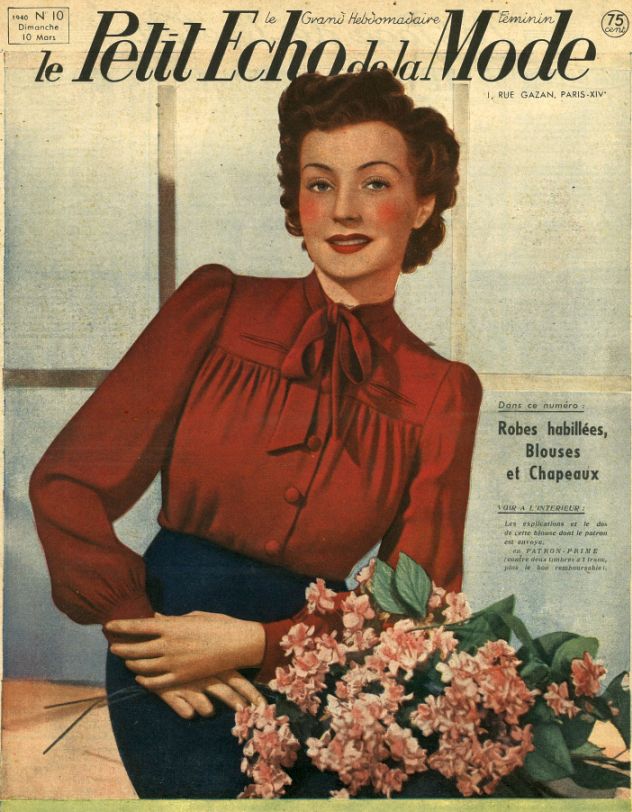
Le Petit Echo de la Mode, Mars 10 1940
K. 90505.  Blouse en satin.  De chaque coté du devant, elle se fronce dans une découpe au-dessus de lanquelle se place un petite poche fendue.  Encolure, nouée.
McCall Style News, March 1941
4087.  A three-button blouse, softly tailored.  It is gathered below the shoulders at front and back.  High or low neck.
4091.  This blouse can be made with or without sleeves.  Belted at back to hold it in nicely.
4106.  A very smart tucked-bosom overblouse—just waistlength.  Narrow double-breasted buttoning.  Made on fitted waistband.
4124.  Shoulder-to-shoulder shirring beneath two rounded yokes.  Short V neckline.  A grand suit blouse.  Slender sleeves.

Wake's, Spring-Summer 1942-3

Dazzling White Classics
 Two impeccably tailored-shirt waists, typifying to perfection the trend towards smarter simpler beauty.  Both with new, wide rever'd collars; generously gathered yoke action backs, waists double-darted front and back for bulkless fit.  Trimmly stitched collars, cuffs, pocket flaps. Strongly sewn and neatly pinked seams.
 As the war continued, blouse styles became almost severely practical.  They began to resemble men's (open-necked) shirts, recalling the days of the "New Woman" and her shirt-waist.  Ornamentation (embroidery, tucks, lace) was not only considered wasteful and unpatriotic, but actually made illegal in some countries.

Australian Home Journal, June 1943

Blouses from Oddments.  You can make new blouses from a large patterned scarf square, the best parts of a man's shirt, and from coloured and fancy linings of discarded garments.  Smaller pieces of material will make backless fronts.  Give them collars, or fasten with bands buttoning at the nape.
Make Do and Mend (Board of Trade, 1943)

Montgomery Ward catalog, Spring-Summer 1944
5. BOLD AND BRIGHT... Screen printed Rayon Jersey; shirred yoke, 1 flap pocket.
6.  FRUIT-OF-THE-LOOM... Well-known Rayon in a muted screen print.  Has a delicate and Summery air.  Deep collar and front opening prettied with embroidered eyelet ruffling.
One of the real advantages of the blouse during wartime was it could be made out of odds-and-ends of materials—remnants, salvageable parts of a worn out dress, scarf squares.  There were some blouses made out of even stranger scrounged materials, such as the examples below.

Blouse made from an escape map, held by
Smithsonian's National Air and Space Museum

"A young girl working in a government drawing office was given an old linen map, which she boiled to remove the starch and printer's ink.  'Then I washed it, dyed it with a fourpenny dye.  Ironed it.  Cut it out from a much-used blouse pattern.  Made it up with a fivepenny reel of cotton and used the buttons from an old dress.  Result—one new wearable garment.  Total cost ninepence—no coupons.  I was very proud of this blouse.'"
From Norman Longmate, How We Lived Then (Chapter 21)

A new or refurbished blouse could brighten up an old outfit!

Easy Dressmaking for Spring, 1945
Our Free Pattern this month is planned to cut five simple, smart and popular blouses that are ideal for wear with a modern suit.  Here are blouses for all occasions, from the tailored shirt to the frilly little model that is dressy enough for a party.
Our models have been specially planned so that they can be cut from the least possible amounts of material.  Search your drapers for remnants from which you can make them.

Australian Home Journal Winter Fashions, 1946

Shortages did not end with the war.  While fashion designers were still deciding which way to jump, women were still having to make do and mend.

"PARACHUTE BLOUSES

When material, formerly parachute cloth, was recently released, textile manufacturing firm of Aschers engaged artists to experiment with designs suitable for blouses and evening wear.

Printing of designs succeeded only after many failures, but nylon garments attracted much attention when exhibited at Dorchester Hotel, London, recently.

All were in pastel colours except a new pink (Ophelia) and a bright cyclamen.

Apart from small patterned prints with outlined violets on a cream ground and other contrasts in the same pattern, the designs were mostly large flowers or bold outlines and crazy patterns.  Some show free sketches of different rooms in a house—including a bar—all in one dress length."
Northern Times, 29 March 1946


"ACCORDING to fashion decrees every suit is given a harem of blouses, one of which should be giddy, and maybe with stripes, dots, plaids, checks, done in bright colours. Some of the new blouses are essentially fresh and Spring-like.

ONE of the attractive points about this fashion is that a change of blouse, a simple and inexpensive thing in itself, will put a completely new-aspect on a single suit.

Choose a smart, semi-tailored suit with a plain blouse for the morning, and the same can be worn for the afternoon with a frivolous model of taffetas or quilted satin, which is now much in vogue. The woollen jumper which is seen in bright colours, striped, embroidered, and with fancy patterns, is a useful item, and must not be forgotten when choosing your blouse harem."
Hobart Mercury, 28 March 1946.

McCall Style News, January 1947
6749.  A drop-shoulder blouse.  The front yoke is simulated by a tuck edge.  It buttons down the back and the round neck is faced.
6750.  The front panel gives you a chance to do special things with stripes.  Round neck and cap sleeves, and back buttoning.
6748.  Here is a tailored shirtwaist with shoulder shirring and bishop sleeves to give it softness.  Front buttoning.
By the end of the decade fashion took a turn for the nostalgic, the feminine and the romantic.  This did not mean the abandonment of blouses, however, as separates and suits were too practical and too entrenched in women's wardrobes to discard.  It did mean that it was possible to experiment with new styles once again.

Butterick Fashion News, December 1948

4719.  "The Yoke blouse"
4721.  Tailored blouse.  "Quick and Easy" to sew.
4720.  Curvaceous bib yoke on a soft blouse.
"Blouses have definitely become glamorous.  The severe skirt collar and long sleeves have given place to frills and trimmings of all kinds.  Printed material is most fashionable for blouses at the moment."
Central Queensland Herald, 6 January 1949 

Vogue Pattern Book (British ed.) Autumn 1949
6351.  Natural sloping shoulderline to cut effectively in plaid taffeta or cotton.  Beneath the mandarin collar you can button it as high or as low as you please.
6736.  Notched horizontal tucks crisply tailored in crêpe or spun rayon.
6849.  Casual blouse with a Chinese air for clinging rayon jersey.  Forearm sleeves.
6541.  Dart detailing for a soft yoke effect.  Illustrated in a polka-dot silk.
6817.  Trim tailored shirt blouse in striped poplin.  Push-up, flared-cuff sleeves.
5843.  In dark wool jersey, this is a top for anything from slacks to dinner skirt.
6628.  Below a mandarin collar, a deep tucked yoke like a dress-shirt front.
6837.  Kimono-sleeved blouse, fastening like a man's shirt without the collar.
6704.  Three box pleats take well to moss crêpe.  Turn-down or band collar.

"Blouses are Important
 
Blouses form one part of a woman's wardrobe that is not subject to seasonal and fashion changes.
 

No wardrobe is really complete without several blouses, for they are appropriate to so many occasions, and meet the needs of housewife and business girl alike, as well as the woman who has more leisure time for social outings. 

There's no age limit to the wearing of blouses, either. Matron or maid finds them to her liking and advantage, choosing a style best suited to her taste and to the outfits for which she requires them as a complement. 

No tailored suit is complete without a blouse, and after winter wear a suit is given a new lift when the warmer days of Spring come by crisp-fresh looking blouses in white, pastels, or other colors. 


Many women prefer the look of a blouse even in winter, wearing one with a cardigan beneath a suit jacket instead of a woollen jumper."

Weekly Times (Melbourne), 8 June 1949

Saturday, February 29, 2020

"A Snowy Afternoon" (Peterson's Magazine, February 1878)

Although this plate is captioned "A Snowy Afternoon" it in fact depicts garments meant to be worn at different times of the day.


For those who could afford to change clothes several times a day, the general rule was the later the hour, the more formal the costume.  The outfits above would have most probably been worn for afternoon visits and evening parties.  From left to right we have a
  • Walking costume of green camel's-hair
  • Evening dress of primrose colored silk
  • Carriage-dress of brown silk and light-gray India cashmere
  • Evening dress of light-blue silk for a young lady
  • Walking dress of chamois-colored camel's-hair.  

The "walking" dresses seem rather impractical, but contrary to modern expectations, they were not intended as exercise costumes.  They were fashionable outfits be seen in while promenading and paying visits!

Wednesday, February 26, 2020

"Make For the Sun" (Woman and Beauty, July 1948)

In their July 1948 edition the editors of Woman and Beauty published a number of simple patterns for clothes that could be worn on a summer holiday.  They included this "enchanting summer dress cut on dirndl lines... from a straight piece of material, complete with beribboned neckline!"  The
instructions are as follows:

You need 3 yards of 36-inch-wide material, plus one spool of shirring elastic.
TO MAKE: Fold material and cut to 44 inch lengths as shown in the diagram.  Join these lengths together by the selvedges to form a tube.  Turn the bottom edge up for about one inch.  Then with shirring elastic stitch and gather the other extreme edge, fitting it to your figure under the arms.  About five inches lower insert another gathering line and once again, five inches below this second line, insert a third, this being your waist.  Cut out and stitch together by the short ends the three six-inch-wide strips.  Fold lengthwise, and between the open edges of each strip stitch the gathered top of the dress for about nine inches at the back and nine at the front.  The rest of the dress top is bound to form armholes.  Roll the strip over and tie on shoulders.


Once again, happy sewing to anyone who ventures this!

Friday, February 21, 2020

"A Lovely Frock for 10/6" (Woman's Own, November 21 1936)

In November 1936 Woman's Own offered its readers a "lovely frock" cut out in a "soft winter-weight woollen" and ready to sew—and all for only 10/6 (50p in modern money).


"Sleeves strike the smart keynote in any of this winter's frocks, and the newest notion of all is to have their full tops box-pleated into a crisply-tailored shoulder line.  Just how up-to-the-minute that looks you can see for yourself on this week's cover, where we show you our Cut-out Woollen Frock made up.  You can make yours look every stitch as smart with next to no effort.
It comes to you perfectly cut, complete even to the crossway facing for the neck, and you'll find that the pieces go together almost by themselves.  The bodice is quite plain; the four-piece skirt only has to be seamed together, with no darts or gathers or pleats to think about.  The very modern twin scarf ends are of self-material, and stitched to either side of the front neck placket.  The belt matches the frock...
What We Offer You
Cut out Frock No. 1,903 in woollen with narrow shadow stripe of self-colour and detachable collar in artificial silk crepe: Price 10s. 6d.
Colours—(1) Chinese green with ivory collar; (2) Squadron blue with ivory collar; (3) Wine tone with beige collar."
Alas, it's not possible for readers of my blog to take up the offer, as it closed on December 19, 1936!

Monday, February 17, 2020

"Sun-Shine Companions" (Spiegel Anniversary Sale, 1955)

The Spiegel "Anniversary Sale" catalogues were miniature versions of their "Big Book" catalogues, with pages packed full of clothes and other consumer goods. 


 Casual wear for outdoor activities (you can see the clothes accessorised by a beach back and a picnic basket).   These postwar play clothes for women consist of mix n' match shorts, tops and capris.  All  are made of cotton, and bright colours, stripes, and modernist prints predominate. Women's pants were still strictly for casual or home wear in the 1950s!


Wool is no longer the material of choice for making swimsuits.  The costumes above are mostly made of "rayon faille Lastex".  (The exceptions are the two at centre bottom, which are made of cotton broadcloth.)   They are more glamorous and form-fitting than their pre-war predecessors though they are also obviously more structured.  All have built-in bras.


From the same catalogue: play clothes for little girls!  They are wearing garments not unlike their mothers', but the manufacturer seems to have eschewed patterned fabrics for plain colours with trimming.  There also seems to be a bit of a Western theme going on.


These beach styles for girls are also very like their mothers' (or older sisters') costumes, right down to the materials they are made of.  However they are obviously less structured (there's no need for built-in bras for a start!)  Ruffles and shirring are used to underline the girlish innocence of the costumes.

Wednesday, February 12, 2020

Fashions from "Burda Moden" (Mei 1969)


I feel like going back to the 1960s today.  Who would like to join me on a short trip through the pages of Burda Moden?  All these warm-weather clothes appeared in the May 1969 issue (no doubt to give their readers time to sew their clothes for summer proper).


First, we have a pair of standard 1960s a-line shift dresses, with interest added by rows of daisies embroidered or appliqued on hems and yokes.  You can't get a more late-60s-early 70s motif than daisies, by the way.  They appeared on everything from wallpaper to vans.


Lace!  Lace was fashionable in 1969.  But this was not necessarily your mother's lace.  The dress on the left looks particularly modern with its bold, geometric lace pattern.  In shape it's a classic 1960s shift dress, and there's also just a hint of transparency.


Two summer sundresses in cheerful yellow, the one on the left worn with long trousers.  (Presumably it could also be worn without trousers.)   And look—both dresses are made with large patch pockets!

(Once again, note the daisies worn by the model on the right.)


These feminine dresses have a rather old-fashioned air: by 1969 nostalgia was in the air.  The captions for this photograph, however, indicate that both these garments were made with the latest synthetic materials—so perhaps not quite so old-fashioned after all.


Tuesday, February 4, 2020

A History of Blouses, Part 5 (1930s)

BLOUSES ARE BACK
The blouse and skirt, banished for some years is back in favour, and Spring has brought us many adaptations of this style.
The Home, An Australian Quarterly, September 1930

With the start of the 1930s and the onset of the Depression "grown-up" fashions came back into style.  Waists rose, skirts fell, and the frivolous flapper found herself replaced by the serious "business girl".  

Australian Home Journal, March 1930
Pattern No. 11,105.  The ever popular tuck-in blouse is gradually coming back to its old place in the fashion world.  Fastening is down the front; material is cut wider at the waist and ornamented with buttons.  Inverted tucks are supplied on the shoulder, and neck is bordered with a roll collar.  Sleeves are slightly eased into turn-back cuffs.
It's not surprising that the blouse made a comeback as well.  It was not only smart but worn with a suit or separate skirt it was an economical way of introducing variety in a limited wardrobe.

Weldon's Ladies' Journal, November 1931
853832.  There is a decidedly period look about this blouse with its double collar crossing high at the neck... Make in cream Japahan silk or meadow green taffeta.
853632.  Designed for a spotted material... the severe lines of this blouse are somewhat modified by knotted ends.  Round yoke in one with panel is unusual and becoming.
853842.  Great importance is given to hand-made blouses, and here is a design I'm sure you'll like in Clytie satin or washing silk.  Binds or pipings, lingerie folds down the front, and bows give smartness.
8538272.  Raglan sleeves impart a trim, main-tailored appearance so they have been used for this blouse...
853852.  The basque again!  This time the blouse is of softly draping fabric, because it has a scarf collar.
853882.  Paris is using a supple taffeta for many little tailored blouses.  It would be smart for this design with shoulder yokes buttoned over inverted pleats, trim turn-down collar and "pressed flat" jabot.
Butterick Fashion News, October 1932
Make Your Suit a Convertible— with Blouses.
4569.  Here is an important surplice blouse with its back and sleeves cut in one.  Gusset at underarm.
4611.  Puffed sleeves which are gathered into a deep cuff and the new soft neckline are smart details here.
The blouses depicted in early 1930s women's magazines were usually soft and fluid in appearance.  Satin, georgette and crepe de chine were frequently mentioned as materials—as was the cheaper "art silk" (rayon).  Colours were usually white, off-white or very pale and decoration was often in the form of diagonal or decorative seaming.  V-necks, surplice bodices and cowl-necklines were popular, often set off with a very soft bow.


Vogue, February 15 1933

 Dark bright colors rise to the top.
....Schiaparelli's ribbed silk blouse... Bonwit Teller.
Schiaparelli's suit has an empire blouse of silk peau d'ange jersey; Altman. 
...Ribbed wool blouse with a semi-turtle neck... The blouse, Schiaparelli's "476", from Hattie Carnegie.
1933 saw a shift away from these styles when Schiaparelli (in Paris) and Adrian (in Hollywood) introduced padded shoulders.  Suddenly a bolder, crisper look was in vogue.  With broad shoulders fashion went to the neck, with wide collars, jabots, frills and bows framing the face.  (This look probably owed a lot to Hollywood, where collars were used to frame the face in close-up.)  As a rule blouses were more decorative depending on the time of day and occasion they were worn.

Very few of the new blouses are frilly and fluffy; although made in such materials as fine linen, organza and taffeta, they are generally strictly tailored.  Plaids, checks, stripes and spots are printed on all materials and used for blouses.  The designers give you plaid blouses with dark suits and dark blouses with light ones.
Australian Women's Weekly, 22 July 1933

Australian Home Journal, October 1934
11,230.  Picture this becoming jumper in suit effect with the two blues that are so much now in evidence.  It has a Magyar top with the front cut separately; this provides the turn-back trimming of contrast matching the sleeves.  Large buttons are a prominent feature.
11,237.  Portraying one of the newest blouses in spotted crepe-de-Chine.  The raglan sleeves in three-quarter length are cut in one with the tie.  Front forms a V neck; over this the tie is fastened. Sleeves are gathered into narrow cuff bands edged with pleated frilling.
11,234.  An afternoon blouse, made dressy with the pleated frilling—omit the trimming and it is converted into a blouse for sport.  It slips over the head and fastens from the neck; here it is furnished with a roll collar.  Sleeves are slightly eased into narrow cuff bands.

BLOUSES! 
A Note from Margo Hill-Manners

The summer suits have given a great fillip to the blouse vogue.  Every suit has a bevy of blouses and they are of varying styles— soft and frilly, dressy, or of the sports girl type.

Truly one cannot have too many, and this is a wonderful way of using up those short remnant lengths which are irresistible to the bargain hunter.
The Australian Woman's Mirror, November 26 1935

National Bellas Hess sale catalog, 1936
ACETATE CREPE.  A value worth special consideration!  Lovely blouse with gathered sleeves, shoulder shirring, and self belt.  The flower is included!  Rich looking pebbly acetate crepe.
TAILORED SUIT BLOUSE.  Sheer, tailored, washable.  Pure dye Sheer Silk Georgette Crepe [or] washable French finish Cotton Voile.
EMBROIDERED NET—NEWEST!  All you could desire in a blouse!  Exquisite cream-colored embroidered net—our very finest quality.  Ruffled collar, jabot and cuffs edged in fine 'Val' matching lace.  "Boutonierre" of violets at the neck.
CELANESE RIPPLE CREPE.  A blouse you shouldn't miss!  The high collar and jabot edged in matching color Val pattern lace makes it perfect for tailored suits!  A nice weight pebbly surface Celanese Ripple Crepe.  Washable.
Blouses started to be made of heavier and more boldly coloured fabrics mid-decade too.  While satin and and the various crepes were still worn, velveteen and taffeta became popular.   Black, navy, emerald green and canary yellow are mentioned in women's magazines as being suitable colours for blouses.  Patterned fabrics become more common too—with polka dots becoming a favourite.

Butterick Fashion News, July 1936
BLOUSES TO BOLSTER CHIC
6849.  With your tailored suit wear a crisp linen blouse with tucked front, a bow-tied neckline, and short sleeves with turn-back cuffs.
6888 is another smart suit blouse.  The short sleeves with shirred shoulders are new this season.
6851.  Embroidered organdy is smartest for this very feminine blouse with brief, puffed sleeves, and soft gathering below the yoke.  The neckline may be unbuttoned and worn open.
McCall Style News, August 1936

402.  Good news!  A gorgeous peasant blouse—yours to make—in a smart new design.  Alive with bright colors in the cross-stich flowers and deep smocked top.
401.  Cross-stitch makes a handsome decoration on these full sleeves, whether they are short or long.  Such combinations as black on green, red on white, brown on tan are very stunning.
There was a trend in the mid- to late 1930s for decorating garments (not just blouses) with "peasant" embroidery, inspired by the folk traditions of Central and Eastern Europe.

Petit Echo de la Mode, Mai 22 1938
 Z 3592. BLOUSE en flanelle ou en mousseline de laine rayée, ave empiѐcement pris à contressens.  Col rabattu et petite patte boutonnée.  Les manches montées à fronces sont resserrées du bas dans un poignet.

Modes & Travaux, Juillet 1939
6. Blouse en organdi de soie garnie de groupe de plis et d'un jabot bordé de dentelle.
7.  Ce modéle d'un ton bleu, monté par un empiecment, est garni d'un entre-deaux incrusté que le jabot.
8.  Modéle exécuté en organdi noir; le plastron est fait de bouillonnés et d'entre-deux.
9.  L'empiécement de cette blouse est rayé d'entre-deux ainsi que le nœud qui termine d'encolure.
10.  Blouse en organdi garnie d'un jabot fait avec l'entre-deux froncé de chaque coté du pli boutonné.
11.  Plus classique de modéle est garni d'un entre-deux incrusté au milieu de larges plis qui garnissment le devant.

AFTER 20 YEARS FRILLY BLOUSES COME BACK BIG

The spring of 1939 may well go down in fashion history as the season of the frilly lingerie blouse.  At the first blouse fashion show in the history of the industry, held two weeks ago at the Waldorf-Astoria, a hundred French and American shirtwaists were exhibited... Prominent were blouses with jabots and frills every which way.
Life, 23 January 1939

As war loomed in 1939 fashion designers tried to take women back to the past, showing nostalgic collections full of garments with nipped in waists and longer skirts—and frilly, puff-sleeved blouses.   History, however, got in the way, and fashion wasn't to develop along these lines for nearly a decade!