Monday, March 17, 2025

"Paris Smiles" (Woman's Journal, July 1938)


Here is the first in a series about high fashion in the months leading up to World War II.  

Recently I got hold of a bundle of issues of Woman's Journal from the late 1930s.  Each issue of this British magazine, marketed to a well-off, middle-class readership, contained several pages of colour fashion illustrations.  Some depicted clothes that you could buy, some that you could sew.  But always a few were dedicated to showing the latest designs from the couturiers of Paris.  
As to styles, they are very youthful.  You can have your skirt for the morning tight and short, or short and pleated, with your coat cut to suit your figure—that is very important.  Some girls look right with a hint of a waist-line, others don't.


Paquin


Woman's Journal described these as: "For romantic evenings when we dine out of doors by the light of the dipping sun."

Adorable dress and bolero in bluebell-coloured shirred chiffon with big hat to match, or full skirted white chiffon with fascinating trimmings of tiny jet sequins.  More loveliness in a dress and jacket of yellow organdie—the yellow of sun-ripened corn.

Madame Paquin founded the House of Paquin with her husband in 1891.  She was known for her "rich, glamorous, romantic" clothes during the Belle Epoque and her "tango dresses" during the 1910s.  However, by 1938 she was no longer in charge of the business having retired in 1920.

Monday, March 10, 2025

Australian Home Journal, March 1940

 Let's take a look at another issue of Australian Home Journal—this time from the war years.  As usual it's full of advice for women who are both fashion-conscious and budget-aware.


Dearer Materials.
Quite a number of mothers are wondering if the dress materials will be dearer this season.  Yes, they will be dearer, there is no question of that, and they must remain dear for a long time.  Exchange, freights and war risks have added to the cost of all imported goods, and Australian-made materials are also advancing in price.

 World War II is only a few months old, but it's already having an effect on prices.  Things will only get worse in the coming years. 

Monday, March 3, 2025

Styles of '65: Paisley Prints (Vanity Fair, February 1965)

 It's time to take a walk on the wilder side of the fashions of 1965!  Vanity Fair (the version published in London between 1949 and 1972) had always marketed itself to the "younger, smarter woman".  By 1965, with youthful styles in the ascendant and London starting to swing, Vanity Fair had a front row seat to the newest and grooviest in fashion.


Head over heels in love with prints: paisley in pink is a clinging dress in Tricel jersey with headband and stockings to match; paisley in blue is a loose sweater topping a slim skirt, headscarf and stockings to match.  All by Martha Hill.

To a modern eye, these outfits look like tunics worn over leggings.  However the "leggings" are  described as "stockings"—not "tights"—implying that that they are separate garments held up by some kind of garter belt.  The models' skirts, however, fall well above their knees.  This is the dawn of the age of the miniskirt, though at this stage it had yet to percolate out from London and Paris to the wider world.

Martha Hill was a fashion designer and skin care specialist.  Described as having a "kooky manner" she was in fact a generation older than the baby boomers, and started designing in the 1930s.  However, her clothes hit a sweet spot with the young trendsetters in the 1960s and 1970s.  Which goes to show, I suppose, that it's never too late to have one's time in the sun.

Monday, February 24, 2025

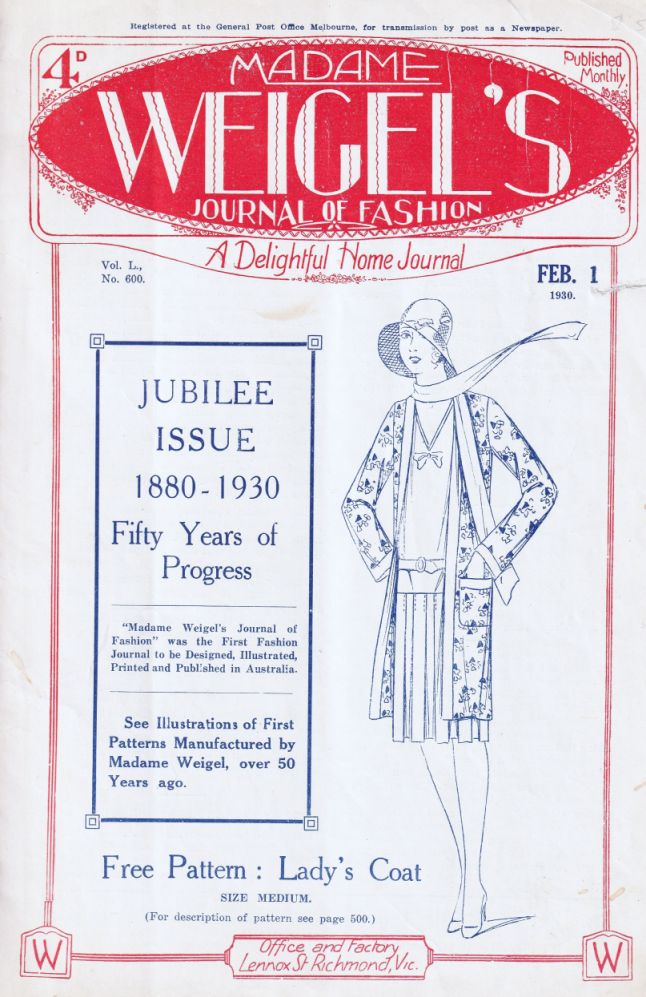
Madame Weigel's Journal of Fashion (February 1930)

 I bought this copy of Madame Weigel's Journal of Fashion at the same time I acquired the copy of Cassell's Family Magazine I wrote about last week.  Madame Weigel's Journal was published to promote Weigel's patterns, and this issue celebrated its 50th anniversary under the proprietorship of Johanna Weigel (yes, there really was a Madame Weigel!)

Inside the magazine are pictures and descriptions of fashionable clothing as worn by middle-class Australian women.  At this stage, only a couple of months into the 1930s, styles looked very much as they belonged in the 1920s.  But change was on the horizon, as noted by Madame Weigel's London correspondent: 

It is really extraordinary to see the way in which fashions have changed since last season.  It is very seldom that such a definite change is made in such a short time, and it is very bad for our purses, although most advantageous for the designers.  But last summer's frocks really can't  be persuaded to do duty again this winter; their whole line is wrong.  All the new frocks fit the figure very closely to the hips, and the waist-line and the hip-line are tightly defined, while below the hip-line the skirt flares out into draperies and panels and flounces.  You have to be thin to wear these dresses successfully, and yet you mustn't be too thin, for there must be a suggestion of curves.

But there's a caveat:

Of course I am only talking about evening frocks and very special afternoon dresses.  For morning and street wear and for sports there is not much change to report; skirts are still short and, for the most part, straight hanging.

"Letter From London by an Australian

Now onto the patterns!


First, the free pattern for a "Lady's Coat" (size medium).

Monday, February 17, 2025

"Chit-Chat On Dress" (Cassell's Family Magazine, February 1895)

I managed to pick up another bound volume of Cassell's Family Magazine the other week.  This one is from 1895, but people who have been following this blog for a while might recall I own a similar volume from 1888.  In 1888 the magazine published a monthly "Chit-chat on Dress" column describing the latest fashions from London and Paris for its female readers.  By 1895 its emphasis had changed: it was still interested in fashionable dress, but it also offered dressmaking patterns so its readers could attempt to make their own versions of the garments described.  (Given the complexity of some of the garments, I suspect many readers enlisted the help of a local dressmaker.)

The February 1895 column begins with the following pronouncement:

SELDOM has Fashion so favoured the contour of a figure that has lost its youthful slimness as at the present moment. 

But let's take a look at a couple of the featured patterns. 

Lounge-Gown for Invalid
Our design... is made in old-rose pink velveteen and Irish point lace, with over-dress of cashmere in either light maize or grey.  The whole of the upper portion, that is, the yoke and sleeves, is made separate and mounted on a short-waisted lining reaching just below the armholes, and the over-dress, cut square back and front, is slipped over the head and fastened on each shoulder beneath the ribbons.

Monday, February 10, 2025

"These Patterns..." (Australian Home Journal, February 1949)

 Fashion can sometimes offer a window onto social and technological change.  For example, the February 1949 issue of the Australian Home Journal advises readers on what to pack for one of those exciting new aeroplane flights. 

Don't Overload
If you are flying—and this is a popular form of travel to-day—you have to whittle your luggage down to essentials because you are only allowed 44 lbs. of luggage—and excess luggage becomes an expensive proposition.
If you plan interchangeable clothes, you'll have less luggage to carry and the right things for the time and the place.

The perennial problem of keeping within one's luggage allowance has arrived!  There are still a few years before our intrepid travellers have to worry about flying "cattle class" or airport security scans, however.  

Monday, February 3, 2025

Styles of 65: "Carefree in Arnel" (Spiegel, Spring-Summer 1965)

 The outfits below are at once relaxed and stylish—and this is why the 1960s is one of my favourite fashion eras!  The coordinating skirts and tops were available in different colours, shown as thumbnails on the same catalogue page as the main photograph.

The garments are all made of "triacetate", a "semi-synthetic" material made of chemically treated wood pulp.  Like fully synthetic materials, triacetate was easy to care for, and like natural fibres it was breathable.  In other words, "carefree"!