Tuesday, September 27, 2022

Found Online: Winns Catalogs IV (Early 1940s)

 We've now reached the War years as we continue to tell the story of popular fashion through the medium of Winn's Catalogues.  (You can also access them via the State Library of New South Wales website here.)

Autumn and Winter 1940

After years of winter catalogue covers featuring the best Winn's had to offer in coats, the store kicks off the new decade by advertising dresses and suits.  From left to right:
Smartly Tailored Frock in All-Wool Jersette, featuring the new neckline—Gored skirt—effectively trimmed bodice and belt.
Man Tailored Two-Piece Costumes in All-Wool Boucle.  Coat is fully lined and finished with two pockets.  Skirt has inverted pleat.
A Becoming "Dressmaker" Suit in Fine Quality All-Wool Jersette.  Coat is trimmed with the new novelty pin tucking—gored skirt.
However, the coats aren't entirely neglected.  You can find plenty of them for sale on page 17.

Summer and Christmas, 1940-41

Since these catalogues were published in wartime, it will be interesting to see how the war affects the clothes sold by Winn's.  So far there don't appear to have been many changes, either on this cover or inside the catalogue.  (If you look at page 17 of this issue you can see a selection of women's trousers on offer, but it's clear they're meant for holiday wear rather than doing war work!)

Autumn and Winter 1941

For the first time we see photographs taking the place of drawn models on the cover of Winn's catalogue (an innovation which didn't last the war years).  Also of interest: Winn's is featuring separates (at left "cosy brushed all-wool cardigan jumpers" and "popular sun-ray pleated tartan skirts") as well as more formal one-piece dresses and suits.  (Centre: "smartly tailored frock in all wool jersette" and right: "a becoming two-piece jumper suit in wool jersette".)  Separates really came into their own during the war years, as women could extend their wardrobes by mixing and matching individual garments.

Summer and Xmas, 1941-42

The Australian summer of 1941, and the things are about to get serious for people Downunder as Japan enters the war and strikes south.  This catalogue, however, was almost certainly issued before Pearl Harbor, and its cover advertises the usual warm-weather mix of summer "frocks" and frivolous hats.  From left to right we have:
SMART... TWO-PIECE in Sheer-Sak—trimmed with cornelli work, cuffs of white...
ATTRACTIVE Sheer-Sak... bodice is trimmed with ... richeleau work...
INEXPENSIVE with a dressy air—colourful Florals are ... fast washing...
 
Autumn and Winter 1942

Separates are very much in evidence in the Autumn and Winter catalogue of 1942.  Clearly the marketing people at Winns thought they were more appealing to the average wartime consumer than dresses and suits.  Clothes rationing was introduced in Australia in June 1942, but this catalogue was clearly released before then because the garments advertised are only priced in money, not in ration coupons.

Spring and Summer 1942-43

NOTICE TO CUSTOMERS
Our Mail-Order customers will be well aware of Wartime difficulties in regard to supplies.
However, Winn's have always valued highly their extensive Mail-Order Trade, and have always aimed to look after their country clients.
To be assured of Catalogue supplies, in the main the goods catalogued have been bought early, and are already in stock.  How long supplies of some lines will last, we are unable to judge.  In most cases it will be impossible to obtain further deliveries, so that customers are asked in the case of Frocks, Hats and such goods to make a second choice in color, or indicate another garment as a second choice.
They weren't joking about supply difficulties.  Paging through this catalogue I can see a number of items over-stamped with the words "Sold Out", including, on page 22, a "Coat Frock in White Pillow Cotton, Link Cuffs, slightly soiled"(!) 

Autumn and Winter 1943

All the clothes on this cover are priced in coupons as well as in pounds, shillings and pence.

Clockwise from top:
LADIES' ALL WOOL FLANNEL COAT, fully lined Art. Silk, boxey style finished with two pockets... 27 coupons.  Hat... 3 coupons.
LADIES' 2-PIECE FLANNEL COSTUME.  Coat is lined and has two pockets.  Skirt has pleat in front... 23 Coupons.
LADIES' ALL WOOL BASQUE JUMPER CARDIGANS, with fancy stitch self-coloured trimmings... 7 Coupons
Spectator SPORTS BLOCKED FELT.  Shaped crown.  Snap brim will turn up or down at back.  Contrast trimmings of cut out Felt and ends... 3 Coupons.
As you can see, the coat and suit were the most "expensive" items.  However, even more utilitarian garments had their coupon price.  For example, both "Bib and brace" overalls advertised on Page 6 and "Farmerette" overalls on Page 12 would set the wearer back by 6 coupons!

Spring and summer 1943-44

You wouldn't know there's a war on by the designs on the cover of this summer catalogue, except "Sold Out" is stamped over the fancy floral frock on the left ("Gaily Coloured Floral Frocks of British printed spun cotton") and once again, everything has a coupon value.  The little girl's dress on the cover only costs 6 coupons, as opposed to the adults' 13. 

Navigating one's way around clothes rationing must have been quite a task.  If you check the hosiery on Page 19 you'll see that even the most basic pair of rayon stockings would set the purchaser back 2 coupons.  That seems a small amount compared to the ration value of a coat or a dress, but when you consider how many pairs of stockings the average woman must have got through before the war you realise how carefully she had to manage not to blow her entire coupon budget on them during the war!

Spring and Summer, 1944-43

The State Library of New South Wales is missing its copy of Winns catalogue for Autumn and Winter 1944, so we have to skip straight to Spring and Summer 1944-43.  For some reason the artist who designed this cover decided to pose his ladylike models in a stable.  I'm not sure whether he was trying to illustrate wartime farm chores, or looking forward to a postwar racing season!  

In spite of the narrow wartime silhouettes of these dresses, there are a few touches that would be further developed after the war, in particular the emphasis on hips with ruffles and peplums.  From left to right:
Dressy Frock of Imitation Linen.  Tunic effect, bodice opens to waist, pockets and collar bound with White, various designs on grounds of Blue, Rose, Gold or Green.
Maids' [i.e. Teenagers'] Frocks of Plain Imitation Linen, bodice is trimmed with contrasting stitching, two pockets, gored skirt.
Attractive Figured and Floral Art. Silk Frocks.  Various multi-coloured designs, Apron style. 

Monday, September 19, 2022

"The Country's Call" (McCall's Magazine, July 1917)

 Women have always worked, but in total war the working woman suddenly becomes more fashionable than the lady of leisure.  In the summer of 1917 McCall's issued a number of patterns for the patriotic war worker.

At the top (and to the top) we have a "nurses' or maids' cap and aprons" and a "nurses' uniform".  By 1917 nursing was a conventional career for a woman, and the uniforms depicted above would not have been considered startling by anyone.

The figures at the bottom, however, are more challenging.  On the right is a woman wearing a "waist" and a "ladies' sports skirt" for working outdoors.  The skirt is very short by the standards of 1917 (see the nurses uniforms by way of comparison) and the outfit is completed by a pair of "bloomers" and leggings worn underneath.  The leggings can be seen peeking out from under the skirt.  The recommended material for this costume was khaki. 

On the left is an even more shocking innovation: pants!  Or, as the magazine puts it, a "ladies' and misses' overall suit".  In its dressmaking column, McCall's Magazine goes to some length to sell the garment to potential wearers: 

The woman with the hoe is becoming more and more a familiar figure; but the hoe and the skirt, these two which have always been antagonistic, are yet to be reconciled.  The fact is that skirts must be dispensed with, however short they may be, you cannot get away from the fact that they are always a handicap in the work that farming or gardening entail.  The only practical and comfortable thing to wear for working in the fields is the overall suit with roomy bloomers, which many women have adopted.  Even if your gardening activities are limited to a small backyard only large enough to supply the vegetables for the needs of the family, you will find that you need overalls.  If you think about that shabby old skirt you had hanging in the closet ever so long and wanted to get rid of by wearing it out this summer, will do just as well, you are mistaken.

And, here may I say that many women have learned the value of using overalls for work about the house.  They are also used by women workers in factories.

Wednesday, September 14, 2022

Suits VIII (David Jones, Autumn-Winter 1974)

 In the 1970s the skirt suit had a new rival: the pants suit!  However, the newcomer didn't push the traditional suit entirely out of the picture.  This cover from the David Jones catalogue of Autumn and Winter 1974 shows a suit in a fashionably large plaid.  Jackets have once again become classically masculine, as opposed to the cardigan style jackets popular in the 1960s and the fitted jackets worn in the 1950s.

As often in the 1970s, there was an element of "do it yourself" involved in creating this outfit.  The skirt and jacket were sold as separates: you could combine them to make the suit below, or buy coordinating garments to build your own "look".

Clever you... Creating your own fabulous look from our superb separates from Sportscraft in pure Wool.
Checked blazer
with interwoven buttons, pocket trim.  Tan/Navy...
Skivvie in fine wool jersey with concealed back zip...
The checked skirt has fluid knife pleats.  Also in tan/navy.

Wednesday, September 7, 2022

Found Online: Winns Catalogues III (Late 1930s)

 I get the impression that the person designing the Winns Mail Order Shopping Guide in the late 1930s had fallen into a bit of a rut.  All their winter catalogues feature covers depicting the latest in warm coats, while all their summer catalogues depict the latest in summer "frocks".  Still, they are nice enough coats and frocks, and very typical of their era!

Winter 1935

The coats depicted on the front cover have a typically narrow 1930s silhouette with large collars.  The collar of the coat on the left is made of all wool tweed with "big squared revers that look just as smart when buttoned as when worn open".  The coat on the right is made of wool velour with a "Coney" (i.e. rabbit) fur collar.  The copy stresses the value for money

The hats on the right of the cover are fashionably shallow-crowned and worn tipped over one eye.  The hat at the bottom features "Something new!"—"the New "LASTEX" head lining".  LASTEX was the first elasticised fibre, and had only appeared on the market in 1932.

Spring & Summer, 1935-36

The dress on the left is made of "British Crepara".  Doing a bit of research into the term I've discovered that it was a mixture of rayon and cotton with a silk finish.  The earliest reference to "crepara" I can find is from 1929, and the term disappears from advertising after around 1937, indicating that the fabric was a passing fad.   Also popular in the mid-1930s was the cape sleeve, seen here on the two models on the right.

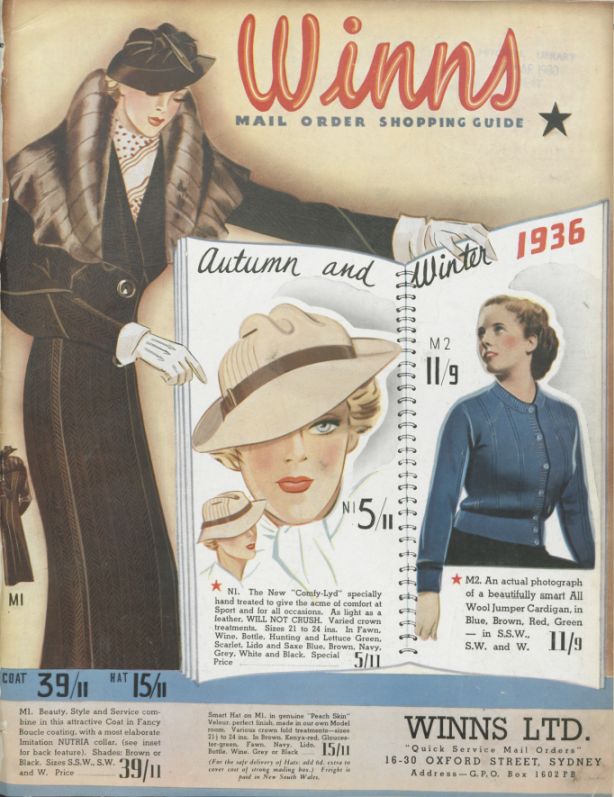
Autumn & Winter 1936

The State Library of New South Wales has not one, but two editions of Winns Mail-Order Shopping Guide for Autumn and Winter 1936.  The first, above, is from their Sydney store.

The coat on the left has a large collar made of "imitation nutria" (no coypus were damaged in the making of this coat).  The interior pages show more coats with broad collars, some made of "coney" (i.e. rabbit) fur, as befits a store catering to the budget-conscious.  On the right is an "actual photograph" (a first for these catalogues?) of an all-wool cardigan.  More cardigans, in full colour, are advertised on the second page of the catalogue.

Of interest is the plain hat in the middle which WILL NOT CRUSH and vaguely resembles the men's hats of the era.  Of course the model has it stylishly tilted over one eye!

Newcastle store, Autumn & Winter 1936

And from Newcastle (New South Wales) comes a catalogue featuring two coats in diagonal "coating.  The one on the left has a collar of "lapin" fur (that is, angora rabbit.  It is remarkable how the writers of these catalogues avoided the word "rabbit" in their copy.)  The description of the second coat emphasises the wide lapels and the big collar: anything to increase the apparent width of the shoulders!  The plain, "sports-like" hat on the right is very like the one sold in the Sydney catalogue, and once again is tilted over one eye.

Spring and Summer, 1936-37

Spring and summer 1936 brings the usual collection of summer dresses, including the one on the right which has a matching jacket.  The shoulders are still the main focus here: they are not only padded, but use wide and puff sleeves to look even broader than they are.  The summer hat in the top right is fancier than its winter counterparts ("with... Smart French Trimming"!) but it is still worn tilted forwards.

There are more "frocks" inside, of course, but for those interested in what women wore under their dresses, check out the lingerie on the second page.  

Autumn and Winter 1937

Styles don't appear to have changed much since the previous winter, with a cardigan jacket depicted on the left, and a coat in "all wool Boucle Coating" with a "LAPIN fur collar" on the right.  In the centre is a plush felt hat which, if anything, looks more like a man's hat than ever.

Summer and Christmas, 1937-38

Winns is selling a wedding dress on page 10 of this catalogue, which seems to be a first!   On the cover, however, the models wear printed frocks (on the left in imitation linen and on the right in floral flat silk crepe) with puffed sleeves.  The line is slowly, but surely, becoming less fussy and hems are rising.  

Also, for the first time in years, Winns depicts a child's costume on one of its covers.  The dress is a "Pretty Party Frock and Bloomer Set in Swiss Hail Spot Muslin".


Autumn and Winter 1938

Winns turns practical with this coat on its cover from Autumn and Winter 1938: 
Ideal for sports and travel wear.  All wool Boucle Coat which can be worn without or with patent belt as illus. Fully lined art. silk.  Two pockets.
More elaborate coats—including ones with fur collars— can be found inside on page 19.   Winns also advertises some formal wear, "For All Occasions" which can be found on page 31.  Garments include a wedding dress and evening clothes.  Alas, somebody has cut out one of the figures on this page in the original catalogue, so we can't see the illustration of the "Satin-back Crepe ... Maternity Gown" that once featured here.  It's a pity, as we don't often get a glimpse of formal maternity wear!

Summer and Xmas, 1938-1939

Summer and Xmas sees two floral dresses on the cover of the catalogue: a summer "sheer" on the left, and on the right at half the price, a "tub frock".  In spite of the price difference the dresses are nearly identical in cut, with puffed sleeves.  (The little girl in the centre of the picture is also wearing a dress with puffed sleeves very like the ones worn by her elders.)  

In fact sleeves seem to be the big fashion feature in 1938.  While not every dress in this catalogue has puff or leg-of-mutton sleeves, the majority of them do.  The bridal gown and bridesmaid's dress on page 6 are particularly good examples!

Autumn and Winter 1939

This was the last Australian winter before the Second World War.  As if in anticipation of grimmer days to come, the fashions depicted here are quite austere.  Firstly, on the left, a suit—I beg your pardon, a:
Smart man tailored 2-piece Costume in All Wool Novelty Suiting.  Coat fully lined—pleated skirt.
The coat on the left is an "All-Wool Boucle Coat—fully lined."

Spring-Summer 1939

For some reason Winns decided to go casual for its last catalogue of the 1930s.  The two women on the left and right of this cover are hatless, and the one who is fully visible is bare-legged and open-toed sandals!  The dresses appear to be designed for wearing on the beach or in the garden.  To the left we have a "Bright and Gay" peasant frock, in the centre a dirndl for a child and on the right a dirndl for a woman.  All three garments have shirred waists.

Thursday, September 1, 2022

100 Years Ago (The Delineator, September 1922)

 I've no idea what the weather was like in the late summer of 1922, but in its September issue The Delineator was encouraging women to look ahead to colder weather with these patterns for coats.  You'll notice that they all have large collars, and all wrap around the wearer and fasten on her left hand side.


As usual, working from left to right:
Autumn styles see the initiation of the draped costume coat in the new silks and amply trimmed with fur or fur cloth collars.  The soft lines of this coat owe their origin to the drape at the front and the graceful sash does double duty in marking the draped tendency in the front and creating a slight blouse or drapery at the back of the coat.
The interlaced stuffed tubings are the latest French word in collars to trim a coat of this type.  It has the new silhouette—wide through the body from a straight shoulder to the hip, straight at the lower part.  The back is plain and the front has a raglan cut which contributes a voluminous, almost blouse-effect to the upper part.  The lower part is quite straight, narrow in effect but wide enough to be comfortable for walking.  The coat may have a plain collar and cuffs or they may be embroidered.  
One could indefinitely sing the praises of the wrap with a wide armhole which gives the new wide easy look to the body of a coat and which does not crush one's fragile frocks beneath.  The deep square armhole is new and gives the roomy loose effect to this coat; otherwise the lines are quite straight.  The snugly fit collar is warm and the half-cuffs are very smart.  An ornamental pair of buttons closes the coat.

Monday, August 29, 2022

Suits VIII (La Pastorale, Winter 1964)

 In 1954 Coco Chanel reopened her business, and introduced what was to become known as the "Chanel suit".  The Chanel suit consisted of a short straight suit and a loose fitting, hip-length "cardigan" style jacket.  Her suit swept away the constricting, shaped-to-the-figure suits fashionable in the early 1950s and replaced them with something much more modern and easier to wear.

By 1964, when this catalogue was published, every ready-to-wear manufacturer of women's clothing was producing their own imitation of the Chanel suit.  Of course they couldn't afford the craftmanship and materials of a genuine Chanel—but their source of inspiration is obvious!


Four suits in "textured wools".  From left to right we have:
Perfect elegance is the story of this outstanding suit in diagonally woven pure wool.  The fully lined Jacket with set-in sleeves in double-breasted style has a velvet collar, matching self buttons, slanting pocket flaps.  The slimming skirt, lined too, is detail finished.
Pure Wool Hopsack Tweed in rich deep colours, hits the fashion headlines with this outstanding two-piece suit.  Fully lined, it features White saddle stitching around the Hip-length jacket.  Note the simple neckline, the three covered button opening, and the pocket flaps.  The slim skirt has a kick pleat, of course.
Young Australians will love this California styled two-piece, and look very dashing in it.  We selected a pure wool woven with small checks and finally trimmed the short Jacket with Suede in a very sporty fashion.  The skirt we styled with release pleats both back and front.
Faultless styling in figured Terylene/Worsted!  Who could resist this flattering suit with the charming low revers.  Immaculately finished, of course fully lined, this model suit represents classic tailoring everyone will admire.  Best of all, being Terylene, you can wash it at home and drip dry!


And five more suits, including three in double-knit Jersey and two trimmed with braid (a decorative touch also favoured by Chanel).  From left to right:
The lithe look in "Janilaine" Double-knit Wool Jersey.  There's a free-n-easy shaping with chic detail to the delightful two-piecer.  Note the Chanel treatment and bow highlighting the top.  The skirt is lined for shape.
Wonderfully fashionable, this co-ordinated three-piece Ensemble in Double-knit Wool Jersey with a toned floral top which is short sleeved and back zipped.  Styled for all ages, all figures, this three-piece is a fabulous investment.
Style, value and instant appeal are obvious in this lovely suit in pure wool textured Tweed.  The surface interest is accented with black braid and button trim.  The jacket is really shaped to flatter and the skirt is cut to give a slender silhouette.
A Wool pebble Tweed suit priced to please, styled to appeal!  The Jacket richly trimmed with braid has self buttons and set-in sleeves.  The half-lined skirt has the popular twin inverted pleats both front and rear.  Truly amazing value.
The feature of this stylish pure Wool Double-knit "Janilaine" Jersey Suit is the lavish EMBROIDERY on the Jacket.  Difficult for the camera to catch, it extends in depth all round the jacket in an exquisite pattern.  The slim skirt is half lined.

Friday, August 26, 2022

Found Online: Winns Catalogues II (Early 1930s)

 Let's take another look at the collection of Winns Mail Order Shopping Guides held at the State Library of New South Wales.  This time we're moving onto the early 1930s

Autumn & Winter 1930

The garments on the cover of the first catalogue for 1930 still look very 1920s in style.  Skirts fall to a little below the knee and hats are still close-fitting.  (They were made of felt, by the way, and available for the price of 12 shillings and 11 pence.)  One-button coats with heavy collars feature prominently: on the left, in wool velour, and on the right in a new "fur-fabric" with "the wearing quality of an expensive fur".  Down the bottom left is a cardigan in wool with "art. silk" (i.e. rayon).

Spring & Summer 1930

In the world of high fashion hemlines were starting to fall, but Winns skirts still hover around their wearers' knees.  As you can see by this cover however, the waistline is back in its normal position and dresses now outline the figure.  (How you got the right figure for these dresses is illustrated by the Berlei "Foundation" garments on page 14 of this catalogue.)   The skirts flare out from dropped hip-yokes.

For the first time not only hats, but fashionable shoes, are featured on the front page of the catalogue.

Winter 1931

Winter 1931 sees more coats, cardigans and hats on the cover of Winns Catalogue.  The figure at the centre is wearing a suit made of tweed—with the coat made long so it can either be worn as part of the ensemble or separately.  The coat on the left is made of wool velour with a rabbit-fur collar.  The cardigans are made of mixed wool and silk.

Hats are now being worn off-the-face.  For the first time in a decade, foreheads are visible!

Spring & Summer 1931-32

The cover of the Spring-Summer catalogue for 1931 sports four typical dresses (now with hems dropped to calf-length).  From left to right: a dress for an older woman in "Good Quality Lockstitch JERSEY RAYON with smart vest effect".  Second left: "An Effective Sleeveless TENNIS or AFTERNOON FROCK" in "good washing Cambrics".  Right: Ladies frock in "FANCY ALL SILK FUJI".  Far right: "FASHIONABLE CAMBRIC ENSEMBLE SUIT" with piped contrast trimmings. 

Autumn & Winter 1932

There's an innovation on the front cover of the Winns catalogue for Autumn and Winter 1932: an evening dress!  This one was made of Milanese silk on "the latest lines, with full flare and deep frills on Skirt" and came in opal green, barbaric red and apricot.  Note the fashionably deep cut-outs on the back of the frock.

Spring & Summer 1932-33


From left to right we have: A Ladies' Frock of Art. Silk Rayon in "neat floral designs with contrasting shades"; A Pretty Frock of Floral Haircord for School Girl; A Smart Frock in the Popular Silk Milanese; and An Attractive Washing Frock in Reliable "Meadow Sweet" Cambric.  Floral prints are popular, but the main things to note here are the large, rever-like collars on the two dresses on the right.

Winter 1933

Wide revers and big collars create an illusion of width near the top of the coats and suits depicted on the cover of the winter 1933 catalogue.  (For more examples, check out the coats on page 11 inside.)  The red coat on the left is decorated with steel buttons and revers which can be fastened back to create a double-breasted effect.  Hats now appear to be worn entirely off the face or tilted so the brim nearly covers one eye—once again, for more examples look inside at page 16.

Spring & Summer 1933

Decoration seems to have gone to the top of the bodice by the spring of 1933, with bows and scarves being popular.  The dress on the upper left (a smart tub frock in "fadeless Falcon Cloth") has puffed sleeves, while the dress on the upper right (in pique voile fabric) has cape sleeves.  Shoulders are starting to broaden out, a fashion which will last until the end of the next decade.

Winter 1934

Shoulders are broad, hats are small, and fashionable gloves are gauntlet style.  On the left we have two dresses in "wool crepe de chene". At the far left is "an exact copy of one of the latest overseas models".  Next to it is a dress "featuring the new sleeve and plastron front treatment".  The coat on the right is made of wool velour "finished with a lavish fur collar of good quality"—though the authors of the catalogue don't state what kind of good quality fur the model is wearing!


Spring and Summer, 1934-35

And now we reach the end of the first half of the decade with these four models who are "smartness personified".   From left to right:
Printed Cambric has has been chosen for this Dainty and Attractive Style.  Contrasting collar and cuffs to tone, edged with printed organdi, gives a delightful "summery" finish.
An Attractive Frock in the new uncrushable Floral Crepara Crepe.  Neck and sleeves prettily trimmed with goffered frilling of self material, and smartly cut skirt gives a distinctive air.
This Charming Frock is in Floral Pique Voile: short sleeves with an opening; and a very effective Jabot trimmed with knife-pleated organdi, adds a smart note to the bodice, with godets in skirt.
A Very Striking Jumper Suit, in Matchbox Check and Pin-spot Silk Moracain, with self-trimming of pleating around shoulders and on sleeve; contrasting bow gives a snappy air to the Jumper.  The Skirt in White, having an inverted pleat back and front.