Sunday, July 5, 2020

Marcus Clark's Catalogue, Autumn-Winter 1946

 I found this little mail-order catalogue from a Sydney department store on eBay.  It's a tiny little thing—postwar shortages still existed!—about digest size and with just over sixty pages to advertise household goods of all kinds.  Of course a good few of these pages were dedicated to women's clothing.


On the cover, a four-button women's suit in houndstooth checked wool.


Inside the front cover: more suits in Donegal tweed (left) and wool serge (right).  These suits still look very like their wartime counterparts, with broad shoulders and short narrow skirts.


A box coat in all wool tweed.  "Dog's Tooth Checks are back," says the description.  Presumably the more elaborately patterned weaves were abandoned for the duration.


More coats—a wrap coat in cherry boucle cloth (left) and a box coat in checked wool (right).  The broad shoulders are a selling point in the descriptions of both garments.


Separates!  A woollen blouse is paired with a striped woollen skirt at left, and a tailored woollen jacket with skirt in herringbone worsted at right.


There are some postwar features in these dresses: the dress on the left has a flared skirt and trim on the yoke.  The dress in the centre likewise has a flared skirt, and the dress on the right is "in a new style... with... frills and roules bind."  The square shoulders are still very much in evidence however.
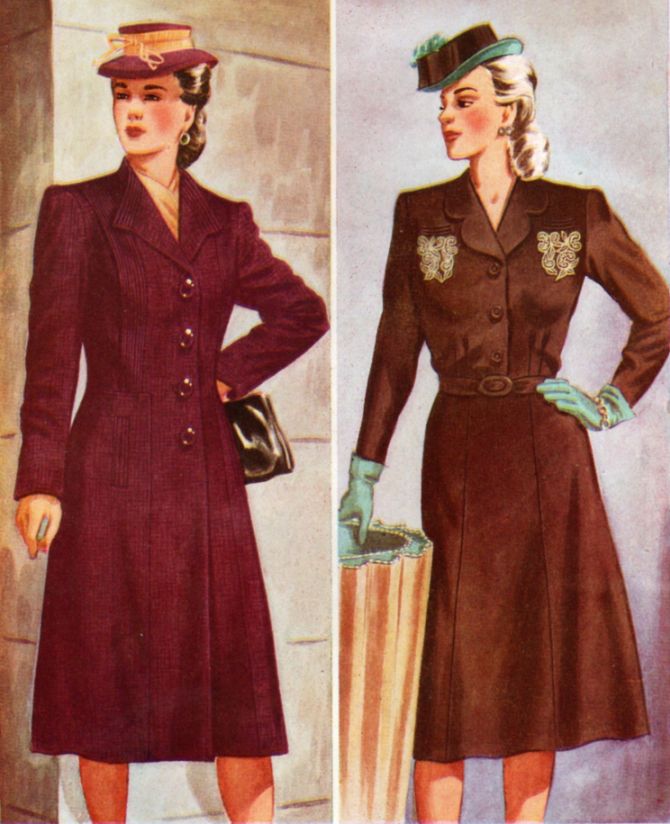

In larger sizes: a coat and a dress in "up-to-the-minute" styles.  Once again there are few changes from the war years (the description points out the rever collars) and the broad shoulders are still a feature.

There's one last thing to note: since clothes were still rationed in Australia in 1946, all these garments are priced not only in money, but in ration coupons as well!

Monday, June 29, 2020

Coats from 1959

To conclude my month of blogging coats, here are a few examples from 1959.

Vanity Fair, January 1959

From the cover of Vanity Fair:
First sign of spring, the yellow coat, cut softly slim, in a delicious bouclé textured wool. 
Beyer Mode, March 1959
90330.  Sommermäntel brauchen kein grossen Verschilüsse.  Wie hübsch wirkt eine durch ein Knopfloch gesteckte Schleife statt der üblichen Knöpfe.
[90330.  Summer coats do not need large closures.  A bow tied through a buttonhole looks pretty instead of the usual buttons.]
90331.  Modische Mäntel bevorzugen jetzl interessante Rücken.  Dagegen bleibt die Vorderfront mit Reverskragen, Knöpfen and Taschen klassich schlicht.
[90331. Fashionable coats prefer interesting backs.  However the front remains classically simple with lapels, buttons and pockets.] 
Flair, May 1959

From the cover of Flair:
Australian contribution to international fashion: the shorn lambswool coat, as snug as it looks and surprisingly light to wear.  Now being made in a rainbow range of colours, too.  This one is in Racing Scarlet, in a modified trapeze line that stops short of your hemline.
(Available at Grace Brothers, Sydney, for 29 guineas.)

Marcus Clark's catalogue, Autumn-Winter 1959
W1W2: "Ralex" coat.  Good quality Furlaine fabric.  Stitched panels front and back.  Stitching on collar, revers and cuffs.  5 button fastening, 2 pockets.  Fully lined.  In Grotto-Blue, Cloud-Grey or Foliage-Green.
W2W2.  All wool novelty coat.  For all ages.  Smart collar.  Good fitting sleeves, panelled back.  Two pockets.  Red, Sapphire-Blue, Expresso.
W3W2.  A very smart coat!  Good quality, all wool Kashmir coating.  Yoke stitched fromt and back.  Cosy style collar.  2 stitched pockets.  4 button fastening.  Beige, Blue-Thistle, Waterlily Mauve.
Constanze Mode, Herbst-Winter 1959/60
A typical example of the smart town coat with informal note.  This has a wide ocelot collar, leaving the neck free and entirely covering the shoulders.  The belt is narrow at back and gently emphasises the waist.  Large patch pockets. Two buttons visible.

Saturday, June 20, 2020

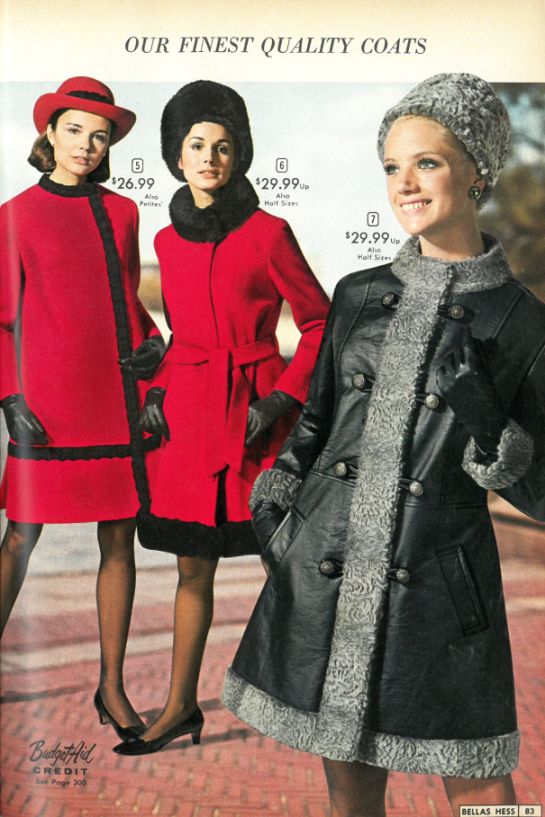
Coats from National Bellas Hess (Fall-Winter 1969)

My theme this month appears to be "coats", so going with the flow here are a couple of pages from the National Bellas Hess catalogue for Fall-Winter 1969.  Catalogue fashions tend not to be the most stylish or trendiest clothes going, but they do illustrate what was worn by the ordinary "woman in the street" at any given date.

5. STUNNING... understated simplicity marks this high-fashion coat with its subtle bands of chic , persian fur-look trim.  Acrylic laminated to polyfoam for lightweight warmth, crease resistance. 
6. ELEGANT... the sashed wrap-coat lavishly bordered with plush fur-look Dynal modacryliuc.  Fashioned of woolen coating... blend of reprocessed wool-silk-nylon; acetate taffeta lined.
7. DASHING... the leather-look , demi-fit mini-coat with smart persian fur-look accents.  Fashioned of heavy vinyl that simulates genuine leather... wipes clean with damp cloth.

4. TERRIFIC VALUE... dark brown, piece-dyed, genuine mink collar tops cardigan collar coat.  Wool coating of reprocessed wool-silk-nylon.
5. GENUINE, brown mouton collar tops shortie coat of expanded vinyl with cardigan neckline.  
6. RICH LOOKING... corduroy shortie has shawl lamb collar with self-collar under it.  Wide-wale cotton laminated to polyfoam; quilt interlined.
7. SMART PLAID has lavish black-dyed lamb collar with self-collar under it.  Reprocessed wool-rayon-silk laminated to polyfoam.

(Dynal, vinyl and polyfoam—apparently artificial fur and synthetic fibres were all the rage in 1969.  If this catalogue had been published today, I might say that these materials were used for environmental or ethical reasons—reprocessed wool! simulated leather!—but as it is, cost was probably the deciding factor.  These clothes imitate more expensive garments made from real persian lamb and real leather.)

Tuesday, June 16, 2020

Coats From Around the World in 1949

If I had to use one word to describe the coats of 1949, that word would be "big".  Whether they swung out from the shoulders or were nipped in at the waist, they were generous in both cut and use of material.  In practical terms this was sensible: there had been some exceptionally cold winters in the 1940s and one would need to make room for one's fashionable New Look clothes underneath one's new coat.  However, I suspect that these coats, with their big collars and cuffs, were also a reaction against the skimpy, rationed garments of the war and immediate postwar years.

Here are four examples, taken from four different countries.

Weldons Catalogue, Autumn-Winter 1949

From Great Britain: Weldons Bargain Pattern:
"Here we think, is a Bargain Pattern that's starred for success.  As smart and practical as a Coat can possibly be; a joy to look at, a joy to wear, and a grand ally when winter winds blow.  There's fashion news in that high, important collar, those wide coachman cuffs—did you realise cuffs were back?—and the big square pockets with their velvet trimmed flaps.  All the velvet trimming, by the way, is optional.  But please do have it; it adds such a lot of luxury!  Colours?  Why, be as bright as the girl on our cover, with black for your contrast; or choose on of the subtle new tone-harmonies such as olive green with bronze."
Butterick Fashion News, October 1949

From America: Butterick pattern 5032:
"That classic favorite... the polo coat has a smartness all its own.  You'll love the details on this new 1949 version... the casual collar, the full boxy lines held taut at the waist by a self belt."

Myer catalogue, Autumn-Winter 1949

From Australia: two coats "American style".  On the left:
"A Flare for Fashion, swirling panel gored, pleated back, two-way collar, set in sleeves, moulded shoulders. Satin twill lined."
On the right:
"Exhilierating Swing Back Regency Dandy caped collar, adjustable sleeve-length cuffs, Moulded shoulders, flaring four-gored back, satin twill lined."

Schöne die Wienerin, No. 22 (1949)

From Austria:
"Sportlicher Herbstmantel aus großkarlertem Wollstoff, in welt ausfallender, einreihiger Hängermachart."
["Sporty autumn coat made of large-scale woollen fabric in a world class, single-breasted hanging style."]

Wednesday, June 10, 2020

"Eight Additional Coat Fashions" from Philipsborn (Fall-Winter 1909)

In my copy of Philipsborn's Fall and Winter catalogue for 1909 is a little four-page supplement advertising "Eight Additional Coat Fashions".  I don't know whether this leaflet was added as an afterthought, or whether it was the result of a printing error in the main catalogue.  However it does provide a capsule summary of what was in fashion in women's outerwear at the end of the first decade of the 20th century.

All the coats appear to be cut princess style, with braid and seaming to emphasise their unbroken length.  The s-bend figure, so fashionable earlier in the decade is well and truly gone and the models are depicted as being (somewhat unrealistically) narrow-hipped.  The sleeves in each coat are gathered at the shoulder and narrow at the wrist, but the the gathers aren't full enough to turn them into leg o' mutton sleeves.

"W13—A REMARKABLY HANDSOME BROADCLOTH COAT, SATIN LINED THROUGHOUT... Semi-fitted back has broad graduated plaits with deep inverted vents at either side.  Single breasted front fastens with large jet buttons..."
"W14—ELEGANT... BLACK OR BLUE, SATIN-LINED BROADCLOTH COAT... Has novel plaited effect below hip line consisting of side and inverted plaiting.  Neatly stitched at top forming  scalloped tailored pockets which in turn are fashionably trimmed..."

"W15—LATEST PAULIERAINE" MODEL IN...GRAY SATIN-LINED BROADCLOTH COAT.  The beautiful model pictured here is a copy of one of the latest creations sent to us by our Parisian connoisseur... Tailor-stitched seams ornament front and back of coat full length, forming a graduated panel in back which is relieved at either side with plaits and folds to correspond... Very chic."
"W16—ANOTHER NEW PARISIAN COAT MODEL.  Good quality broadcloth in black, blue, brown or maroon... Is most handsomely and extravagantly ornamented on collar, cuffs, front, sides and back with richest silk cording, strapping and handsome scroll braid ornaments..."

"W17—VERY ELEGANT AND SWAGGER 56-INCH TAN COVERT OR BLACK BROADCLOTH COAT... This garment is most exquisitely tailored and is fashioned with new Dutch collar, tailor stitched and button trimmed..."
"W18—THIS STUNNING, 54-INCH BLACK BROADCLOTH COAT PORTRAYS ONE OF THE SEASON'S NEWEST MODES.  Is made in semi-fitted style with single-breasted front.  Line throughout with finest quality gray satin.  Has beautiful shawl collar inlaid with silk moire..."

"W11 —EXCEEDINGLY SMART 52-INCH BLACK PRESSED CHEVIOT COAT.  Semi-fitted mode, lined to waist with silk Venetian. ... Fastens in single-breasted style with jet buttons. "
"W12—54-INCH ALL WOOL BROADCLOTH, TAILORED IN THIS SEASON'S MOST FASHIONABLE MODE.  The garment pictured here is a most exceptional value and is made of good quality all-wool broadcloth in black, navy blue, maroon, green or brown.  Lined three-quarter length with good quality satin..."

Saturday, June 6, 2020

Ladies Coats from "The Tailor and Cutter" (1939)

The Tailor and Cutter was a trade magazine for (you guessed it!) tailors.  Published in Great Britain it mostly specialised in custom made menswear, but it also touched on tailored clothing made for women.  The images below are from one of two supplements to The Tailor and Cutter published in late 1939.  The men's supplement has a number of natty officer's uniforms illustrated, but at this early stage of the Second World War the "Ladies Supplement" only depicts civilian clothes.


Saturday, May 30, 2020

"La Pastorale" (Autumn-Winter 1966)

Here are some more fashions from "La Pastorale", a boutique that operated from "the Paris End" of Collins Street in Melbourne in the 1950s and 1960s. 

(For a look at their Summer catalogue of 1961, see here.)

Though the dresses in this catalogue are mostly stylish straight shifts, the fashions portrayed are not quite up-to-the-minute for 1966.  To be really modish the hemlines should have been an inch or two higher.  The models very styled hairstyles were also slightly out-of-date, as were their shoes with pointed heels (shoes with lower square heels were the trendiest footwear in 1966).  In brief, these clothes don't appear to have been made with the grooviest young trendsetters in mind: they appear to have been made for slightly older women who wanted appear fashionable but were not part of the sixties "youthquake".

Since millions of women must have worn clothes like these, but they seldom appear in the history books, this little catalogue is a valuable historical resource!

 SNAPPY WOOL FROCKS WITH THE LATEST FASHION IDEAS

(The dress on the right is described as being "inspired by" Courreges.)

 4 WONDERFUL STYLES IN THE NEW WASHABLE DOUBLE-KNIT JERSEY

 
NEW TREATMENTS IN WARM RICH WOOLS AND JERSEYS 
 
FOR OLD AND YOUNG —  FROCKS STYLED TO FLATTER

(The dress second from the right is described as: "Dashingly styled for young people "on the go" this frock of pure Wool doe-skin is specially cut for the youthful figure")
 
ORIGINAL WOOL DESIGNS — INCREDIBLY PRICED TO PLEASE!
 
WARM WEATHER "CUTIES" in CARE-FREE DRIP-DRY FABRICS

(On the right: "The latest craze—OP-ART hand screen printed designs.")

PARTY PRETTY STYLES in NYLON LACE and DRIP-DRY CREPE 
 
TUB-HAPPY FROCKS with CLEVER STYLING and TINY PRICE TAGS

NEW IDEAS, NEW TRIMS in LUSCIOUS PURE WOOLS

GAY CASUAL IDEAS TO FLATTER THE MODERN MISS